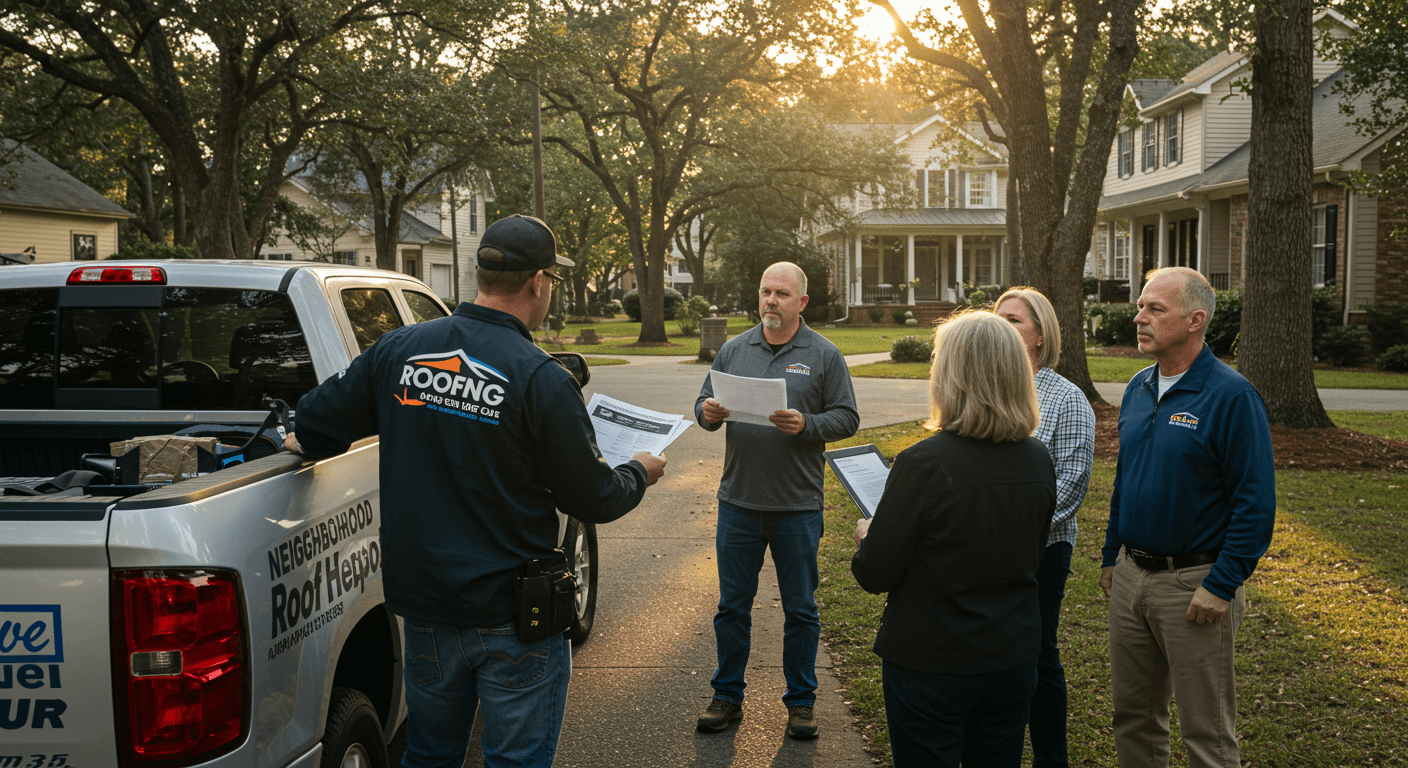
Reactive crews paired with heavy digital spend are often packaged as community strategy. In practice, writing checks for youth league signage is more likely to inflate customer acquisition cost than to shrink it. Across the humid, crowded Southeast corridor from Charlotte to Savannah, I have watched shops burn through about $14,400 a year on generic local sponsorships that never tie back to a replacement, simply because someone said you need to get the name out. Real engagement is not generic awareness. It is disciplined local positioning so you are already trusted before the next wind event fills the call queue.
The old idea that being seen around town quietly converts into residential roofing contracts breaks down when buyers compare three firms on a phone screen in under a minute. If your logo sits on a outfield fence but your estimators are absent from property manager and HOA conversations, you are funding signage, not pipeline. I recently audited a Charleston operator, Xavier, who was routing 8.4% of gross revenue into local visibility. His monthly community line item, near $2,200, was producing a CAC near $914 per closed job, while direct neighbor referrals sat under $240. The gap was not charity. It was measurement.
Where Southeast community spend either drains or supports CAC
| Focus | Passive sponsorship habit | Engagement tied to pipeline |
|---|---|---|
| Primary goal | Logo repetition | Teaching that produces booked follow-ups |
| Success signal | Handshakes and compliments | CRM tags with source and job type |
| Cost control | Hope for seasonal lift | Capped spend versus CAC by cohort |
Primary goal
Success signal
Cost control
Figures in the article are illustrative shop examples. Your market math still needs to be tracked weekly.
Stop treating community reach like a billboard
Strategy 1 · Why passive brand awareness quietly raises CAC
Many owners still run community marketing like outdoor advertising, assuming impressions eventually produce a ring. Reporting from Roofing Contractor points to high-performing firms leaning into sharp, local touchpoints instead of broad awareness plays. In the Southeast, steady humidity and frequent wind mean homeowners are anxious about hidden deck damage. Engagement should answer technical questions, not only flash a brand color.
When you support a neighborhood event, aim for the moment where you can show how wind lifting tab edges turns into interior loss. Xavier replaced a token booth with small evening briefings for real estate agents and HOA contacts, plus short Saturday walk-through clinics. The topic was how to spot lifted shingles before they become a five-figure water claim, not why you are the nicest crew in town. Lead-to-close time dropped by 11 days because trust came from competence first.
The logo-only trap
If you cannot describe the next follow-up step after the event, you bought visibility, not acquisition. Name recognition without a captured next step keeps CAC opaque.
Action Plan
Educational authority in four moves
Use local gatherings as classrooms, not billboards. This sequence is built for Southeast roof age bands, storm frequency, and insurance conversations that actually happen on porches.
Map neighborhoods where composition roofs are 14 to 17 years old and replacements cluster after named storms.
Co-host a workshop with a non-competing trade such as a landscape firm that shares your quality bar so attendance feels curated, not random.
Give attendees a printed or emailed Southeast storm readiness checklist with ventilation, flashing, and documentation tips tailored to your county.
Offer a time-bound inspection window for attendees and log every card into CRM stages tied to neighborhood cohorts.
HOAs quietly set the rules for whole zip codes
Systematic HOA outreach is still an underused community channel. Suburban boards approve color bundles, accessory rules, and maintenance expectations that steer spend before a homeowner ever searches roof replacement near me. If you are not on the short list the board trusts, you start the bid already negotiating against mystery criteria.
Xavier noticed recurring attic vent errors across one Mt. Pleasant subdivision. He summarized what that airflow pattern did to shingle life, presented it to the board, and paired a preventive maintenance package priced for the community. Treating the subdivision as one asset stack instead of a chain of one-off fixes produced 14 full replacements in a quarter because the board could defend the spend to residents.
Measured from Xavier's shop after shifting board conversations ahead of scattershot door hangers.
Community engagement is a spreadsheet, not a vibe
Compare two ways to deploy $5,600. A regional festival that yields three closes lands near $1,866 CAC before you add crew indirect time. The same dollars routed to mapped homeowner education and neighborhood mailers that reference local code quirks can, in a tight operation, land closer to $466 CAC when twelve jobs book because messaging matches actual roofs. The point is not the festival being evil. It is that unmeasured optimism lets CAC balloon quietly.
The National Roofing Contractors Association (NRCA) keeps pushing technical fluency as the modern sales advantage. In the Southeast, that means steep-slope experience plus calm clarity on carrier paperwork. Show up to a civic listening session or a safety day with charts on what you are seeing across local installs, and you read as the resource, not the pitch deck.
When your outbound calendar still leaves the pipeline uneven, pairing grassroots teaching with demand you can qualify keeps the swing from community to production crews intentional. Shops I work with use LeadZik to review Southeast roofing requests with detail up front so estimators spend time on jobs that match the story they told at the HOA meeting, not low-fit repair calls that never match your replacement model.
What this does to CAC in the field
Tag HOA programs separately from generic events so you can compare booked revenue per dollar, not anecdotes.
Teach storm documentation and deck risk before you pitch color boards; urgency follows clarity.
Move spend away from passive sponsorship unless you can name the follow-up asset you collected.
Review local engagement cohorts quarterly like any paid channel so silent leakage stops early.
The five-house habit
"After you finish a replacement, offer a complimentary gutter and edge check for the two homes on either side and the house straight across. Fifteen minutes of crew time plants a visible proof point in the tightest referral radius you have."
Handshakes have to land in the CRM
The Southeast failure pattern is meet someone at a chamber breakfast, swap cards, and watch nothing populate in the pipeline. Every local introduction should carry a tag, a next task, and an owner. Without that discipline, community CAC is fiction.
Xavier pushed his team toward quick mobile notes after each neighborhood touch. Alerts from the LeadZik mobile app let reps claim fresh demand between those in-person days so storm cycles did not outpace their calendar. The app did not replace community work. It kept revenue tied to the zip codes they actually influenced.
Graduating from local roofer to community authority is a mindset shift from exposure to usefulness. Solve a defined neighbor problem on purpose, and acquisition cost finally tracks in the right direction.