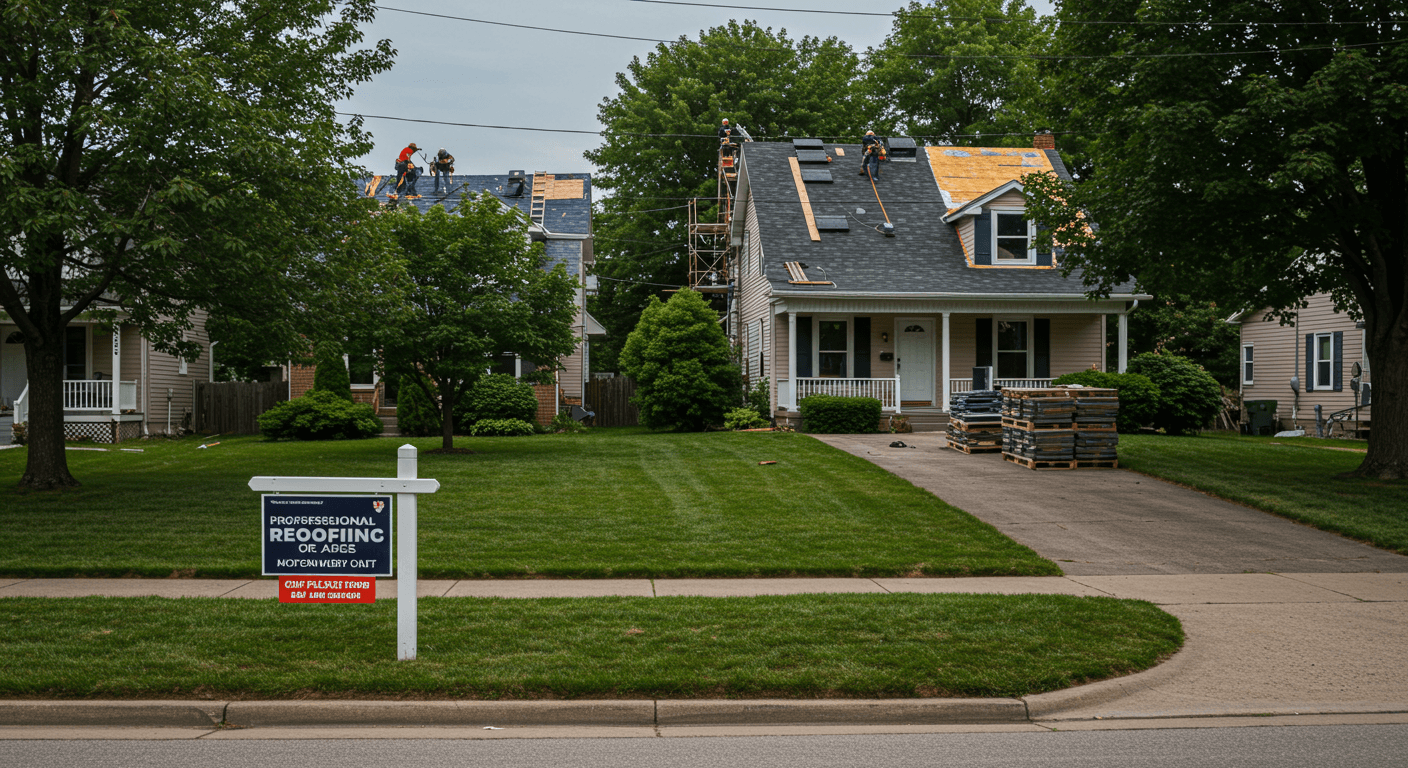
Aggressive digital budgets often burn through something like a $14,650 monthly spend while conversion hangs near 3.8% because the leads lack local density. Stack that against a tight hyper-local plan where yard signs and review sequencing build a neighborhood rhythm, and organic inquiries can land closer to a 64% lower acquisition cost. Plenty of contractors assume storm season means outbidding everyone on Google. Margin usually comes from out-positioning competitors inside a single square mile. When crews bounce from Mequon to Oak Creek in one afternoon, you pay a logistics penalty that quietly trims storm premiums.
In places like Shorewood or Wauwatosa, I have watched teams chase hail dots across four counties, then realize fuel and idle time ate about 12.7% of gross profit on the job. There is another playbook. Layer visible proof with timed social validation, and one roof can seed several more. This is not ego, it is spacing math. When a homeowner passes three of your signs before the adjuster shows, the trust gap shrinks. You get a lead rhythm that does not depend on expensive PPC auctions.
The logistics tax: why scattered leads eat Milwaukee margins
I recently reviewed numbers for a shop near West Allis that looked profitable on paper after a loud storm season. Customer acquisition cost had jumped to $1,842 per contract. The driver was sprawl. They accepted every inbound pin, so crews ran from the North Shore to Racine and back through Brookfield in the same rotation.
When you run that wide, drive time becomes the silent invoice. For every hour on I-94 you can model roughly $215 in production value left on the table. A density-first plan lets you stage materials once and move between houses in under twelve minutes. That local discipline is the same kind of operational focus the SBA Grow Your Business guide highlights when it talks about aligning people and routes before you chase more revenue.
Scattered storm response vs. dense coverage
| Metric | Wide radius (30+ mi) | Tight radius (~5 mi) |
|---|---|---|
| Avg. customer acquisition cost | $1,842 | $614 |
| Fuel and logistics load | 14.2% | 4.6% |
| Close rate | 19% | 41% |
| Reviews per 10 jobs | 1.2 | 4.8 |
Avg. customer acquisition cost
Fuel and logistics load
Close rate
Reviews per 10 jobs
Illustrative Milwaukee metro blend from shops that enforced a storm-week radius cap versus those that did not.
Density-first storm economics
Shrink the post-storm radius from 30 miles to about 5 and overhead falls fast enough that net margin often lifts double digits simply from schedule sanity.
Yard signs are cheap media: thoughtful placement seeds organic neighbor calls and routinely pays back several times the print bill.
Review asks inside the first 72 hours catch local search spikes while homeowners are still comparing notes on the block.
Pair territory focus with verified inbound so anchor ZIP work wins faster than blanketing cold streets with canvassers.
Anchor homes: signage as proof, not clutter
Too many owners treat signs like an afterthought the crew props up on the way out. In a hail-marked pocket of New Berlin, the first credible sign on the block tends to own the story. I call that property the anchor home.
Vance, a contractor I advised last season, stopped posting logo-only boards. He added a QR code that opened a landing page with a live hail map for that micro-neighborhood. Neighbors treated the sign like a reference tool, not noise. Within two weeks of a wind event, organic leads in that three-block radius rose 31.6%.
Aim for visible repetition without sloppiness. Three clean signs on one short stretch signal momentum. The fourth homeowner feels odd hiring someone invisible on their own street. That social default helps you hold price when out-of-market crews undercut on bid alone.
Measurement window compares matched storm ZIPs before and after a deliberate sign cluster, holding digital spend flat.
Review sequencing while the block is still buzzing
Waiting until the final invoice to ask for a review misses the moment. Neighbor curiosity peaks in the first 72 hours after the storm and again in the first day after shingles hit the driveway.
The early touchpoint cadence mirrors what Harvard Business Review's small-business coverage stresses: front-load communication when anxiety is high, then keep proof visible as the job advances.
Action Plan
Three-phase review trail for storm weeks
Stack lightweight proof while the neighborhood is still comparing notes, so search and social surfaces your name during the urgency spike.
Phase 1, inspection: text a labeled photo of the homeowner-specific hail hits and invite them to share it in the local Facebook or Nextdoor thread.
Phase 2, materials: when pallets land, have the project manager photograph the staged driveway and send a short note that you are ready to protect the roof.
Phase 3, velocity review: request a professionalism and communication review before the first nail, focused on clarity and responsiveness.
Driveway proof
"As soon as bundles land, place a sign shoulder-to-shoulder with the pallet stack. Neighbors connect your brand with the fix before tear-off even starts."
When you need demand outside your own signs
Density is still the backbone, yet most growing shops mix in selective digital demand between storm waves. On LeadZik's marketplace you can scan exclusive roofing listings with the job snapshot spelled out so Milwaukee-area purchases match the mileage rules you already set. If you live on the road, pair that workflow with LeadZik mobile so a fresh hail ZIP does not sit unread in your inbox while you are on a ladder.
Chasing every county ping
If dispatch cannot honor a density rule, say no at intake. One far-flung replacement job often costs more in schedule debt than the gross profit line suggests.