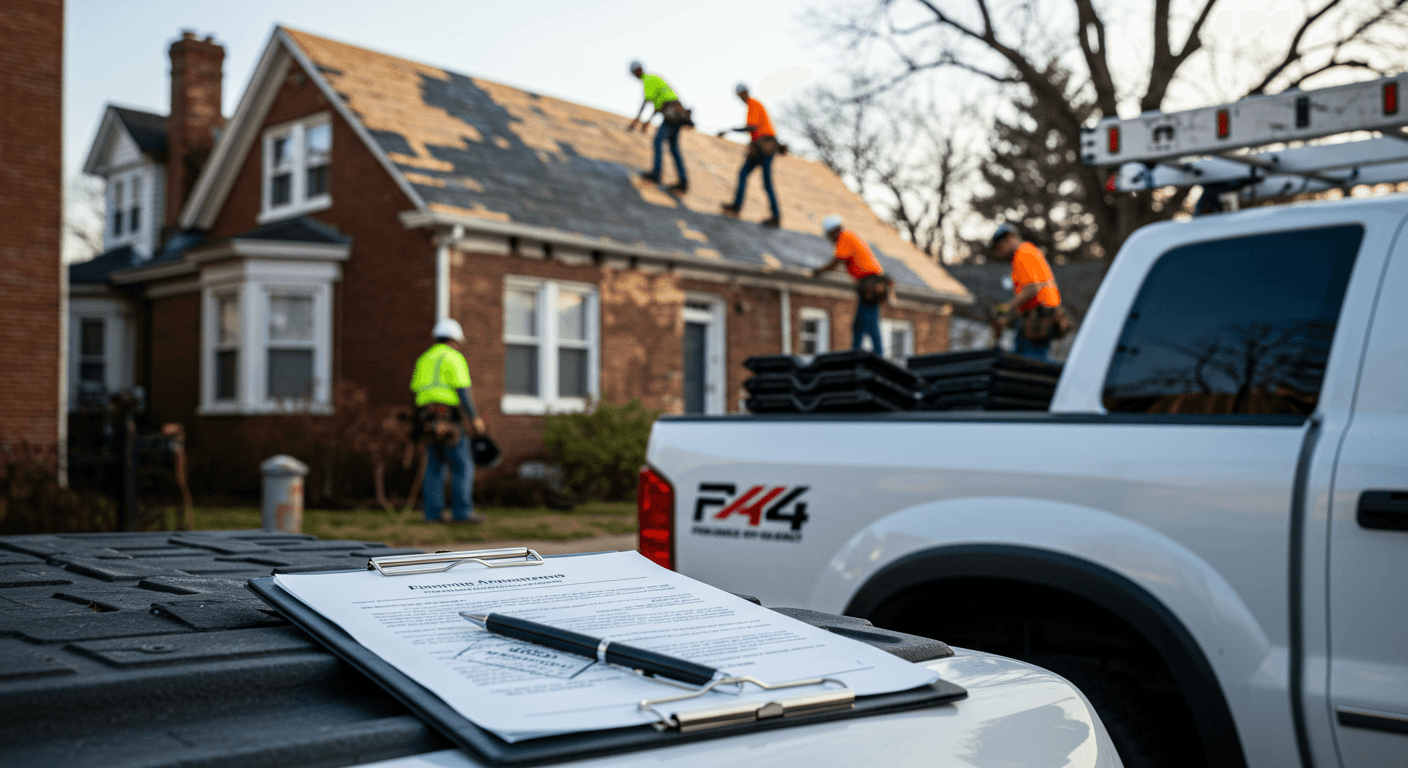
Balancing cash-on-hand against a financed pipeline is a real fork in the road for Newark roofing owners. Moving off a pure cash-and-insurance model toward a modern financing stack can lift average ticket size by about 41.6%, but it also introduces dealer fees that can shave net margin by roughly 4.2% to 7.8% if you never bake them into the estimate. Shops that only mention financing after the homeowner flinches at the total often see a 23.4% jump in slow-down objections, while teams that normalize soft-pull pre-qualification earlier can shorten the sales cycle by close to 9.5 days. The call is not only whether you offer credit, but whether you are building a tight-margin boutique or a higher-volume replacement engine. In the Essex County corridor, middle-market buyers are about 2.8 times more likely to step up from standard architectural shingles to a higher-performance system when the monthly payment is the anchor instead of an $17,845 lump sum. Getting that tradeoff right takes a deliberate plan to strip friction out of the process, not a financing link buried at the bottom of a PDF.
Newark financing leverage playbook
Dealer fee recovery: fold a 5.5% to 11.2% dealer cost into base pricing if you want to hold 20%+ net margin on financed work.
Friction points: hard credit pulls during the first inspection can drag lead-to-contract conversion down about 14.8% versus fast soft-pull pre-approvals.
Neighborhood fit: financing tends to land best in pockets like Vailsburg and the North Ward, where equity is solid but cash stays earmarked for other projects.
Systems: wiring your financing portal into the CRM routinely saves back-office teams around 6.2 hours per week on admin chasing.
The Newark replacement gap
Older housing stock, tight liquidity, and a competitor that is not always another roofer.
Newark forces a specific operating reality. Large swaths of older homes in the Ironbound and Forest Hill are past a 22-year roof life, yet owners resist draining savings for a full replacement. I recently reviewed a shop just over the line in East Orange that closed only 19% of retail leads. They were quoting about $16,500 for standard GAF Timberline HDZ systems with no way to spread the cost.
When they added a 12-month same-as-cash path next to a longer low-rate installment, close rate climbed to 31.4% inside 90 days. Their ops manager, Kieran, spotted the real leak: financing showed up too late. Reps would spend two hours on the roof, build a full estimate, then trot out credit only after the homeowner balked. That timing trains the customer to treat you like you are hiding a workaround instead of leading with a payment plan that matches how people actually buy. Your competition is not only the contractor down the block, it is the decision to wait another season. Material swings make that delay expensive for everyone, which is why trade groups such as the Western States Roofing Contractors Association keep warning that postponed work and volatile costs squeeze future margin.
High-friction vs. low-friction financing workflows
| Factor | High friction (margin risk) | Low friction (volume driver) |
|---|---|---|
| Timing | Mentioned at the end of the pitch | Mentioned on the first intake call |
| Credit check | Hard pull before a useful quote | Soft-pull pre-qual in under 90 seconds |
| Dealer fees | Broken out as a separate line item | Absorbed into a single package price |
| Process | Paper forms or a clunky external login | Mobile flow tied to your CRM |
| Approval rate | About 62% with a single traditional bank | About 84% with a multi-lender platform |
Timing
Credit check
Dealer fees
Process
Approval rate
The math hiding inside dealer fees
If you ignore financing cost, you are effectively funding part of the job yourself. Picture a $21,340 replacement in the North Ward on a 10-year note with a 9.5% dealer fee. That is $2,027.30 to the lender before you buy a bundle. If you modeled 22% net, you are suddenly closer to 12.5% unless the estimate already reflected the product you sold.
I have watched companies blow past $5M in sales and still print less net than their $2M years because price books never moved with financed demand. Fix it with two disciplined price paths or a calculator that adjusts totals whenever the financing product changes, so the rep cannot accidentally quote cash economics on a credit deal.
New Jersey contractors who added automated soft-pull financing at signing versus shops that stayed cash-only or insurance-dependent.
Reducing friction with an early pre-qual rhythm
Friction is anything that makes a homeowner pause. A $19,500 lump sum stops conversations. A $215 monthly number keeps them listening. The Newark crews I like best moved financing language to the front of the journey.
When a lead hits your office, especially if you are using how LeadZik verifies each opportunity to focus on full replacements, train intake to state plainly that most local clients pick a monthly plan. By the time Aria, your rep, parks near Branch Brook Park, the homeowner is thinking about budget bands, not bracing for a surprise invoice.
The three-minute pre-qual habit
"Run a soft pull before the rep walks the roof. If the household is cleared around $25,000, your rep can propose a full system with upgraded underlayment and ventilation instead of defaulting to a short-term patch."
Operations, permits, and the volume paradox
Financing can spike closes overnight, then slam production. Essex County permits often sit 14 to 26 days, so fifteen net-new financed deals in a week can jam scheduling fast. When the board lights up red, crews cut corners before they admit it.
Hold the line on fall protection and staging discipline, especially on steep-slope Victorians in Forest Hill. One serious incident erases the margin you fought for. Keep crews aligned with OSHA roofing safety guidance on harnessing, anchors, and job sequencing so speed never becomes the excuse.
The recourse debt trap
Steer clear of with-recourse agreements where the lender can claw money back from your business if a homeowner defaults after you are marked complete. Non-recourse structures keep cash in your account once the install is funded.
Seasonal timing in North Jersey
Humid Julys and ice-dam Januaries teach Newark owners to wait for a crisis. Financing lets you pull some of that demand into shoulder months. In March and November, a simple deferred-first-payment offer can bridge someone who is waiting on a tax refund but cannot survive another nor'easter season on brittle shingles. Shops I track have held crew utilization near 94% in those windows versus the low 60s when they only pushed cash.
Shoulder-season pulls only work if you still have homeowners raising their hands. Use $150 in LeadZik credits to test a handful of Newark ZIP codes before you fund a broad campaign, so you are not buying airtime where your production calendar cannot follow.
Action Plan
Five Newark strategies that keep financing and margin aligned
A practical sequence for Essex County roofing owners who want volume without quietly donating margin to lender fees or process drag.
Bake dealer fees into the financed package price and ban add-on fee lines that make people feel nickel-and-dimed.
Move payment language to intake, then follow with soft-pull pre-qual when the job profile justifies it so site visits start with buying power.
Run parallel price logic for cash, insurance, and each financing SKU so reps cannot quote the wrong economics.
Cap sold work to permit cadence and crew capacity, and keep safety checks visible on steep residential pitches.
Use shoulder-season financing hooks to fill March and November, and keep top-of-funnel tests tight to ZIPs you can actually service.
Want to skip the manual work and get exclusive, verified leads instead?
Get $150 in Free CreditsThe systematic close
Financing is not a brochure stapled to the back of a contract. It is part of operations, pricing, and how fast you can safely install. When you remove the shock of the big number, homeowners argue less about shingles and more about workmanship and reputation.
A multi-lender stack spanning roughly 580 to 800+ FICO bands stops your reps from burning afternoons on declines. In a dense Newark market, the contractor who makes yes easy, without hiding the cost, tends to own the block.