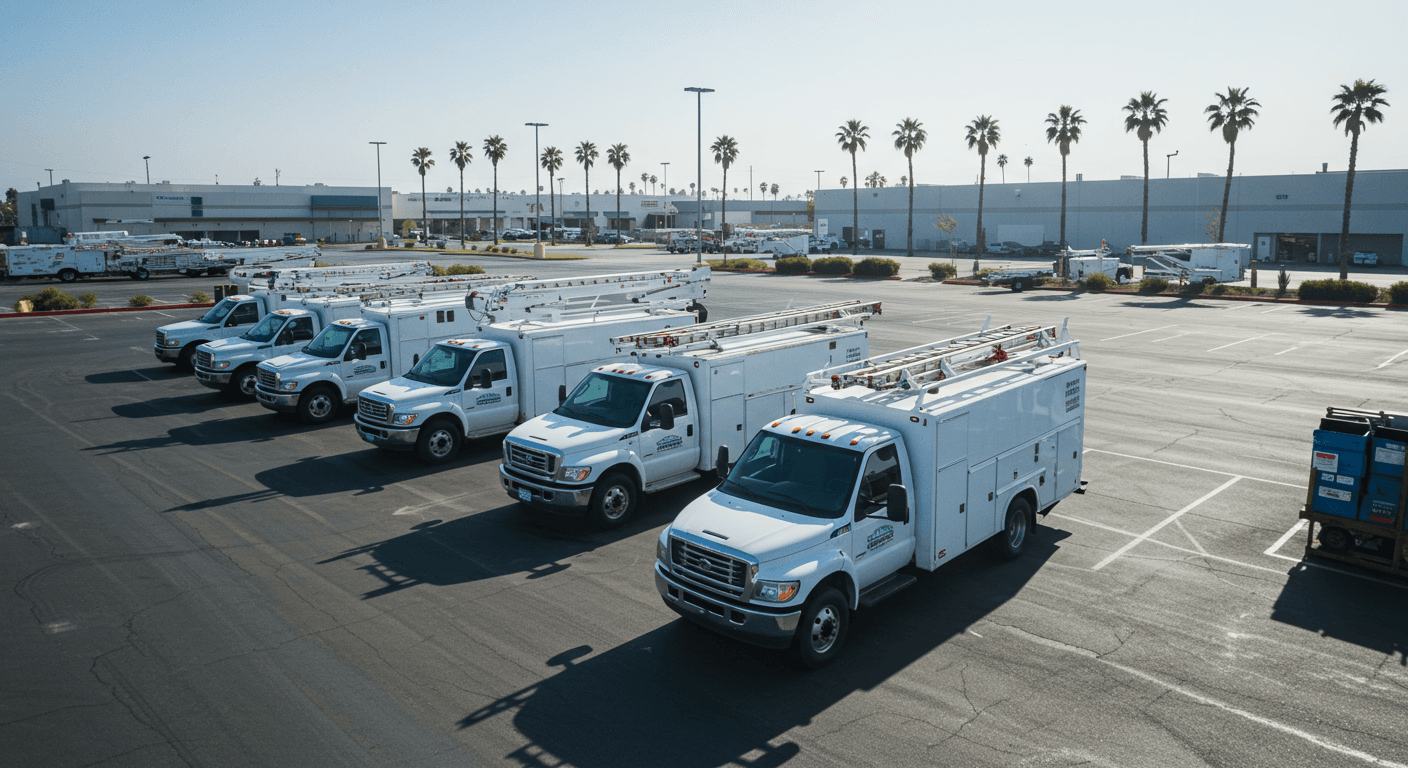
Most California roofing owners believe that GPS tracking is just a digital leash to catch guys taking long lunches at In-N-Out, but that perspective is costing them roughly $14,680 per truck every single year in invisible leaks. This "big brother" myth is the single greatest barrier to scaling a profitable roofing business in the Golden State.
When I was consulting for a mid-sized shop in Riverside last year, the owner, Jaxon, was adamant that his crews would walk if he installed "trackers." He viewed it as a trust issue. I viewed it as a math problem. We weren't looking to catch a foreman grabbing an extra coffee; we were looking for the 43 minutes of daily unauthorized idling and the erratic braking patterns that were spiking his commercial auto insurance premiums by 18.4% annually.
California presents a unique set of logistical nightmares that make fleet visibility a requirement rather than a luxury. Between the soul-crushing traffic on the 405 and the strict CARB (California Air Resources Board) idling regulations, an unmonitored fleet is a massive liability. If your crews are sitting with engines running while staging materials in a residential zone in Irvine, you aren't just wasting fuel priced at $4.87 a gallon; you are risking non-compliance fines that can gut your monthly margin.
At a Glance
Recover an average of 13.6% in fuel costs by eliminating excessive idling and unauthorized side-trips.
Protect your business from 'nuclear verdicts' in California courts with hard telematics data that proves your driver wasn't speeding.
Improve crew arrival accuracy by 27%, leading to higher customer satisfaction and better online reviews.
Lower vehicle maintenance costs by 11.2% through automated engine diagnostic alerts and preventative scheduling.
Action Plan
Transitioning from Manual to Automated Fleet Management
How to transition from manual fleet management to a high-ROI automated system without losing crew trust.
Audit Current Leakage: Track fuel receipts against estimated job site distances for 14 days to establish a baseline of 'missing' miles.
The 'Safety First' Pitch: Introduce the system to your foremen as a tool for roadside assistance and theft recovery, not a punch-clock.
Route Optimization: Use historical traffic data to schedule North Bay or Inland Empire jobs during off-peak windows.
Insurance Leverage: Present your tracking data to your broker to negotiate a high-performance safety discount.
Want to skip the manual work and get exclusive, verified leads instead?
Get $150 in Free CreditsThe High Cost of the "Golden State" Commute
In a state where the mean hourly wage for roofers is $26.85, every minute a three-man crew spends stuck in avoidable traffic is a direct hit to your bottom line. I sat down with Jaxon and looked at his "dead time" (the hours between leaving the yard and hitting the first shingle). His crews were losing an average of 6.2 hours per week simply by choosing the wrong routes during the morning rush.
By implementing a basic fleet tracking system, we were able to visualize these bottlenecks. We discovered that by shifting their start time by just 25 minutes, they avoided a specific congestion point near San Bernardino, saving nearly 54 minutes of paid labor daily across four trucks. That is over $4,100 a month back in Jaxon's pocket without selling a single extra square of shingles.
This is the kind of operational efficiency that the founders of LeadZik realized was missing when they started their own journey. They saw that while getting leads was vital, managing the execution of those jobs was where the real profit lived or died. If you are paying for high-quality, verified leads, you cannot afford to waste the margin on poor logistics.
Protecting Your Assets in a Litigious Environment
California is notorious for high insurance premiums and a legal climate where a single fender bender can turn into a million-dollar lawsuit. Without telematics, it is your word against a "witness." I remember a case with a contractor in San Jose who was sued because a homeowner claimed his truck was speeding through a school zone.
The contractor had a fleet system in place. We pulled the report and proved the truck was actually parked three blocks away at the time of the alleged incident. The data didn't just save him from a lawsuit; it saved his entire business. Telematics provide an "integrity shield" for your drivers. When they know their hard braking, rapid acceleration, and speed are being logged, their behavior changes. We saw Jaxon's fleet safety score improve by 38% in the first 90 days, which we then used as leverage to renegotiate his policy.
Average increase in fleet lifespan for California contractors using preventative maintenance alerts via GPS tracking.
Typical reduction in fuel expenditure within the first six months of implementing route optimization software.
Beyond Location: The Maintenance Multiplier
Most owners forget that these systems do more than show dots on a map. They plug directly into the OBD-II port, giving you a real-time health check of your engines. In the heat of the Central Valley, cooling systems are under constant stress. Jaxon had a habit of waiting for a "check engine" light to appear before sending a truck to the shop. By then, the repair was usually $2,400 instead of $300.
The tracking system we installed sent an alert to his phone the moment a sensor detected a minor misfire in Truck 4. He pulled it off the road that evening, replaced a spark plug and a coil pack for $214, and avoided a total engine failure on the Grapevine the next day. This proactive approach is a cornerstone of modern roofing business growth, where preventing a loss is just as valuable as generating a lead.
Manual Logging vs. Automated Fleet Tracking
| Factor | Manual Logging | Automated Fleet Tracking |
|---|---|---|
| Data Accuracy | 65-70% (Human error/guessing) | 99.9% (GPS/OBD-II direct) |
| Fuel Savings | Negligible | 12-18% average reduction |
| Liability Proof | Anecdotal/Inconclusive | Court-admissible telematics |
| Maintenance | Reactive (Fix when broken) | Proactive (Predictive alerts) |
Data Accuracy
Fuel Savings
Liability Proof
Maintenance
Managing the "Culture Shock"
The biggest hurdle isn't the software; it's the men and women behind the wheel. When I train sales reps and crews, I emphasize the "What's in it for me?" (WIIFM) factor. If you frame fleet tracking as a way to catch them doing something wrong, they will hate it. If you frame it as a tool that proves they are doing things right, they will embrace it.
Here is the exact script I had Jaxon use during his Monday morning tailgate meeting:
"Guys, we are installing a system in the trucks this week. The main reason is safety and theft. If a truck gets stolen tonight with all your tools in it, I want to be able to find it in ten minutes so you don't lose your livelihood. Also, if someone claims you cut them off in traffic and tries to sue us, this data is the only thing that proves you were driving safely. It protects your reputation and it protects this company so we can keep the crews busy."
Once the crews realized the system was there to watch their backs (and potentially provide data for "Safe Driver" bonuses), the pushback vanished. In fact, his top foreman, Nolan, started using the app to see which of his sub-crews were arriving at the job site first, turning it into a friendly competition.
The California Idling Strategy
"Configure your fleet alerts to trigger a notification to the driver's phone after 5 minutes of idling. In California, this prevents neighborhood complaints and potential CARB fines, while saving roughly $1.14 in fuel per instance."
The Long-Term ROI of Connectivity
The roofing industry is becoming more data-driven every day. According to the Occupational Outlook Handbook, the demand for roofers is projected to grow by 6% through 2034, but the shops that will dominate the market are the ones that control their overhead.
When you have a tight grip on your fleet, your bidding becomes more accurate. You know exactly how much "windshield time" to bake into a job in Malibu versus a job in Long Beach. You stop guessing and start calculating. This level of precision allows you to bid more competitively while maintaining higher margins than the guy down the street who is still using paper logs and "gut feelings."
If you have questions about how these systems integrate with your existing workflow, or how to handle the initial setup, checking out a comprehensive FAQ on operational tech can help clear the air. The goal is a seamless loop: get the lead, dispatch the crew efficiently, protect the asset, and collect the profit.