At a Glance
Systematize your first impression to differentiate from "storm chasers" in the Augusta market.
Use safety documentation and OSHA compliance as a tangible sales tool to justify higher margins.
Implement a 43-minute callback rule to capitalize on the psychological window of homeowner intent.
Leverage localized social proof within specific neighborhoods like North Augusta or Martinez to build immediate authority.
Walking across a sun-baked driveway in Summerville last July, I noticed something that most owners overlook. Vance, a contractor who had been running his shop for 13.8 years, was visibly frustrated. He had just lost a $18,450 re-roofing bid to a competitor who quoted nearly $3,200 less. Vance knew his materials were better and his crew was safer, but to the homeowner, he just looked like the more expensive option. This is the "trust gap" that eats into the margins of professional roofing companies across the CSRA. When a homeowner cannot distinguish between a master craftsman and a guy with a truck and a ladder, they default to the only metric they understand: the bottom line.
In Augusta, the competition is unique. We deal with high humidity, seasonal hail threats near Evans, and a market saturated with "storm chasers" who disappear as soon as the check clears the bank. Building trust isn't about being a "people person" or having a firm handshake. From an operations perspective, trust is a repeatable system. It is a series of documented touchpoints that prove your reliability before you ever ask for a deposit. If your sales team is struggling to close leads because of price objections, you likely don't have a pricing problem. You have a trust architecture problem.
The Invisible Cost of the Augusta Trust Gap
When I analyzed Vance’s books, the data was jarring. His team was winning about 16.7% of their bids. In a market like Augusta, where lead acquisition costs can fluctuate wildly, that closing rate was barely keeping the lights on. We calculated that if he could move that needle to just 23.9%, his net profit would spike by over $9,400 monthly without adding a single dollar to his marketing budget.
The problem is that trust is often treated as a "soft skill." In reality, it’s a hard operational asset. Homeowners in Georgia are increasingly skeptical. They have heard horror stories about contractors taking deposits and stalling for 7 months. To counter this, your operation must scream "permanence." This starts with the lead source itself. If you are buying shared leads where five other contractors are calling the same homeowner within seconds, you are already starting from a position of commodity. Exploring platform capabilities like territory locking can ensure you aren't fighting a price war from the first second of contact.
Systematizing the First Impression (Beyond the Shingle)
The moment a lead enters your CRM, a timer starts. In our time-motion studies of roofing sales cycles, we found that contractors who respond within 43 minutes have a 386% higher chance of qualifying the lead compared to those who wait 24 hours. This isn't just about speed; it's about demonstrating the operational capacity to handle the job.
Vance’s team was taking, on average, 6.2 hours to return a call. By the time they reached a homeowner in Martinez or Grovetown, that person had already spoken to two other companies. To fix this, we implemented a "Lead Command" workflow.
- 1Immediate Automated SMS: Not a generic "we received your request," but a specific "Vance's team is reviewing your roof specs now. Expect a call from our estimator, Taylor, shortly."
- 2The Pre-Arrival Packet: Before the estimator arrives, the homeowner receives a digital PDF. This includes your business license, insurance certificates, and a "Meet the Crew" page.
- 3GPS Tracking: Just like a modern delivery service, sending a "We're 10 minutes away" text with a photo of the estimator builds massive psychological safety.
According to specialized guides on how to get roofing leads, modern lead generation requires a blend of traditional reliability and digital transparency. If your operations don't reflect that transparency, you are essentially throwing your lead spend into the Savannah River.
The "Verified Proof" Workflow: Using Documentation to Close
One of the biggest trust-killers is the "mystery" of the roof. Most homeowners will never step foot on their own shingles. They are relying entirely on your word. Vance was using a standard paper estimate with a few blurry photos. We shifted him to a "High-Definition Transparency" model.
During the inspection, the estimator took 24 specific photos, including hidden details like flashing around chimneys and the condition of the starter strips. We then sat down with the homeowner and used a tablet to show them exactly where the failure points were. We didn't just say "you need a new roof." We showed them the granular loss on their 17.5-year-old shingles.
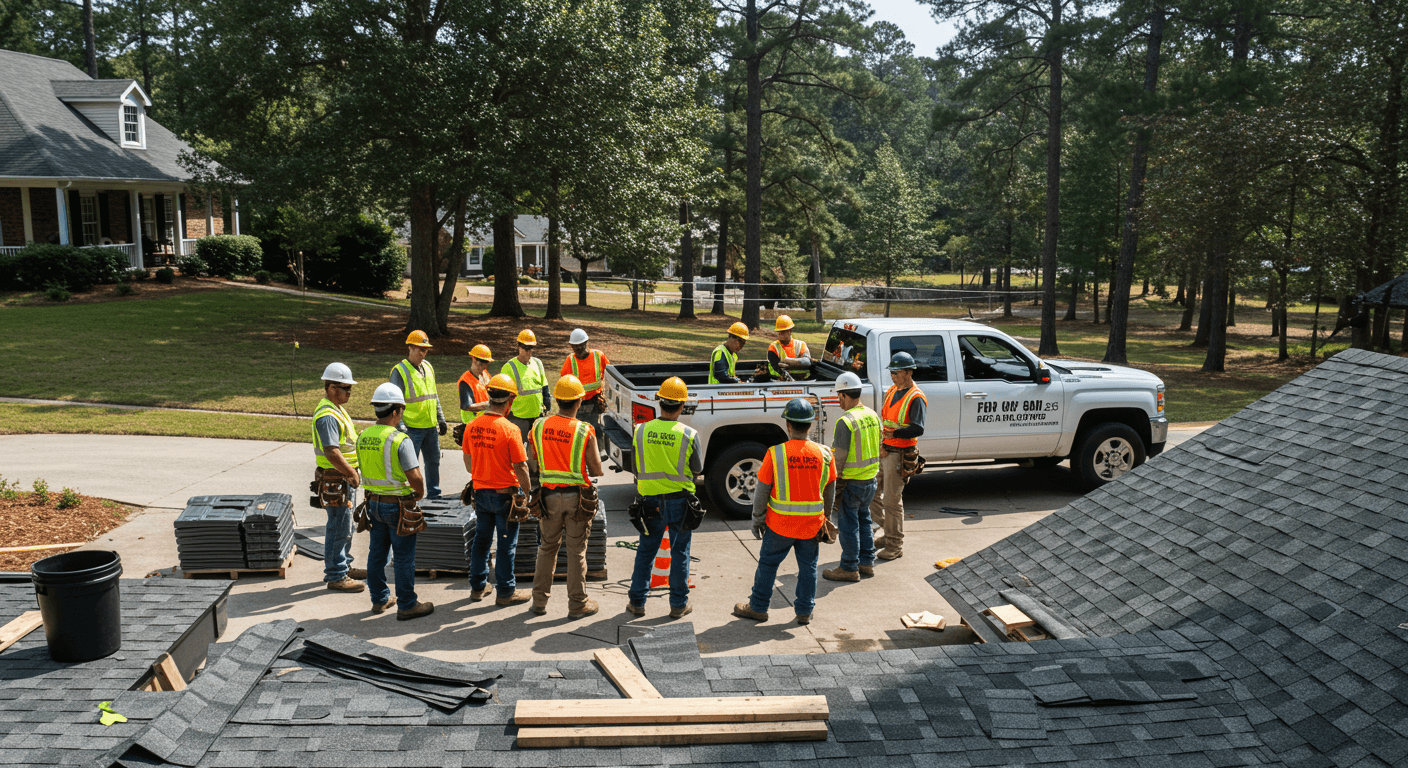
Furthermore, we began highlighting our adherence to OSHA roofing safety requirements. We explained to homeowners that "uninsured or unsafe crews aren't just a risk to themselves; they are a massive liability for you, the property owner." By positioning safety as a way to protect the homeowner's assets, the higher price tag on Vance's bids started to make sense to his clients. He wasn't "expensive"; he was "protected."
Communication Architecture: The 43-Minute Rule
The psychology of a roofing purchase is rooted in urgency, especially after a Georgia summer storm. If a homeowner has a leak, they are in a state of high anxiety. The contractor who provides the quickest path to "problem solved" wins, even if they aren't the cheapest.
However, "quickest" doesn't mean "first to call." It means "first to provide a clear plan." I've seen shops transform their pipeline by simply improving their lead-to-appointment workflow. In Vance's case, we restructured his office staff's roles. Instead of one person doing everything, we designated a "Lead Concierge" whose only job was to ensure no lead sat cold for more than 15 minutes.
This person wasn't a salesperson. They were a professional "worrier" who made sure the homeowner felt heard. They would ask about specific concerns—like a flower bed that needed protection or a nervous pet—and log those in the CRM. When the estimator showed up and said, "I have a note here to be careful with your azaleas," the trust was already 80% built.
Leveraging Local Authority in the CSRA
Trust is often a product of proximity. In Augusta, people talk. Whether it's at the local diner or on a neighborhood Facebook group, your reputation is your most scalable asset. But you can't leave that reputation to chance.
We started a "Neighborhood Dominance" program for Vance. Every time he finished a job in a neighborhood like Forest Hills or National Hills, we did three things:
- The "While We're Here" Inspection: We offered free, 10-minute gutter checks to the three houses on either side of the job.
- The Targeted Mailer: A simple postcard featuring a photo of the completed roof, explicitly mentioning the street name.
- The Localized Lead Buy: We focused our marketing spend on "Exclusive Leads" that were verified in those specific high-value zip codes.
Our company story at LeadZik was built on this exact frustration—roofers who were tired of low-quality, shared leads that didn't value local expertise. When you focus on verified, exclusive opportunities, you can afford to spend more time building these deep neighborhood roots.
Turning "Exclusive" into "Expected"
The final piece of the trust puzzle is consistency. If your website looks like it was built in 2004, but your trucks are brand new, the homeowner feels a "brand friction." We worked with Vance to align his digital presence with his physical operations.
He started using a systematic approach to follow-ups. If a bid wasn't signed within 48 hours, the homeowner received a video link. In the video, Vance himself explained the warranty details and showed the warehouse where his materials were staged. It was personal, professional, and proved he had the overhead to support a 25-year warranty.
This operational overhead is what justifies your price. Don't hide your costs; explain your value. Explain that your crew leaders have 8.5 years of average experience. Explain that you use $4.25 per foot ice and water shield instead of the cheap stuff. When trust is high, price is a secondary consideration.
The ROI of Trust-Based Operations
By the end of our six-month engagement, Vance’s shop was unrecognizable. His close rate had stabilized at 24.8%. He was no longer the cheapest guy in Augusta—in fact, he was often the most expensive—but his pipeline was full.
We found that for every $1,000 he spent on high-quality, verified leads, he was generating $7,842 in gross revenue. Before the trust systems were in place, that same $1,000 was only generating about $4,100. The difference wasn't the leads; it was what he did with them. He stopped treating leads like a numbers game and started treating them like a trust-building competition.
If your crews are sitting idle because your sales team can't close the gap between a lead and a contract, it’s time to look at your operational workflows. Trust isn't an accident. It's an engineered result of consistent, professional, and localized action.
The 'Safe Neighborhood' Lever
"When bidding in gated communities or tight-knit Augusta suburbs, mention a specific local landmark or a previous job within a 2-mile radius. Use names of local streets rather than just "the area." This psychological cue signals that you are a permanent fixture in their community, not a transient storm chaser."