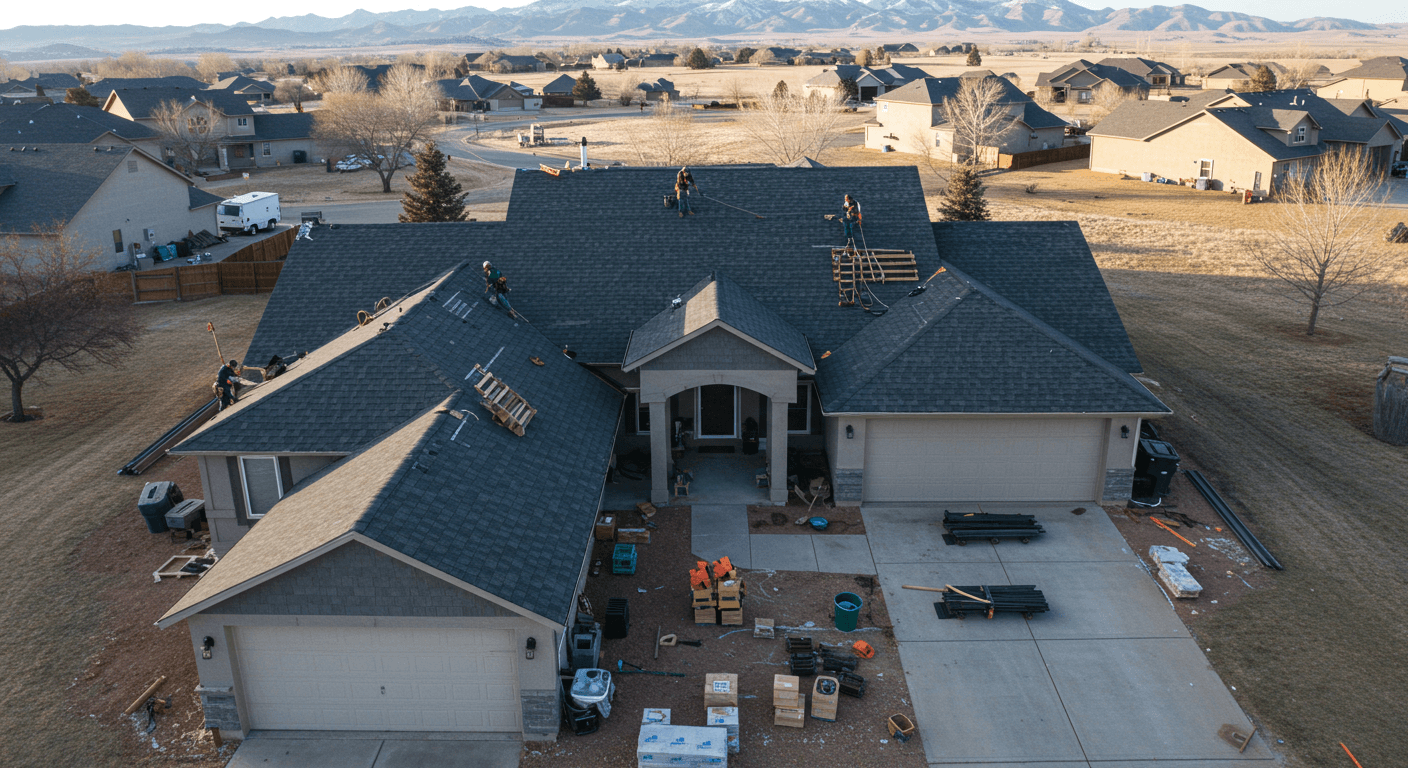
Would you hand a crew lead $845 in cash every Tuesday morning just to watch them sit in a Starbucks parking lot for three hours? It sounds absurd, but that is exactly what I saw happening with Jaxon, a mid-sized residential roofer out of Aurora, last July. He had sixteen guys spread across three crews, but his "scheduling" was essentially a series of panicked text messages sent at 6:15 AM based on a weather app that hadn't updated since midnight. Because of the unpredictable Front Range wind patterns, Jaxon's teams were constantly hitting job sites only to realize the shingles would blow off before the nails were in, or worse, they were double-booked on a tear-off while a simple repair sat idle forty miles away in Castle Rock.
We sat down and looked at his actual labor-to-revenue ratio, and the leaks were staggering. He wasn't losing money because of bad craftsmanship; he was hemorrhaging profit because his logistics were reactive rather than predictive. In a market like Colorado, where the window for high-margin work is compressed by early snows and sudden hailstorms, being "okay" at scheduling is a slow-motion business suicide.
Static vs. Dynamic Scheduling Efficiency
| Factor | Traditional Static Scheduling | AI-Driven Dynamic Scheduling |
|---|---|---|
| Daily Drive Time | 124 minutes | 78 minutes |
| Weather Delay Recovery | 12-24 hours | 2-4 hours |
| Labor Margin Leakage | 18.6% | 6.4% |
Daily Drive Time
Weather Delay Recovery
Labor Margin Leakage
At a Glance
Shift from reactive to predictive routing to cut fuel and labor waste by 14%+
Implement a 'Buffer Job' system for small repairs to fill weather-induced gaps
Integrate real-time material delivery tracking to prevent crew idle time
Use geofencing to verify actual 'shingle-to-roof' time vs. clocked hours
Why the "Old Way" is Killing Your Front Range Profitability
The question isn't whether you have a schedule; it's whether that schedule can survive a 2:00 PM thunderstorm rolling off the Rockies. For years, Colorado roofing owners relied on the "Whiteboard and Prayer" method. You'd map out the week on Sunday night, cross your fingers that the sub-crews showed up, and hope the I-25 traffic didn't turn a twenty-minute drive into a ninety-minute nightmare. That model is officially broken. According to the Roofing Industry Report from IBISWorld, rising operational costs and intense local competition are forcing contractors to find efficiency in the margins. You can no longer afford to "figure it out" on Monday morning.
I recently audited a shop in Fort Collins that was convinced they needed more leads to grow. After digging into their project management software, we found they were actually over-booked but under-utilized. They had 4.3 days of "ghost time" per month per crew. That's time where crews were clocked in but not laying shingles due to poor material staging or overlapping site arrivals. When you calculate a fully burdened labor rate of $47 per hour for a five-man crew, those ghost hours were costing that owner nearly $9,847 every single month. That's not a lead problem; that's a scheduling hemorrhage.
The Deep Dive: How Predictive Logistics Changes the Game
The emerging trend I'm seeing among the top 5% of Colorado contractors is the move toward predictive logistics. This isn't just looking at the calendar; it's using data to decide which jobs get prioritized based on proximity, material availability, and hyper-local weather patterns. For instance, a roof in Boulder might be under a high-wind advisory while a job in Parker is perfectly clear. Modern shops are using tools that allow them to pivot crews in real-time.
Construction Dive has highlighted how labor shortages are forcing a "do more with less" mentality across the industry. In Colorado, where the labor pool for skilled roofers is tighter than a new boot, you have to treat your crews like a finite, high-value resource. If your crew lead is spending ninety minutes at the supply house because the order wasn't ready, that's an executive failure, not a field failure.
I've seen contractors transform their bottom line by implementing "Zone Scheduling." Instead of taking every job that comes in across the entire state, they cluster jobs by zip code for specific weeks. This reduces the "windshield time" by roughly 32%. When your teams aren't exhausted from fighting Denver traffic, their output on the roof increases. I watched one crew in Colorado Springs go from 12 squares a day to 15.7 squares a day just by eliminating the cross-town commute.
for shops moving from manual to automated scheduling systems
Alternatives: The Sub-Contractor vs. In-House Scheduling Dilemma
One of the biggest debates I have with owners in Lakewood or Arlo's shop in Wheat Ridge is whether to keep everything in-house or lean on subs. The scheduling challenges are different for both. With in-house crews, you have total control but 100% of the overhead risk. With subs, you have flexibility but zero loyalty.
The "Hybrid Buffer" model is the winner here. You keep a core in-house crew for your high-margin, complex residential jobs and use a rotating pool of verified subs for the "churn and burn" hail work. But here is the secret: you have to provide the subs with the same level of tech-driven scheduling as your employees. If you want them to prioritize your jobs, you need to make their lives easy. This means having the mobile app ready for them to check in, see the job photos, and confirm the material drop-off without five phone calls.
I remember talking to a veteran roofer who was resistant to using any digital tools. He told me, "Ava, I've been doing this for 17 years with a notebook." I asked him to show me his profit per man-hour from 2019 versus 2023. He couldn't. When we finally tracked it, he realized he was working 20% more hours for 12% less profit. The complexity of modern roofing—insurance supplements, municipal inspections, and material lead times—has outpaced the human brain's ability to track it on a legal pad.
Decision Framework: Mapping Your Path to 25% Better Efficiency
If you're ready to stop the bleeding, you need a framework for making scheduling decisions. It shouldn't be based on who complained the loudest on the phone this morning. Instead, use a "Revenue-Per-Mile" (RPM) metric.
1. The Proximity Filter: If Job A is worth $14,000 but is 50 miles away, and Job B is worth $12,500 but is 5 miles away, which one is more profitable? Once you factor in fuel, wear and tear on the 3500s, and three hours of lost labor for five men, Job B wins every time.
2. The "Dry-In" Priority: In Colorado, getting the roof dry is everything. Your schedule should prioritize tear-offs for days with 0% precipitation forecasts, saving the "over-lay" or minor repair work for the high-wind or high-probability rain days.
3. The Lead Quality Factor: Nothing kills a schedule like a "dead" lead. If your crew shows up and the homeowner hasn't even signed the contract or the insurance check hasn't cleared, you've wasted a day. This is why I always tell my clients to check out LeadZik's platform where they can actually see verified job previews before committing. It ensures the job is real before you put it on the calendar.
The 48-Hour Staging Rule
"Never put a crew on the schedule for a roof until the materials have been sitting on the driveway for at least 48 hours. Material backorders are the #1 cause of 'Ghost Time' in Colorado. If you verify the drop on Wednesday, the crew starts Friday. No exceptions."
Tactical Implementation: Moving Toward a Frictionless Pipeline
Transitioning your shop doesn't happen overnight. Start by digitizing your job flow. Every project should have a "Digital Twin" that includes the scope of work, material list, and site photos. When Jaxon (the roofer I mentioned earlier) finally moved his Aurora shop to an automated system, the first thing we did was look at his lead-to-install timeline. It was taking him 19 days to get a crew on a roof after a contract was signed. By tightening his scheduling clusters, we got that down to 11.4 days.
The ripple effect was massive. Faster installs meant faster invoicing. Faster invoicing meant better cash flow. Better cash flow meant he could finally buy that second dump trailer he'd been eyeing for 18 months. He even had enough breathing room to sign up and grab $150 in free lead credits to start testing some higher-end commercial leads without stressing his bank account.
The reality of the Colorado market is that the weather won't change, and the traffic isn't getting any better. The only variable you can control is how you deploy your troops. If you're still treating scheduling as a chore rather than a strategic advantage, you're leaving a massive chunk of your net profit on the table. It's time to stop being a roofer who "does some business" and start being a business owner who "does some roofing."