Would you willingly hand a competitor $687 every single time you climbed into your truck to run a "maybe" lead? Most owners across the DFW Metroplex do not realize they are doing exactly that through fuel burn, vehicle wear, and wasted sales hours before they even unzip a shingle sample.
I was working with a contractor in North Richland Hills last quarter, a guy named Gavin, who was frustrated because his top producer was spending four hours a day fighting traffic on the 820 Loop just to reach three appointments. Out of those three, one was a "no-show" and another just wanted a "ballpark figure." Gavin was bleeding cash on logistics while his actual closing opportunities sat in the passenger seat of a Ford F-150. We sat down and looked at his overhead, and the numbers were staggering. Between gas, insurance, and the opportunity cost of his rep's time, each physical site visit was costing him $214 before a single measurement was taken.
That is when we pivoted his team to a virtual-first sales model. By the end of month two, his operational costs dropped by 19.4% and his sales volume actually stayed steady because his reps were running six presentations a day instead of three. This shift is not just about convenience (it is about survival in a market where labor costs are rising and margins are getting squeezed by every storm-chaser who rolls into town).
At a Glance
Virtual sales models reduce customer acquisition costs (CAC) by an average of 22.8% by eliminating unnecessary travel.
Digital presentations allow for higher touchpoints, enabling one rep to handle 40% more leads weekly.
Integrating high-resolution satellite imagery improves estimate accuracy compared to manual tape measurements.
Operational safety improves as estimators spend less time on steep slopes for preliminary bids.
The True Cost of the "Kitchen Table" Tradition in Fort Worth
There is a long-standing belief in the Texas roofing community that you cannot close a deal unless you are sitting at the homeowner's kitchen table. While rapport is vital, the "kitchen table" model is becoming a luxury many shops can no longer afford as a primary strategy. If you are sending a $100,000-a-year sales rep to drive from Keller to Burleson for a lead that has not been vetted, you are misallocating your most expensive resource.
The math for a typical Fort Worth operation is sobering. When you factor in the IRS mileage rate, the hourly wage of a skilled estimator, and the administrative burden of scheduling, a physical estimate often consumes $185 to $260 in company resources. If your close rate on those leads is 25%, you are spending over $800 in "sales attempts" for every signed contract. Virtual sales models target this specific leak in your bucket.
By moving the initial discovery and presentation to a digital platform, you filter out the tire-kickers without the fuel bill. I have seen shops transform their pipeline by adopting a "Virtual-First, Physical-Second" approach. They use the digital meeting to establish value, then only send someone out once the homeowner has agreed to the price range and scope.
Comparing Virtual Sales vs. The Hybrid Model
When you look at modernizing your sales process, you generally have two paths: the Pure Virtual model and the Hybrid model. Each has a different impact on your bottom line.
The Pure Virtual Model
This approach relies entirely on satellite imagery and video conferencing. Your rep never visits the property until the crew arrives. For Gavin, this worked exceptionally well for standard composition shingle replacements in suburbs like Saginaw where the roof geometries are predictable. The overhead reduction here is massive, often slashing sales-related expenses by 37% or more. However, you need a highly disciplined sales team that can build trust through a screen.
The Hybrid Model
In this scenario, you send a lower-cost "measure tech" or use a drone service to capture data, and the senior sales rep conducts the closing presentation virtually. This keeps your "closers" doing what they do best (closing) rather than climbing ladders or navigating school zones at 3:00 PM. This model is often safer for the business. According to OSHA roofing safety guidelines, falls remain a top hazard in construction. Reducing the number of times your team has to set a ladder just to provide a quote significantly lowers your risk profile.
Fort Worth reps switching from 100% field sales to a hybrid virtual model see a 23.4% increase in weekly presentation volume.
Leveraging Data to Protect Your Margins
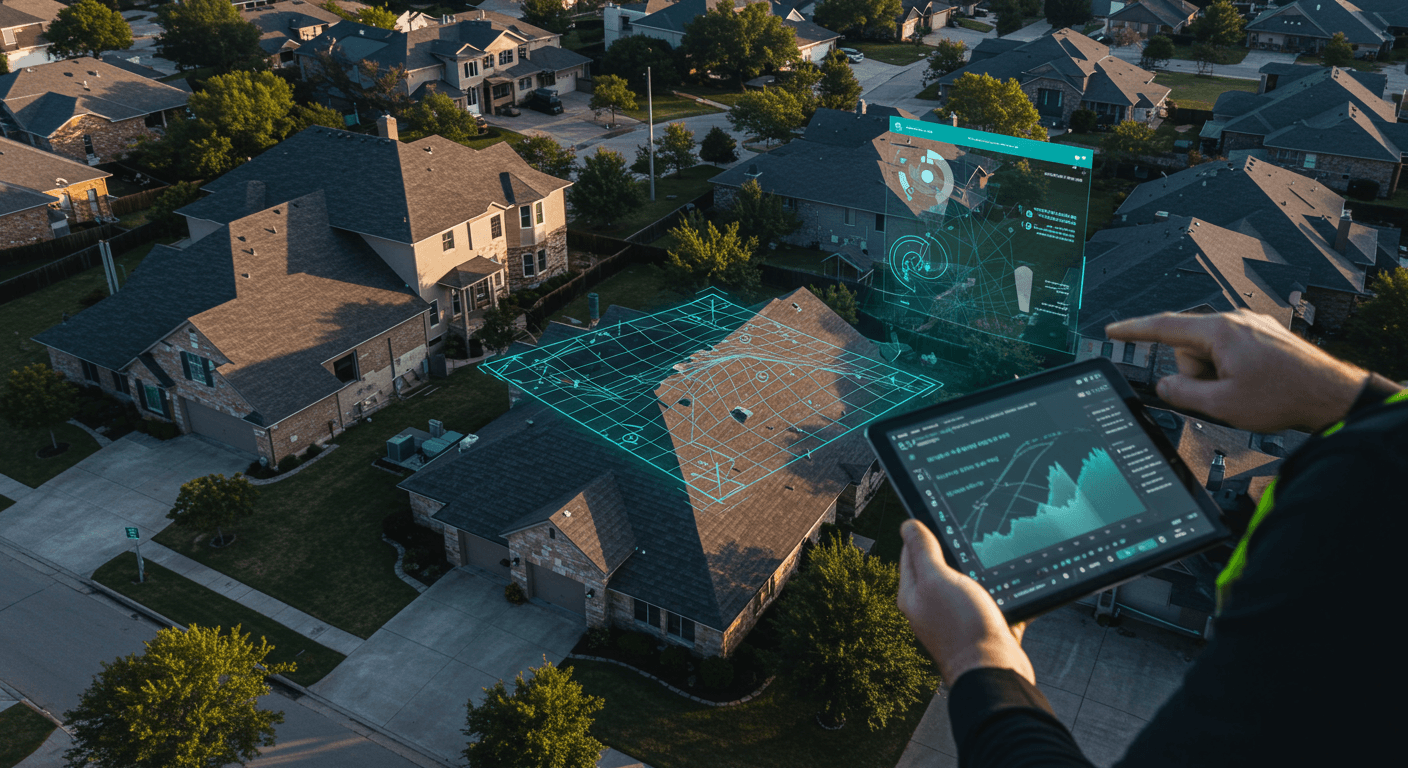
One of the biggest hurdles I hear from owners is the fear of "missing something" on the roof. They worry that a virtual measurement will miss a rotted deck or a weird flashing detail. This is where modern technology has closed the gap. High-resolution aerial imagery now provides sub-inch accuracy, often more reliable than a tired rep with a tape measure on a 10/12 pitch.
Training your team to use these tools is a professional standard that pays dividends. Organizations like the National Center for Construction Education (NCCER) emphasize the importance of standardized training for accuracy and safety. When your reps are trained to interpret digital roof reports, they appear more professional to the homeowner. It changes the dynamic from "a guy with a truck" to "a technology-driven solutions provider."
If you are curious about how to feed this new digital engine, understanding the lead flow is the next step. Most contractors struggle with virtual sales because their leads are junk. When you have verified leads with locked previews, your reps can see the roof and the job details before they even pick up the phone. This transparency is what makes the virtual model profitable.
Tactical Implementation: The $9,400 Pivot
Let's look at the actual implementation costs. Switching to a virtual model is not free, but the ROI is usually realized within the first 75 days. You will need a high-quality screen-sharing platform, a premium satellite imagery subscription, and potentially a CRM upgrade. For a five-person sales team, these tools might cost $1,100 a month.
Compare that to the savings. If those five reps stop driving 400 miles a week each, you are saving roughly $1,340 in fuel and maintenance alone across the team. More importantly, you gain back approximately 15 hours of "active selling time" per rep, per week. At a modest $500 profit per square, that extra time can translate to an additional $8,400 to $12,700 in monthly revenue per rep.
The 15-Minute 'Pre-Flight' Rule
"Before every virtual presentation, have your rep spend 15 minutes analyzing the satellite imagery for nearby obstructions, access points, and solar panels. Mentioning these specific details early in the call proves to the Fort Worth homeowner that you have 'done your homework' on their specific property, even if you are not standing on their driveway."
Handling the "I Need to See You" Objection
You will inevitably run into a homeowner in Tanglewood or Southlake who insists on an in-person meeting. This is not a failure of the system, it is a segment of the market. The goal of a virtual model is not to eliminate human contact, but to prioritize it.
When a lead insists on a visit, we use it as a closing tool. Gavin started using a script that sounded like this: "Mr. Homeowner, I can certainly come out. However, I've already pulled the 3D imagery of your roof and prepared three different material options. If we hop on a 15-minute Zoom now, I can show you exactly where your leaks are likely starting. If it looks like a fit, I'll head over tomorrow to finalize the color selection and sign the paperwork."
This approach flips the script. The virtual meeting becomes the "expert consultation," and the physical visit becomes the "finalizing step." It ensures that by the time you are burning gas to drive to Benbrook, you are going there to pick up a check, not to beg for a job.
Common Questions
If your current sales process feels like it is stuck in a traffic jam on I-35, it might be time to audit your overhead. The transition to a more efficient model starts with better data and better leads. If you have questions about how to optimize your funnel for this kind of volume, our team can help you look at the frequently asked questions regarding lead quality and exclusivity.
The roofing landscape in Texas is changing. The companies that will be around in 10 years are the ones that treat their sales process like a manufacturing line, focusing on every cent of operational waste. If you want to discuss how to apply these numbers to your specific zip codes, you can always reach out to us directly to talk strategy.