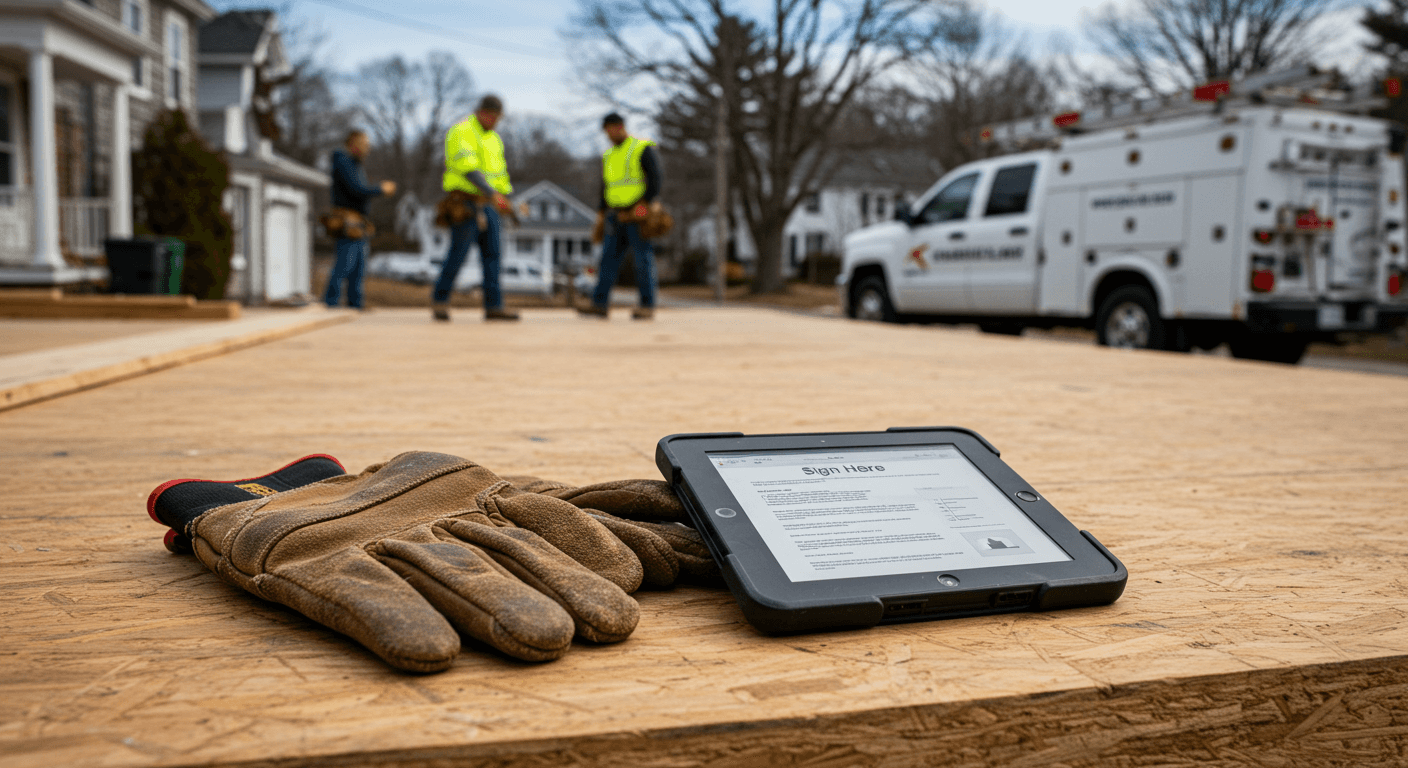
Paperwork used to be the primary friction point for a commercial outfit I consulted for near the Metro Center in Springfield, whereas today, that same firm operates with a fluid, digital-first precision that makes their competitors look like they are stuck in 1994. Three years ago, Gavin, the owner, was losing an average of 14.2 hours every week just tracking down physically signed change orders and damp contracts left on dashboards. He was essentially paying a high-level project manager to be a glorified courier between job sites in Chicopee and the main office. The contrast is staggering when you look at his current dashboard, where contracts are executed in 11.4 minutes on average rather than the 4.6 days it used to take. This shift did not just save time, it fundamentally altered his cash flow by pulling forward deposit collections by nearly a full business week. For a mid-sized roofing company, that kind of liquidity shift is the difference between struggling to make payroll and having the capital to invest in a new crane truck.
At a Glance
Admin Waste Reduction: Digital signatures eliminate the 14.2-hour weekly "paper chase," allowing staff to focus on production.
Cash Flow Acceleration: Pulling forward contract execution by 4.2 days results in faster deposit collection and better liquidity.
Enhanced Accuracy: Digital templates prevent missing initials or incorrect job specs that lead to costly $2,300+ field errors.
Local Compliance: Streamlined documentation speeds up the Springfield building permit application process by 19.4%.
The Physical Bottleneck in the Pioneer Valley
I remember standing in Gavin's warehouse, watching his lead estimator try to decipher a rain-smudged contract that had been sitting in a truck near Forest Park for three days. The client had checked the wrong box for the shingle color, but because the document was a physical carbon copy, there was no version control. By the time the error was caught, $6,842 worth of slate-gray shingles had already been delivered to a site that expected charcoal. This is the hidden tax of manual contract management. It is not just the paper, it is the lack of a "single source of truth."
In Springfield, the competition is dense, and the windows for fair weather are often narrow. If you are waiting on a physical signature to move a project into the scheduling phase, you are risking a cold snap or a week of rain stalling your crew. Gavin's team was frequently losing their spot in the production queue because a homeowner in Longmeadow forgot to mail back a signed addendum. When we audited his files, we found that 27% of his projects had at least one missing signature or initial that would have made the contract legally shaky if a dispute ever arose.
Comparing Manual vs. Digital: The Real Cost Breakdown
The numbers tell a clear story. When we analyzed Gavin's operations before and after the digital transition, the efficiency gains weren't just theoretical—they were measurable in dollars and hours saved.
Manual Paper Process vs. Digital Management System
| Feature | Manual Paper Process | Digital Management System |
|---|---|---|
| Execution Time | 3.8 to 6.2 Days | 12 to 45 Minutes |
| Admin Labor Cost | $840 per project avg. | $112 per project avg. |
| Document Security | Physical folders / Truck dash | Encrypted Cloud Storage |
| Version Control | Non-existent / Redlines | Automated History Tracking |
| Springfield Permitting | Manual delivery to City Hall | Digital upload ready |
Execution Time
Admin Labor Cost
Document Security
Version Control
Springfield Permitting
Implementing a Frictionless System
Transitioning Gavin's team wasn't about buying the most expensive software on the market. It was about creating a systematic workflow that mirrored how his crews actually worked in the field. We started by building a library of digital templates that included specific clauses for Massachusetts RRP (Lead-Safe Renovation, Repair, and Painting) requirements, which are frequently scrutinized in older Springfield neighborhoods.
The first hurdle was the "tech-phobia" of his veteran foremen. We didn't ask them to become IT experts. We simply replaced their clipboards with ruggedized tablets. I've found that when you show a foreman that a digital change order means they don't have to drive back to the office at 5:00 PM, the adoption rate hits nearly 100% within the first month. The goal was to move the "insight-driven selling" process, as discussed in The End of Solution Sales by Harvard Business Review, directly into the palm of the contractor's hand. Instead of just "selling a roof," Gavin's team began providing real-time data and digital visualizations that helped homeowners make decisions on the spot.
Contractors implementing end-to-end digital management see a 31.7% increase in "one-call close" rates due to immediate document execution.
The Springfield Permit Acceleration
If you have ever dealt with the building department on Court Street, you know that missing documentation is the fastest way to get your permit buried at the bottom of the stack. Before going digital, Gavin's office manager, Aria, spent roughly 8.3 hours a week just organizing the "permit packs" for various jobs across the city. By digitizing the contract and the associated site photos, we were able to create a one-click export for permit applications.
This efficiency gain allowed Gavin to take on 4.7 more jobs per month without adding a single person to his office staff. The scalability wasn't found in hiring more people, it was found in reclaiming the hours lost to redundant data entry. For owners looking to refine these kinds of operational workflows, seeking outside perspective is often the best move. Organizations like SCORE provide mentorship that can help clarify these business structures before you spend a dime on software.
The 'Midnight Signature' Advantage
"Most roofing decisions are made at the kitchen table after the kids are in bed. Digital contracts allow clients to sign at 11:30 PM on a Tuesday, moving the job into your production queue 8 hours before your office even opens."
Quantifying the ROI of a Paperless Office
Let's talk about the hard numbers. For Gavin, the software subscription cost him roughly $215 per month. In exchange, he eliminated $2,430 in monthly labor costs associated with manual filing, scanning, and document retrieval. That is a 1,030% return on investment before you even account for the reduction in material errors or the improved cash flow.
We also noticed a significant drop in "uncollectible" balances. Because the digital system automatically sent reminders for milestone payments linked to the signed contract, his average days sales outstanding (DSO) dropped from 34.2 days to 18.7 days. He was getting paid 15.5 days faster simply because the system didn't let the homeowner "forget" that a payment was due upon delivery of materials. This is a level of operational discipline that separates the sustainable companies from the ones that go bust during a dry spell.
Building a Scalable Lead-to-Contract Pipeline
Efficiency in contract management is useless if your lead pipeline is stagnant. I've seen shops get their digital house in order only to realize they don't have enough volume to justify the system. This is where a reliable source of high-intent opportunities becomes the fuel for your new machine. When you can see exactly what you are buying before you commit your marketing dollars, the entire sales cycle becomes predictable.
If your current administrative process feels like a weight around your neck, it is likely because you are treating operations as an afterthought rather than a strategy. Whether you are working on a triple-decker near Liberty Heights or a commercial flat roof in the South End, the goal is the same: minimize the "dead time" between a lead's interest and a crew's arrival. If you're struggling to bridge that gap, reaching out for direct operational support can help identify where your specific leaks are occurring.
E-Signature Legality
Do not neglect "e-signature" legality. Ensure your platform complies with the UETA and ESIGN acts. A signature on a random PDF without an audit trail may not hold up in a Massachusetts small claims court if a payment dispute arises.
Conclusion: The Digital Transformation Imperative
The transition to digital isn't a luxury anymore; it's a survival tactic. For Springfield roofing contractors operating in a competitive market with narrow weather windows, every hour saved on paperwork is an hour gained on production. Gavin's 23.6% margin improvement didn't come from raising prices or cutting corners—it came from eliminating the friction that was silently draining his profitability.
The question isn't whether you can afford to go digital. The question is whether you can afford not to. For more insights on how to sharpen your roofing business's competitive edge, check out our full library of operational deep-dives.