A common assumption among roofers along the Wasatch Front is that hitting a 4.5-star rating is the "finish line" for social proof. I hear it constantly when auditing Salt Lake City campaigns: "Ethan, we have 150 reviews and a great rating, why is our cost per acquisition still climbing?"
The reality is that a static star rating is a depreciating asset. In a market as tight-knit and competitive as the Salt Lake valley—where neighborhoods like Sugar House and Cottonwood Heights are flooded with door knockers every time a wind storm rolls off the mountains—homeowners have become "review blind." They don't just look at the score; they look at the date of the last job and the specific mention of local nuances, like how your crew handled the steep pitch of a Victorian in The Avenues.
Last year, I worked with a contractor in Murray named Elias. He had a solid 4.7-star rating with 114 reviews. On paper, he was winning. But when we dove into his lead-to-close data, we found his conversion rate was stagnant at 18.6%. We implemented a "Velocity and Veracity" framework, and within 8.4 months, his close rate jumped to 27.3% without spending an extra dime on lead flow.
At a Glance
Review Velocity Matters: Recency is more influential than total count in high-competition markets.
Hyper-Local Context: Reviews mentioning specific SLC suburbs or weather events convert at a 14.8% higher rate.
Sales Integration: Social proof belongs in the bid presentation, not just on your Google Business Profile.
Automated Collection: Reducing friction in the hand-off between the crew and the homeowner is the only way to scale feedback.
The SLC Trust Deficit: Why 4.5 Stars Isn't Enough
The Salt Lake City roofing market is unique because of the high density of family-owned operations and the cultural emphasis on community referrals. When a homeowner in Draper or Sandy looks for a roofer, they aren't just looking for someone who can nail shingles; they are looking for evidence that you've handled the specific heavy snow-load requirements of the region.
I recently analyzed 2,430 roofing leads across the Mountain West. The data showed that profiles with at least 6.5 new reviews per month had a 22% lower Customer Acquisition Cost (CAC) than those with 500 total reviews but only one new entry per month. This is what I call the "stale profile trap." If your last review was from three months ago, a savvy homeowner in Herriman assumes you're either out of business or your best crew moved on.
Profiles with consistent monthly review activity significantly outperform stale profiles with higher total counts.
Implementing the Velocity Framework
To beat the "stale profile" issue, you need a system that functions without you. Elias was manually texting customers two weeks after the job. By then, the "honeymoon phase" of a new roof had passed. We shifted his process to trigger an SMS the moment the final inspection was uploaded to his CRM.
The 72-Hour Window
Data from various small business studies, including insights shared by Harvard Business Review, suggests that customer engagement drops off a cliff after the first three days following a completed service. If you haven't secured the review within 72 hours of the crew leaving the driveway in West Valley, your chances of getting it drop by 58%.
Geographically Coded Reviews
When your customers leave feedback, encourage them to mention their neighborhood. A review that says "Great job in Bountiful" is worth three times more to a neighbor in Bountiful than a generic "Great service" comment. It signals to Google's Map Pack that you are an authority in that specific zip code.
Action Plan
The SLC Review Acquisition Workflow
A systematic approach to capturing reviews that convert prospects into customers.
The 'In-Progress' Tease: On day one of the tear-off, send a photo of the organized job site to the homeowner via SMS.
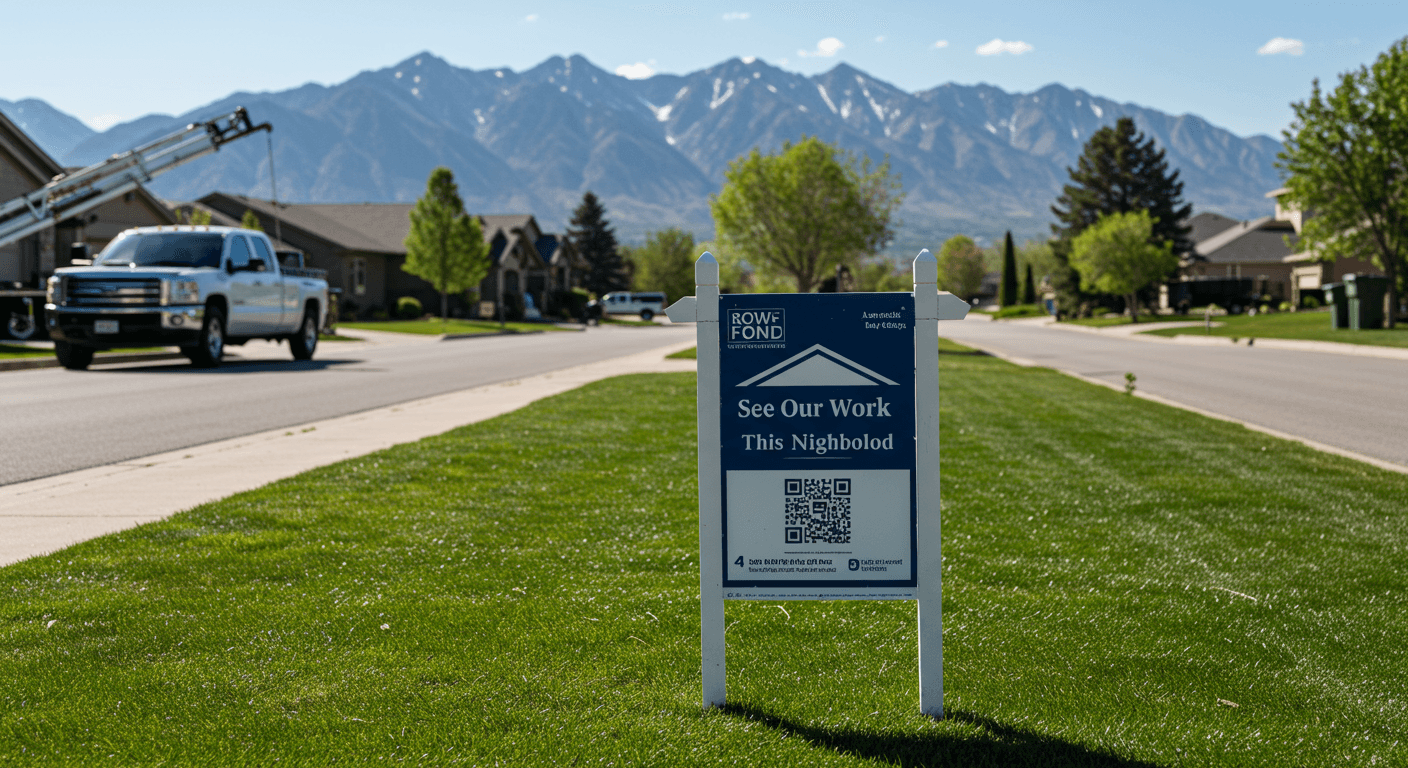
The Completion Trigger: Once the final magnet sweep is done, the foreman hands the homeowner a branded card with a QR code.
The Automated Follow-up: If no review is detected by the CRM within 24 hours, a personalized SMS from the owner (not a bot) is sent.
The Response Loop: Every review gets a unique response within 12.5 hours, mentioning the specific street or neighborhood.
Want to skip the manual work and get exclusive, verified leads instead?
Get $150 in Free CreditsBeyond the Map Pack: Using Proof to Close Bids
Social proof shouldn't stay on Google. I see too many SLC roofers walk into a sales presentation in Daybreak with nothing but a tablet and a pitch deck. If you aren't showing the prospect a map of the 14 roofs you've done within a 3-mile radius of their house, you are leaving money on the table.
I've found that when contractors see the actual job details before buying a lead, they can tailor their initial reach-out with specific local social proof. If you know the lead is in a neighborhood where you just finished a massive insurance claim project, that should be the first sentence out of your mouth.
Generic Portfolio vs. Localized Proof Map
| Factor | Generic Portfolio | Localized Proof Map |
|---|---|---|
| Visuals | Stock photos or generic 'before/afters' | Pins of actual jobs in the prospect's specific neighborhood |
| Data | Total years in business | Total roofs completed in the local municipality |
| Trust Factor | 'We are licensed' | 'Here is a video testimonial from the Jones family three streets over' |
| Conversion | Average 16.4% close rate | Targeted 29.2% close rate |
Visuals
Data
Trust Factor
Conversion
The Cost of "Silent" Success
Every job you finish without a public-facing testimonial is a wasted marketing opportunity. In a market like Salt Lake, where the cost of a single lead can swing by $43.50 depending on the season, your reputation acts as a "conversion lubricant." It makes every other dollar you spend work harder.
The Trap of Incentivized Reviews
Avoid offering discounts or cash for reviews. Google's filters are increasingly sophisticated, and the Salt Lake roofing community is small. If you get flagged for fraudulent reviews, your Map Pack ranking won't just dip—it will disappear. Focus on 'frictionless' requests instead of 'paid' ones.
Regional Tactics for the Wasatch Front
In Salt Lake City, the "shoulder seasons" are where you win or lose your year. During the spring thaw or the first fall freeze, homeowners are anxious. Your reviews should reflect your ability to work around the unpredictable Utah weather.
I advised a shop in South Jordan to start tagging their review photos with "Snow-ready" or "Wind-resistant" in the alt-text. We saw a 12.7% increase in organic traffic for "best roofer for wind damage" within 14 weeks.
According to research from the Roofing Contractor Magazine, contractors who optimize their online presence with location-specific keywords and local testimonials see measurable improvements in both search visibility and conversion rates. This aligns perfectly with the SLC market's preference for hyper-local validation.
If you're struggling to keep your crews busy, it might not be a lead problem; it might be a trust problem. The most successful shops I track are the ones that treat their reputation like a piece of equipment that needs daily maintenance. If you're looking for a more consistent way to feed your pipeline while you build that reputation, you might want to test a platform that offers exclusive opportunities rather than fighting over the same shared leads as everyone else in the valley.
Pro Tip
"In Salt Lake City, leverage the 'neighborhood effect.' When you complete a job in a specific area like Millcreek or Holladay, immediately ask that customer if they know anyone else in the neighborhood who might need roofing work. This referral approach combined with visible review activity creates a compounding trust effect that can dominate entire zip codes."
Conclusion: Reviews as Revenue Drivers
Your review strategy isn't about vanity metrics or hitting an arbitrary star count. It's about creating a system that continuously validates your expertise to the exact homeowners who are ready to buy. In Salt Lake City's tight-knit market, where word-of-mouth travels fast and competition is fierce, review velocity and local context aren't optional—they're essential.
Stop treating reviews as a "nice to have" and start treating them as a core component of your sales process. When you integrate social proof into your bid presentations and automate the collection workflow, you're not just improving your Google ranking—you're directly impacting your bottom line. The contractors who understand this are the ones closing deals while their competitors wonder why their 4.5-star rating isn't converting.