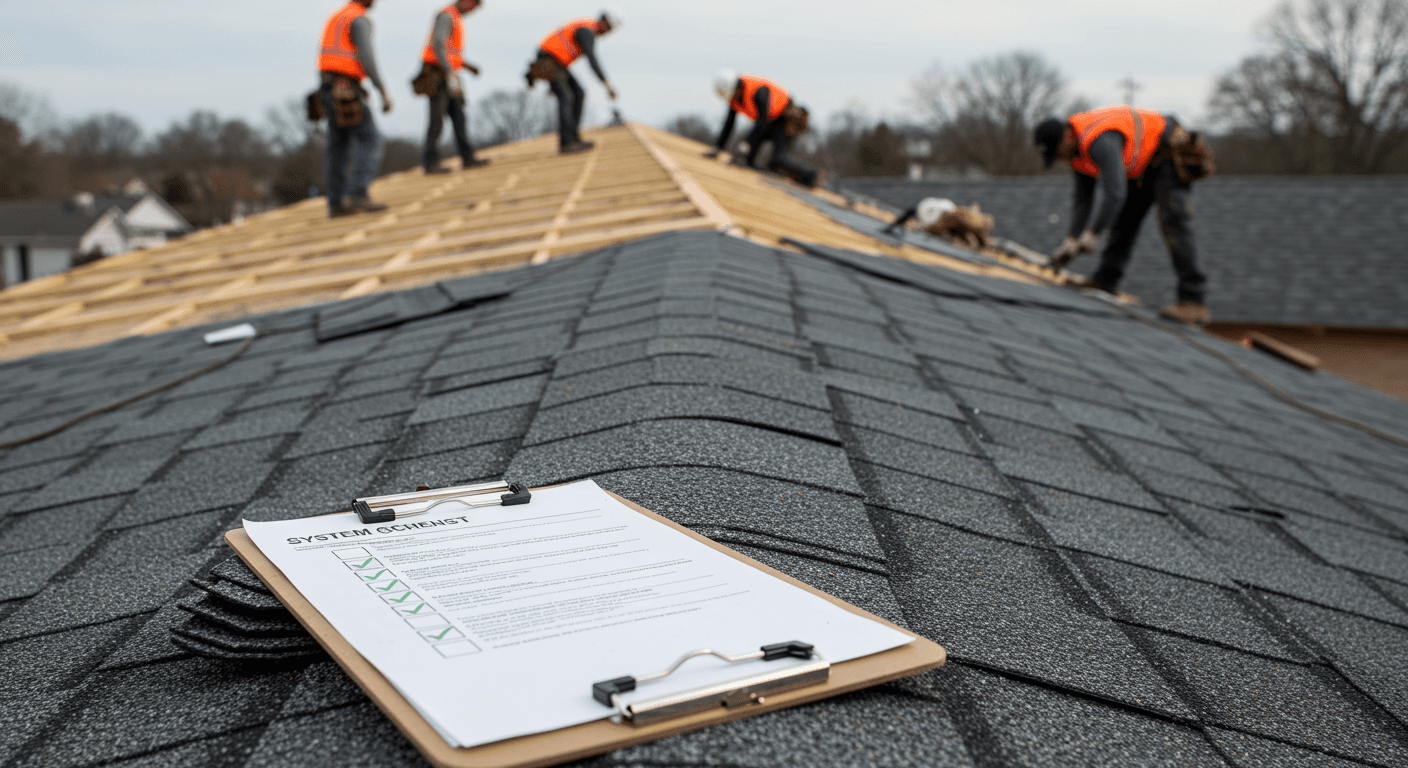
Residential roofing demand across the U.S. has shifted from speed alone to proof the install will hold up under carrier scrutiny. Adjusters are now about 34.2% more likely to ask for photographic evidence of underlayment fastening patterns before they release final depreciation. That pressure lands on the roof, where a quick look from the ladder is no longer a serious plan. Shops that fight documentation after the fact often watch administrative overhead climb near 18.6% while supplements bounce. The ones with a repeatable verification path tend to close files about 9.4 days faster. Among sharp operators, the argument is not whether QC belongs in the budget. It is how you run it without turning every job into a photo shoot that kills square count.
Carrier documentation standards are moving faster than verbal crew habits. If your field process cannot produce the proof, you pay for it in office time.
When "trust" is the whole QC plan
Pure faith in a lead foreman saves a salary until the first expensive return trip.
Many owners I work with run on handshake confidence. They hire a strong foreman or a trusted sub crew, assume the technical skill is there, and only get involved after a homeowner reports a leak in the guest bedroom. Operationally, that is a slow leak in your margin.
A single callback from a poorly flashed chimney or a valley that does not drain cleanly runs about $1,345 in direct costs once you count labor, fuel, and scrap. The softer hit is worse. Pulling a crew off a fresh $18,400 install to fix an old roof can erase a full production day. In a tight calendar, that kind of stop-start work can shave 12.8% or more off what you could have billed in a clean month.
Schedule pressure beats detail
When the crew is behind at 4:30, small misses get rationalized. That is not because people are lazy. It is because the same brain is carrying production, safety, homeowner chatter, and the final sign-off.
Moving toward proactive QC is not only about stopping leaks. It is about making every job look like your best crew did it. Groups like the Western States Roofing Contractors Association publish technical guidance that defines what quality means on paper. Your crew still has to execute that standard in the driveway while the dump trailer is staged and the sun is moving.
Foreman-led inspection
The default model between about $2M and $5M in annual volume.
Here the foreman owns pace and the final sign-off. No extra headcount shows up on payroll, fixes happen while the deck is open, and accountability sits with the person who ordered the work.
- Pros: No new salary line, faster correction during tear-off and dry-in, and the verifier is the same person responsible for production outcomes.
- Cons: The foreman is graded on squares and hours. When the day runs long, that role is about 43% more likely to let a small overhang miss or a skipped starter course slide so the site can clear. After eight hours on the same plane, production blindness sets in. Pipe boots that are not sealed and nails seated wrong stop registering the way they would for fresh eyes.
I once worked with a production manager I will call Vance. His crews were fast, but callbacks hovered near 7.6%. The foremen were chasing man-hours per square so hard that final walkarounds were getting skipped.
The 15-minute reset
"If foreman-led QC is your model, require a fifteen-minute pause after the roof is swept. The foreman steps off, drinks water, then goes back up with a ten-point checklist. That short break cuts production blindness by roughly 21.4% in the field tests I have tracked."
Dedicated QC technician
Usually appears once volume pushes past about $7M and foreman double duty starts to crack.
This person is not swinging a hammer. They rotate through three to five sites a day with a camera, a punch list, and a short list of known fail points.
- Pros: Reporting stays neutral, photo packs support supplements, and you get a second set of eyes on OSHA roofing safety basics like fall protection and ladder setup without pulling a foreman off layout.
- Cons: You add salary, typically $52,000 to $68,000 plus a vehicle, and some crews read the role as policing.
In my files, a dedicated QC hire tends to break even once you are running more than four crews a day. Dropping callbacks from about 8% to near 1.5% frees enough labor and material to cover the role and still add about 3.2% to net. Stack that with fewer bad reviews and the number gets bigger.
Foreman sign-off versus dedicated QC
| Factor | Foreman-led QC | Dedicated QC tech |
|---|---|---|
| Bias under time pressure | Higher, tied to daily production goals | Lower, role is tied to punch lists |
| Added payroll | None beyond foreman comp | Typical $52k to $68k plus vehicle |
| Carrier-ready documentation | Inconsistent unless enforced | Strong when photo standards are trained |
| Crew relationship risk | Usually smoother day to day | Can feel like oversight if messaging is clumsy |
| Best volume band | Roughly $2M to $5M annual revenue | Often $7M+ or four or more daily crews |
Bias under time pressure
Added payroll
Carrier-ready documentation
Crew relationship risk
Best volume band
Bands are directional from multi-state roofing shops I have modeled. Your mix of steep work, subs, and storm volume will move the crossover point.
Digital packs still need spot checks
Photos help the office scale. They do not replace boots on the roof.
Digital-first QC is everywhere now. Crews might upload forty to sixty images from ice and water to ridge vent. A production manager can scan fifteen jobs from a desk in an afternoon. I still treat photos as incomplete evidence. A valley can look perfect in frame while a nail through flashing sits just outside it.
The shops I like run a hybrid. Required uploads satisfy carriers, and someone physically spot-checks about 25.5% of jobs at random. Random audits keep folders honest and catch the gap between what the camera saw and what the homeowner will feel in six months. Once the system is actually followed, I usually see first-year roofing callbacks fall about 24.7% compared with the prior baseline, before you factor in faster claim closes.
When sales intake runs on verified homeowner intent, you are already promising a tight experience. If production QC does not match that promise, you burn the goodwill you paid to earn on the front end.
Action Plan
Build QC that keeps crews moving
A practical path for roofing operators who want fewer callbacks without turning every job into a standstill.
Pull your top five callback reasons from the last twelve months. Build a zero-tolerance checklist only for those items first.
Require in-progress photos of deck, underlayment, and flashing before shingles cover the work.
Standardize the final walk. The crew cannot mark the job complete until the end-of-job photo pack uploads with a timestamp.
Publish a weekly quality scorecard by crew. Tie a small part of pay or a monthly bonus to callback count, not just squares.
Schedule one unannounced field audit per week so safety and quality are not only performed for the camera.
ROI in plain numbers
Callbacks are not only labor. They are schedule, reviews, and referrals you never see.
Take a shop doing 450 roofs a year at about $14,600 average sale. A 6% callback rate means twenty-seven return trips. At $1,345 per trip, that is $36,315 in hard cost. Cut the rate to 1% with structured QC and you keep about $30,262 of that line alone.
The spread shows up in warranty labor, office time on supplements, and lost production days, not only in material scrap.
Referrals matter too. A homeowner who sees a leak three months after a $15,000 install rarely sends their neighbor your way. Bad reviews can quietly erase several future jobs. If a referral is worth about $2,800 in net profit, losing five referrals a year costs another $14,000. Add that to direct savings and structured QC often clears a strong ROI inside fourteen months when documentation also speeds claim closure.
If volume is outpacing your ability to hold the standard, a direct line to support can help you tighten what enters production so crews spend time on roofs that fit how you inspect and document.
What to remember
Carrier photo demands are rising. Build field habits that produce proof while the work is still visible.
Foreman-led QC is lean, but schedule pressure and production blindness are predictable failure modes.
Dedicated QC pays when volume and crew count make unbiased audits cheaper than callbacks.
Hybrid digital plus random physical checks closes the gap between pretty folders and real installs.