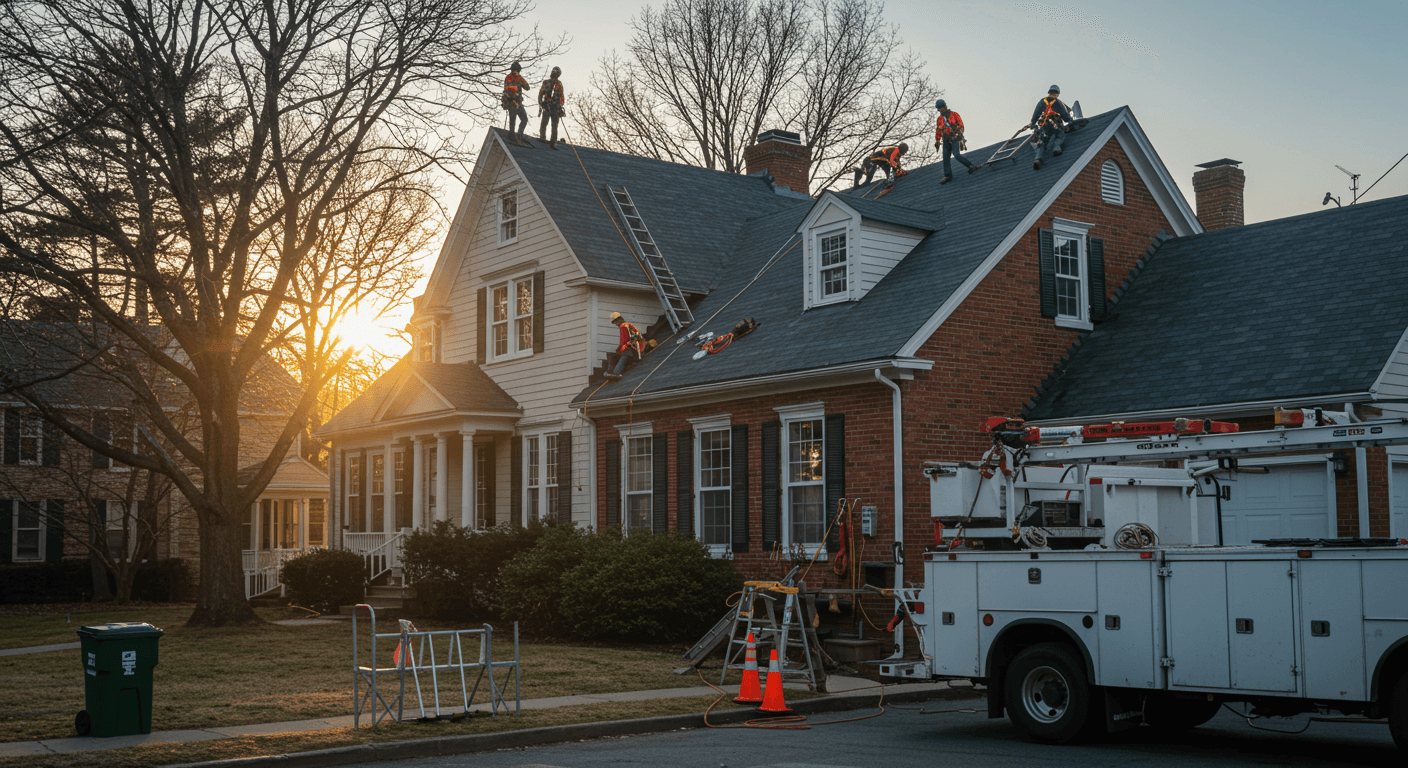
Most Pennsylvania owners do not model the real choice: eat a steep workers' comp experience modification move, or fund fall-arrest systems up front. The comparison that stings is a roughly $24,750 hardware and training outlay versus carrying a mod that adds a third to your comp bill while you hope nobody falls. Scaling around Allentown or Harrisburg is not only about federal minimums. It is the trade between production speed and how much liability you are willing to wear on the P&L.
Waiting for a near-miss to rewrite the field rules is how shops quietly give up about 12.4% of net margin across a three-year cycle. Running crews on steep stock without an audited safety system is not neutral. It is a decision that drags valuation, bids, and renewals in the wrong direction.
At 1.0 you are average. Above that you are funding mistakes you already made. In PA roofing, that spread can clear fifty grand a year before you buy a single bundle.
What safety actually does to the P&L
Lower EMR pulls workers' comp premiums down over time, often in the mid-teens to low twenties on percentage terms once the three-year window turns over.
Written, enforced standards help retention because good roofers gravitate toward shops that do not gamble with their knees or their paychecks.
Consistent field discipline screens out trunk-slammer pricing wars in tight Pennsylvania markets where the low bid is usually hiding bad habits.
Northeast carriers will sometimes credit premium when training is documented, not just promised in a binder.
The math of a single misstep
Revenue can grow while net margin shrinks if claims chase the mod.
I recently walked the books with a contractor in Lancaster I will call Finn. Top line moved from $1.8 million to $4.2 million in twenty-six months. Net margin did not follow. The trail was small comp claims, a few near-recordables, and an experience mod that looked more like a penalty box than a scorecard.
Finn landed at 1.43. In plain English, that is a forty-three percent surcharge on workers' compensation on top of already stiff Pennsylvania roofing class rates. The annual swing was about $53,400 straight off profit because safety meetings were treated like stolen production minutes.
Paperwork feels like overhead until it is the only thing standing between you and a willful citation. If your foremen already live on a mobile workflow for job photos and notes, tacking on a short safety checklist is usually under two minutes. That is cheaper than funding an OSHA conversation from a glovebox manual nobody opened.
Manual on the shelf versus program in the field
| Control point | Binder culture | Operating rhythm |
|---|---|---|
| Daily proof | Signed forms filled out at the yard Friday afternoon | Time-stamped photos from the actual deck that morning |
| Anchor documentation | Generic sketch that never matches the row house next door | Job-specific anchor map tied to the lift path and ladder plan |
| Training | One slideshow when someone gets hired | Competency sign-off on your exact harness and lifeline kit |
| Carrier story | We care about safety verbal promise | Logbook the auditor can read without a translator |
Daily proof
Anchor documentation
Training
Carrier story
Why Pennsylvania rules are only the floor
Federal OSHA applies statewide, but local enforcement has teeth.
Pennsylvania does not run its own state plan, so federal OSHA is the baseline. That does not mean inspections feel distant. Philadelphia and Pittsburgh crews see aggressive walk-ons, and I have watched Poconos jobs get red-tagged when harnesses were on bodies but anchor points were not documented to OSHA roofing fall protection guidance.
Six feet is the federal trigger. A two-story colonial in West Chester clears it before lunch. Checking boxes is not the same as planning for how PA actually behaves on a roof.
- Slate and historic districts: steep, fragile decks need different footwork and edge protection than a tract home tear-off.
- Frost and shoulder season: synthetic underlayment with morning frost is a traction problem generic manuals rarely address.
- Tight Philadelphia rows: ladder angles, sidewalk protection, and material staging need a plan, not a paragraph on page forty.
The 42-minute Monday rule
"Block 42 minutes before trucks roll for a site-specific huddle. Skip the script reading. Walk the actual property in your mind with the crew: overhead lines, brittle skylights, frost in the valley, where the lift will sit. Shops that do this cut incident frequency meaningfully compared with generic toolbox talk theater."
Culture that does not tax the job
Safety framed as elite performance lands better than safety framed as nagging.
Plenty of crews see a harness as a leash. Flip the story: pros preplan anchors the way they preplan valleys. I worked with an Erie owner, Yara, who tied quarterly bonuses to a zero-incident scorecard tied to both injuries and dumb equipment damage. The bonus pool was $15,000 a year. The premium reduction on the other side of better behavior was $39,600.
She also bought lighter harnesses and respirators that did not fight the crew on a ninety-degree tear-off. Comfortable gear gets worn. Heavy junk gets "forgotten" on the ground.
The "paper safety" trap
A thick binder does not stop a five-figure willful fine if your foreman cannot produce today's inspection log. Auditors look for active enforcement, not a label on a spine. If nobody can show what happened before boots hit the ladder, you are holding expensive kindling.
The 1.0 mod barrier and your market
Commercial buyers read EMR before they read your pitch.
Experience modification is a three-year rolling average. A bad season does not age out next quarter. It lingers for 1,095 days of renewals and prequalification forms.
If you want multi-family or GC work in Pennsylvania, a bloated EMR gets you cut before pricing. Plenty of commercial teams will not entertain roofers north of 1.0. Ignore safety and you are not only risking injury. You are shrinking the work you are even allowed to chase.
Technical references still help even when the association name says West. The Western States Roofing Contractors Association publishes steep-slope detail and safety thinking that translates directly to high-end PA work where pitch and exposure punish shortcuts.
Clean sites and tethered crews also read as premium on the curb. Homeowners on the Main Line notice rigging, housekeeping, and PPE. That is how you defend gross margin when the neighbor's quote came from a two-truck outfit with nothing tied off.
Training past the first shingle course
Onboarding sets the safety tone for every future Monday.
One-and-done orientation is how rookies learn bad habits from whoever talks loudest on the crew. New hires should not touch production until they pass a competency check on your exact fall-arrest setup, not a generic video from 2014.
Across more than eighty roofing companies in my data, crews with at least twelve hours of structured safety onboarding were roughly nineteen percent more efficient in month one than crews thrown straight onto a steep deck. They hesitate less because they trust the equipment and the sequence.
Action Plan
Twelve weeks to a margin-protecting safety rhythm
A practical path for PA shops that need insurance relief without turning every job into a standstill.
Pull three years of workers' comp loss runs and carrier correspondence so you know the real EMR story, not the number you remember.
Replace tired lanyards and bulky harnesses with ergonomic kits your lead installers will actually keep on past 2:00 p.m.
Require three morning photos per job: ladder placement, anchors, crew tied off. Store them where the office can see them the same day.
Attach a modest cash or gear bonus to clean scorecards so the field links safety to money, not lectures.
Book a quarterly third-party site audit. Surprise visits cost less than a single serious citation.
Review results with ownership monthly until the behavior sticks, then drop to a lean quarterly review.
Implementation checkpoints
Labor is tight in the Northeast. Losing a lead installer hurts twice.
A serious claim is not only medical bills. It is fifteen to twenty owner hours a week on adjusters, lawyers, and rework while the schedule backs up.
If volume is thin, expensive safety programs feel impossible. Often the real issue is job mix, not crew willingness. When you preview verified roofing jobs with locked scope detail before you dispatch, you can align rigging time, margin, and crew skill instead of chasing random tire-kickers that force shortcuts.
Shops in Scranton and Bethlehem have tightened liability profiles simply by moving checklists off clipboards and into shared systems. When foremen know the office sees the same photos they do, accountability stops being a speech and starts being a habit.