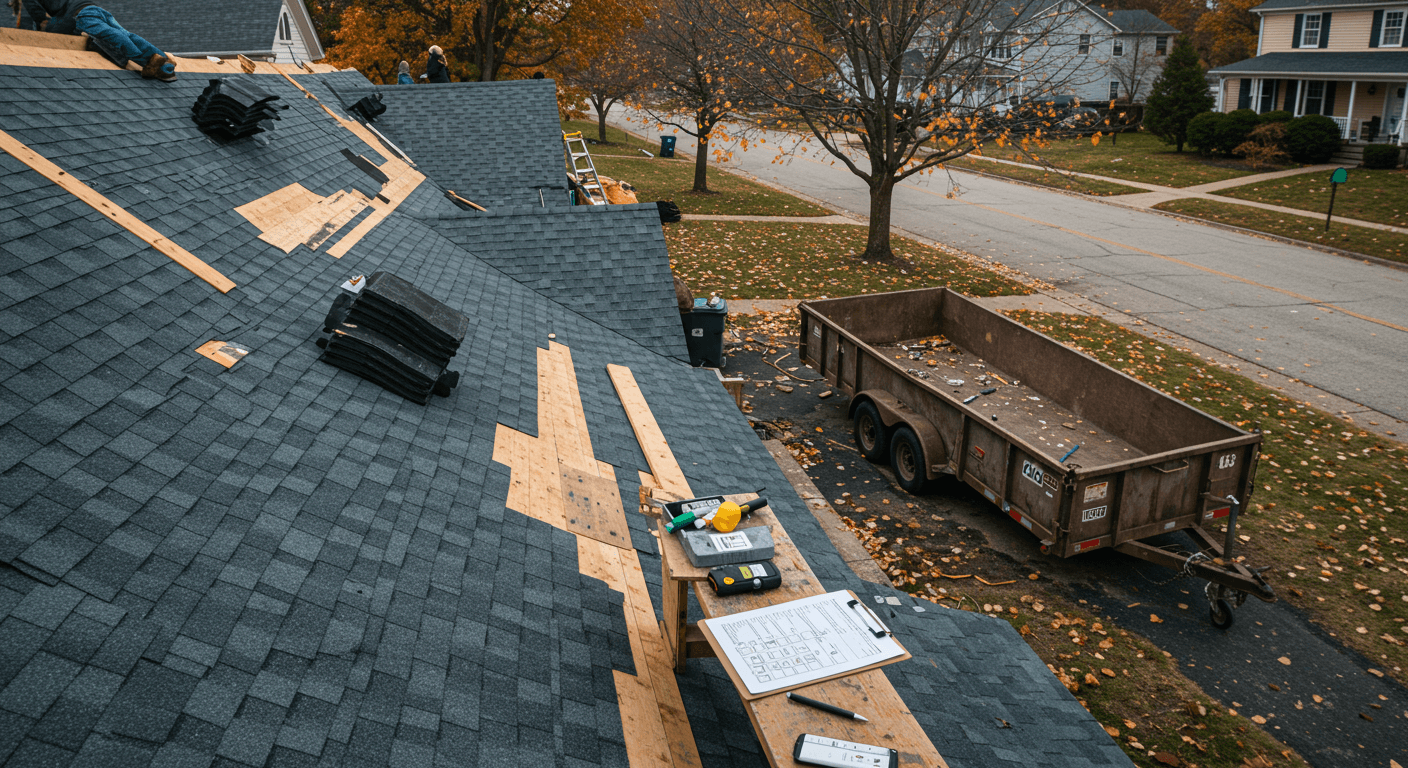
Standing near a pallet of architectural shingles in a Fairlawn driveway, I watched a crew leader shrug when I asked about the step flashing detail on a tricky chimney. The homeowner was already nervous after a leak last winter, and this shrug was costing my client, Jaxon, more than just sleep. Jaxon runs a respectable shop in Akron, but his "mystery box" approach to subcontractor management was bleeding his bank account dry. Every time a crew finished a job in West Akron or Ellet, Jaxon spent roughly four hours of his own time—plus gas and vehicle wear—returning to the site to fix sloppy mistakes his subs should have caught.
We sat down and looked at his production logs. Between the rework, the extra material runs, and the lost opportunity cost of not being out selling new jobs, Jaxon was losing an average of $1,342 per project. In a market like Northeast Ohio, where the season can be cut short by an early lake-effect snowstorm, that kind of operational leakage is the difference between a record year and just breaking even.
Main Points
Management Overhead: Labor-only crews require 38% more field supervision than turnkey subcontractors.
Profit Protection: Implementing a standardized "Photo-Verify" system can reduce warranty callbacks by 22.4% in the first quarter.
Scaling Speed: Transitioning to verified lead sources allows owners to focus on crew quality rather than chasing bad data.
The Akron Subcontractor Landscape: Labor-Only vs. Turnkey
Roofing business owners in the I-77 corridor generally lean toward one of two models. The first is the labor-only sub, where you provide the materials from a local supplier like ABC Supply or Beacon, and the crew provides the muscle. This offers the highest theoretical margin because you aren't paying a markup on the shingles or underlayment. However, the management tax is high. You have to ensure the dumpster arrives at the North Hill job site at 7:30 AM sharp and that the delivery driver doesn't crack the driveway.
The second model is the "Turnkey" or Full-Service subcontractor. They handle the materials, the labor, and often the debris removal. While your per-square cost jumps significantly, your "soft costs"—the time you spend coordinating logistics—plummet. For a growing shop in Akron, choosing between these isn't just about the price of a square; it's about your capacity to manage the chaos.
Calculating the True Cost of Your Crew
When analyzing Jaxon's numbers, we found that his "cheap" labor-only crew was actually his most expensive asset. According to the Bureau of Labor Statistics (BLS), the mean hourly wage for roofers is approximately $26.85, but that doesn't account for the specialized skill of a sub-crew leader. If you are paying a sub $85 a square but spending $400 in your own time to babysit the job, your effective labor cost just skyrocketed.
I've seen shops try to fix this by hiring more in-house production managers, but that adds a heavy layer of fixed payroll. A more efficient route is leveraging technology. Using a specialized mobile app to track job progress in real-time allows you to see the "shingle-to-deck" photos before the crew even leaves the site. This digital oversight turns a labor-only crew into a semi-autonomous unit.
The 72-Hour Retainage Rule
"Never pay out the final 12% of a subcontractor invoice until a 35-point photo inspection is uploaded and verified. This single change eliminates 90% of "missing" drip edge or unpainted vent pipes."
Why Quality Leads Are Your Best Management Tool
It sounds counterintuitive, but your subcontractor problems often start with your lead source. When you're buying low-quality, non-exclusive leads, you're forced to bid tight to win the job. Those razor-thin margins force you to hire the cheapest subs available, creating a cycle of rework and bad reviews.
Contractors who switch to verified, exclusive leads often find they can command a 14.7% higher price point. This extra "fat" in the estimate allows you to hire the elite crews in Summit County—the ones who actually show up in branded trucks and respect the homeowner's landscaping. When your lead flow is consistent and high-quality, you have the leverage to demand higher standards from your subs.
Labor-Only vs. Turnkey Subcontractor Models
| Factor | Labor-Only Model | Turnkey Model |
|---|---|---|
| Material Control | You purchase and coordinate all materials | Sub handles material procurement and delivery |
| Management Time | High—38% more field supervision required | Low—minimal coordination needed |
| Per-Square Cost | Lower upfront cost | Higher per-square rate |
| Profit Margin | Higher theoretical margin, lower actual due to overhead | Moderate margin, but more predictable |
| Best For | Shops with strong logistics systems | Growing shops prioritizing owner time |
Material Control
Management Time
Per-Square Cost
Profit Margin
Best For
The 4-Step Subcontractor Vetting Protocol for Ohio Roofers
Not all crews are created equal, and in Akron's competitive market, you can't afford to learn that lesson the hard way. I've developed a systematic approach that separates the professionals from the problem-makers.
Action Plan
The 4-Step Subcontractor Vetting Protocol for Ohio Roofers
A proven system to identify and onboard high-quality crews that protect your margins instead of eroding them.
Insurance Audit: Collect COIs directly from the agent, not the sub, to ensure the policy hasn't lapsed for non-payment.
The 'Test' Patch: Assign a small, 12-square garage or shed roof first to observe their staging, cleanup, and safety compliance.
Reference Cold-Calls: Ask for three references from the last 6 months, specifically focusing on how they handled a mistake on-site.
Communication Trial: Send a test text and email during the bidding phase; if they take 48 hours to reply now, they'll take 4 days when there's a leak.
Want to skip the manual work and get exclusive, verified leads instead?
Get $150 in Free CreditsThe Scalability Factor in Northeast Ohio
The Occupational Outlook Handbook projects a 6% growth for roofers through 2034, which means the competition for high-quality labor will only intensify. In Akron, where we deal with everything from 1920s slate restorations in Highland Square to new developments in Stow, your sub-management needs to be flexible.
If you're ready to stop being a "firefighter" and start being a CEO, you need to systematize your production. This starts with knowing your numbers. I helped a shop in Cuyahoga Falls transition from "gut-feeling" scheduling to a data-driven model. By securing $150 in free lead credits, they were able to test a new neighborhood without risking their existing cash flow, proving that a steady pipeline solves most "crew culture" issues.