Xavier stood over a printed plot map of the Northeast Heights, his highlighter bleeding through the paper as he circled three distinct clusters of recent projects. We weren't looking at a sales report, but a logistical crime scene. He had one crew finishing a TPO overlay near Paseo del Norte while his second team was fighting traffic on I-40 to reach a minor repair in the South Valley. That cross-town haul was costing him $418 in labor and fuel before a single shingle was stripped. The realization hit him harder than a summer monsoon: he didn't need more leads, he needed to own the zip codes where he was already parked.
Market domination in a place like Albuquerque isn't about being the biggest name on a billboard along I-25. It is about systematic territory control. When you dominate a specific pocket of the city, your marketing costs drop because your signs are everywhere, and your operational costs plummet because your windshield time vanishes. I have watched shops in the Duke City go from struggling with 8% net margins to hitting 19.4% simply by refusing to chase "junk" leads that took them out of their core service zones.
At a Glance
Focus on route density to slash fuel and non-productive labor costs by up to 21%.
Specialize in region-specific systems like TPO and silicone coatings to outpace generic competitors.
Use verified lead sources to avoid the "race to the bottom" on price-shopper platforms.
Prioritize safety protocols to maintain crew retention in a tightening labor market.
The Logistics of Neighborhood Saturation
Most owners think of growth as a straight line upward. In reality, healthy growth in the roofing industry looks like a series of concentric circles. If you are based near Rio Rancho, every mile you travel toward the East Mountains is a mile where your profit evaporates. I recently audited a mid-sized shop that was generating $3.2 million in annual revenue but barely breaking even. We found they were spending 14.3 hours per week per crew just sitting in traffic.
By implementing a "cluster strategy," we limited their sales radius to a 12-mile zone for six months. We focused heavily on the West Mesa and Taylor Ranch areas. The result was a $2,840 weekly reduction in payroll waste. When your crews are five minutes apart, you can share equipment, swap materials, and have a single supervisor oversee three jobsites in a single afternoon. This is how you scale operations without adding overhead.
Domination requires a shift in mindset. You are not just a roofer, you are a logistics manager who happens to install roofs. If your sales team is running from Corrales to Nob Hill in the same afternoon, they aren't selling, they are driving. We started requiring a "density check" for every new lead. If a lead was outside our primary cluster, the price went up by 11% to cover the logistical friction. Surprisingly, the closing rate didn't drop, it just forced us to win the jobs that actually made us money.
Technical Specialization in the High Desert
Albuquerque presents a unique set of technical challenges that many out-of-state "storm chasers" don't understand. Our UV index is brutal, and the temperature swings between day and night can tear apart a poorly installed system. Dominating the market means becoming the undisputed authority on the systems that thrive here.
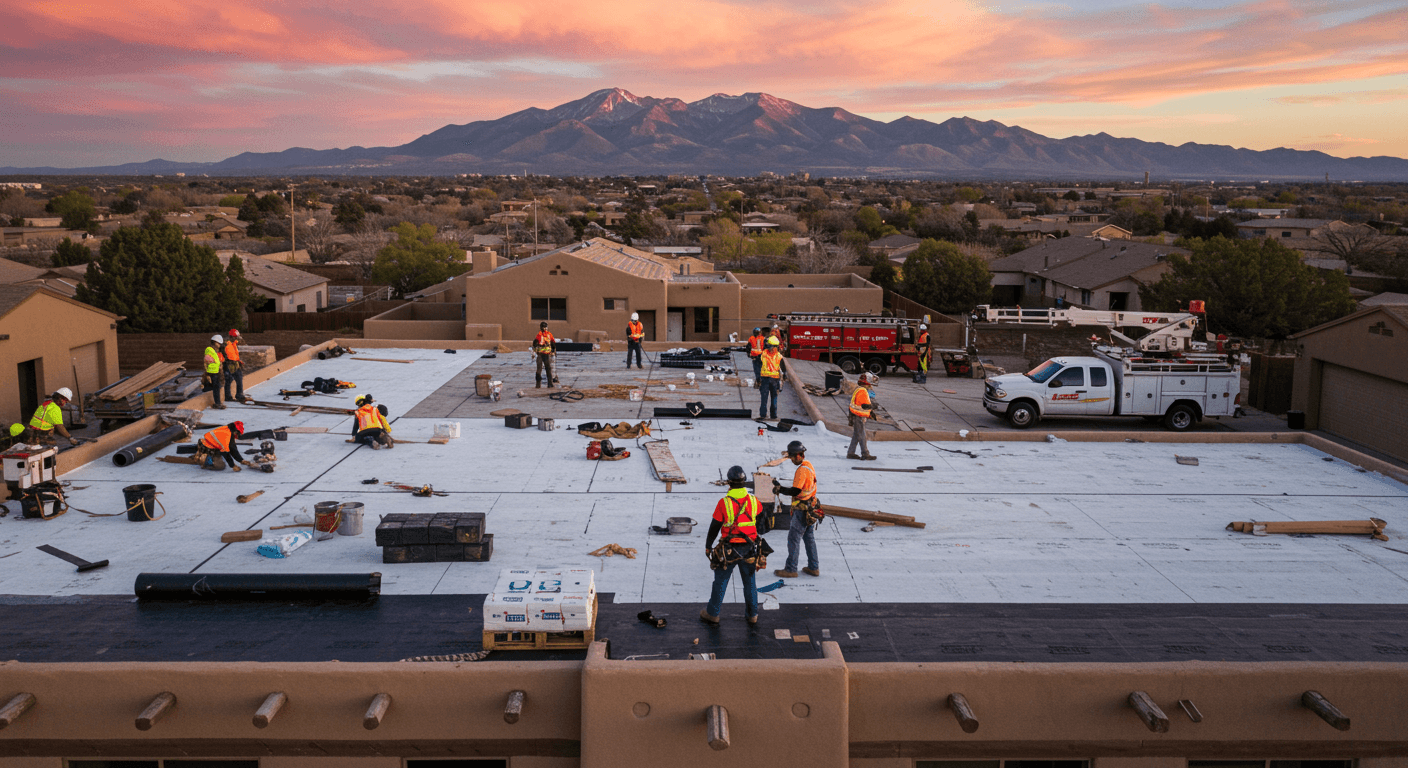
For example, the sheer volume of flat roofs in the North Valley and older parts of the city is a goldmine for contractors who master TPO and silicone roof coatings. I worked with a contractor who stopped bidding on traditional asphalt shingles entirely for three months. He focused exclusively on high-end flat roof restorations. Because he understood the specific drainage issues common in Pueblo-style homes, he was able to bid 16% higher than his competitors and still win the jobs. Homeowners weren't buying a roof, they were buying his expertise in preventing the "ponded water" nightmares common in the region.
Being a member of the National Roofing Contractors Association (NRCA) can provide the technical frameworks needed to train your crews on these specific systems. When you can point to industry-standard certifications for high-wind applications, you move out of the "commodity" category. You are no longer competing with the guy who has a ladder and a beat-up truck. You are an enterprise-level solution for a high-stakes problem.
Market Domination vs. Market Chasing
| Factor | The "Chase" Approach | The "Cluster" Approach |
|---|---|---|
| Service Radius | City-wide service area | 12-mile primary service radius |
| Net Margin | 7.4% average net margin | 19% average net margin |
| Crew Retention | High crew burnout | High crew retention (3+ years) |
| Lead Strategy | Chasing every low-intent lead | Systematic lead vetting |
Service Radius
Net Margin
Crew Retention
Lead Strategy
Safety as a Scalability Engine
You cannot dominate a market if you are constantly replacing your best installers. In the roofing business, your crews are your most valuable asset, and their safety is your biggest liability. According to a recent BLS report on construction fatalities, roofing contractors saw 110 fatal falls in 2023 alone. This isn't just a tragedy, it is a business killer.
When a fall occurs, your insurance premiums skyrocket, OSHA investigations halt production, and your best men start looking for the exit. I've seen a single incident cost a company $84,300 in direct costs and likely triple that in lost opportunities. To dominate Albuquerque, you need to be the shop where the best roofers want to work. That means investing in high-quality fall protection, regular training, and a culture that doesn't skip safety for speed.
We implemented a "Safety Dividend" program for one client where crews received a quarterly bonus based on clean safety inspections. It cost the company $12,400 per year but saved them an estimated $31,200 in workers' comp adjustments. More importantly, they didn't lose a single lead man in two years. In a market where every shop is "now hiring," having a stable, veteran crew is a massive competitive advantage. It allows you to offer consistent quality that the fly-by-night operations simply cannot match.
Refining the Lead Pipeline
The final pillar of market domination is lead hygiene. Most Albuquerque roofers are addicted to "shared leads" from the big national aggregators. They pay $65 for a lead that is sent to five other contractors, sparking a race to the bottom on price. You cannot build a dominant, high-margin business on scraps.
I transitioned Xavier's shop to a model focused on exclusivity. We stopped buying leads that weren't verified. We wanted to know the roof size, the material type, and the homeowner's timeline before we ever picked up the phone. This shift reduced his sales team's "chase time" by 38%. Instead of making 50 calls to get five appointments, they were making 12 calls to get eight appointments.
This level of efficiency is only possible when you use a platform that verifies every opportunity before it hits your inbox. When you aren't wasting your energy on tire-kickers in Rio Rancho who just want a "free estimate" for their insurance company, you can focus on the high-value projects in the NE Heights that actually move the needle for your business.
The 48-Hour Permit Play
"In the Albuquerque metro area, permitting delays can kill your cash flow. To dominate, build a dedicated relationship with the Planning and Development Department. We found that submitting "clean" digital packets with pre-approved engineering for common TPO setups reduced our permit turnaround from 8 days to just 3.4 days. This allows you to close the job, dry it in, and get paid while your competitor is still waiting for a callback from the city."
Building Long-Term Enterprise Value
Dominating a market isn't just about this month's revenue. It is about building a business that has value independent of the owner. A company with 40% market share in three specific zip codes is worth significantly more to a buyer than a company that does a little bit of work everywhere.
The goal is to create a "moat" around your business. That moat is built with route density, technical expertise, a safe and loyal workforce, and a lead pipeline that doesn't rely on luck. As we sat in Xavier's office looking at his new, much tighter map, the stress seemed to lift. He wasn't chasing the whole city anymore. He was owning his territory, one block at a time.