Treating every digital estimate request like money-in-hand is an easy way to burn a $7,840 monthly marketing budget while crews wait between jobs near Old Town. The math breaks when sales reps spend 16.4 hours a week chasing homeowners who mostly wanted a number for an insurance conversation. If your cost per acquisition is floating near $1,320 because closes sit in the single digits, you do not have a lead problem. You have a qualification problem.
I have seen Fort Collins shops lose more than $1,432 a week on low-intent estimates once you add fuel, labor, and opportunity cost. That is not a moral failure. It is a routing problem.
A lot of Northern Colorado roofing teams confuse top-of-funnel curiosity with revenue. The pipeline looks full, then it closes near 12.7% and nobody can name which sources caused the leak. Owners stare at inquiry volume instead of how fast real contracts get signed. In Fort Collins, hail cycles spike demand fast. If you cannot separate a low-intent shopper from a homeowner ready to move, you create a scheduling and follow-up mess that quietly drains gross profit month after month.
Campaign data from Larimer County shops where the web form looked like success, but the calendar told a different story.
Scaling without sinking: the qualification paradox
When easy contact forms create noisy pipelines, your close rate pays the price.
Classic marketing advice says make contact frictionless. In roofing, that often means a bright "free estimate" button on every page. The trade is predictable: easier forms pull more junk data. People treat the online number like a comparison anchor, not a step toward hiring you.
When your team follows up, you start by defending price before you establish scope. I recently reviewed metrics for a shop whose owner, call him Finn, swore his crew was "too busy to sell." His best rep was spending 43% of the day driving to Timnath and Windsor only to learn the homeowner had already signed with another operator days earlier. Finn still paid for the lead, fuel, wear on the vans, and base salary. The return on those visits was zero.
The fix is uncomfortable but simple: add the right friction at intake. Ask for roof age, claim status, photos, and whether the home is owner-occupied. That alone screens a large slice of browsers who were never going to book. When the phone buzzes, it should mean something. If your software can tighten routing, scoring, and territory fit, use it. That kind of precision at the front door is what keeps hail spikes from turning into chaos.
Ballpark numbers stall deals
A fast online range trains the homeowner to stop shopping. When the real scope shows redecking, ventilation work, or steep-slope safety needs, the final price feels like a betrayal even if it is accurate.
Why quick online ranges hurt sales velocity
Speed without context turns your estimator into a free calculator.
The myth is that a quick web range wins the job. More often it sets the wrong anchor. If an automated tool tells someone in Fossil Creek a replacement might land near $14,500, then walk-through work pushes the real proposal higher, you are arguing against your own first impression.
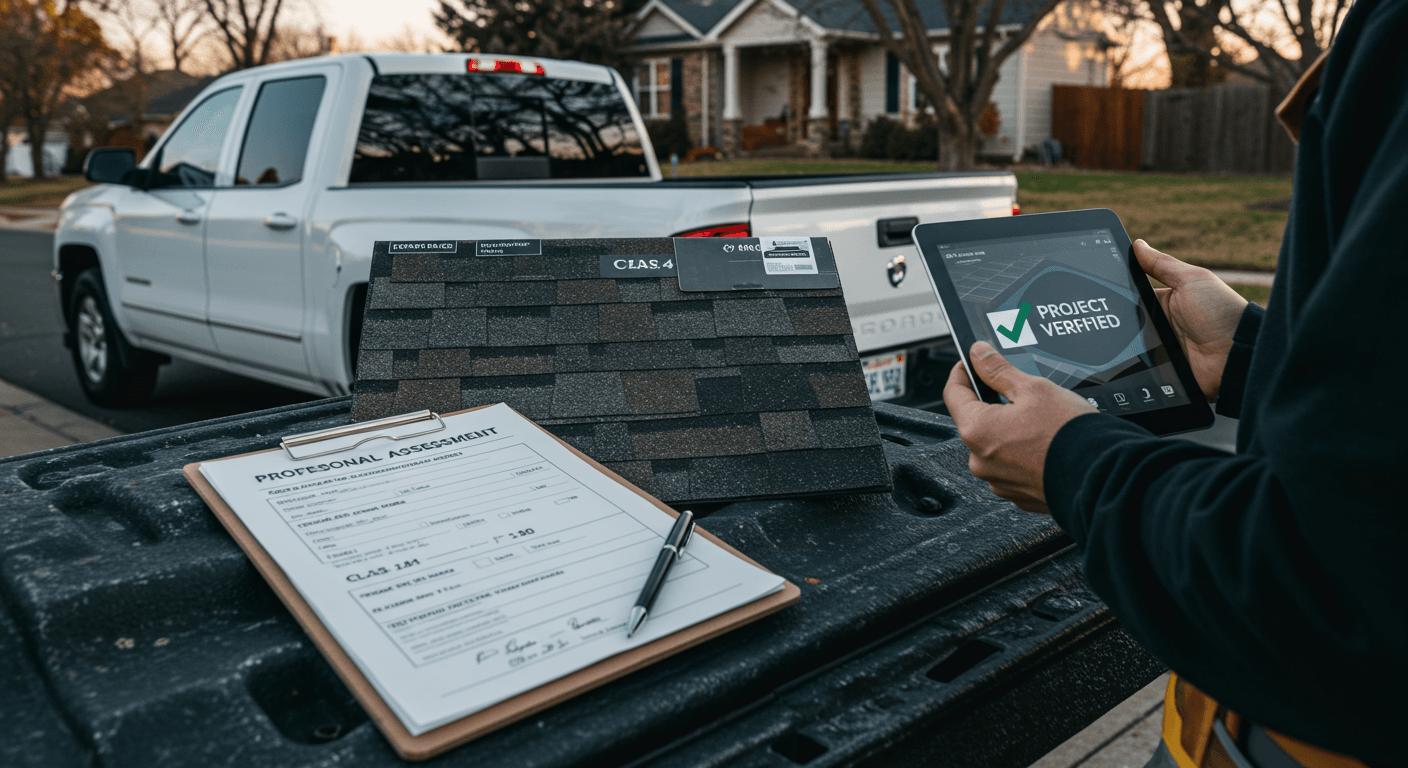
Sales velocity is how quickly a lead becomes a signed contract. A "ballpark" slows that down because the homeowner thinks the decision is finished. When the formal bid arrives 22.4% higher, you get sticker shock, not momentum. Swap the language from estimate to something like a professional project assessment. One reads like a commodity. The other reads like a service.
The BLS outlook for roofers keeps pointing to tight labor and steady demand, which means estimator time is expensive. Spending that time on free math for people who never planned to hire is a bad trade. Aim for fewer conversations, each one vetted for intent, before you send a field rep.
The 15-minute intent audit
"Have the office call to confirm project details, not to 'pin you down on price.' Ask about shingle class, solar mounts, and active leaks. If answers are vague, schedule a short phone review before you block drive time."
The Fort Collins factor: local nuance beats generic bids
Altitude, hail, and code details should show up before you ever open a tape measure.
Fort Collins is not a flat suburb problem. UV at elevation, wide temperature swings, and late-spring hail change what a good assembly looks like. A homeowner near Quail Hollow cares about different failure modes than a newer build along Harmony Road. Your web flow should reflect that specificity.
If your intake ignores Class 4 impact options or City of Fort Collins permitting realities, you sound like every other bidder. When you surface local code and weather context early, conversion from first contact to booked work often lifts double digits because you read as the specialist, not the low bidder.
Competition across Northern Colorado is thick. You are not only up against local shops. National brands with deep ad pockets are in the same ZIP codes. Speed matters, but only on leads that are actually yours. If four companies share the same ping in Loveland, margin gets crushed no matter how fast you call.
What changes when intake matches Fort Collins reality
| Decision factor | Generic estimate flow | Local, qualified intake |
|---|---|---|
| Scope definition before pricing | Instant range from photos only | Assessment + attic/deck checks planned |
| Hail and UV context in messaging | One-size copy for every city | Neighborhood-specific examples |
| Permit and ventilation language | Buried in fine print | Explained up front in plain terms |
| Follow-up goal | Chase the number they remember | Confirm fit, then align on phases |
Scope definition before pricing
Hail and UV context in messaging
Permit and ventilation language
Follow-up goal
Small wording and field changes beat another $2,000 in blind ad spend.
Action Plan
Verify, qualify, then book the visit
Move digital inquiries from curiosity to a booked job with a repeatable filter that protects drive time.
Instant verification: match address to service area, project type, and minimum job size before a human invests time.
Context call: treat it as data collection, not a pitch. Learn leak history, timeline, insurance status, and who else has been on the roof.
Locked preview plus a clear visit promise: email a short pre-inspection brief with photos from nearby work, then schedule a storm-resilience review or ventilation health check instead of a vague free estimate.
When Finn tightened this sequence, his team ran 32% fewer appointments but closed 19.5% more revenue. Same headcount, better targeting. That is the difference between busy and profitable. You cannot scale on guesses. You scale on verified demand you can see clearly and execution that respects drive time.
Safety, labor load, and what prospects quietly check
Reputation details show up in searches while you are still on the phone.
Close rates move when homeowners trust how you work on the roof. While you talk, they scroll. If safety looks thin, they stall even when your online form looked sharp. Mentioning OSHA fall-prevention expectations during scheduling is not paperwork theater. It signals you run a disciplined crew, which matters on high-end residential work around older timber-framed pockets west of town.
Labor backlog changes closes too. If production is six weeks out, some homeowners bail. If you explain the delay as quality control on ventilation and decking, it reads as craft, not neglect. Honest scheduling beats overpromising to win a signature.
What to change this week
Rename the offer from a commodity estimate to an assessment tied to local hail, UV, and code realities.
Add three to five qualification fields and treat missing answers as a pause, not a chase.
Measure estimate-to-job ratio by source and rep, then cut the lanes that burn drive time.
Pair faster callbacks with exclusivity so speed is not wasted on five-way races.
The ROI of precision
Same spend, different math, when intent and territory line up.
Buy fifty shared leads at $45 each and you are in for $2,250. Close two at 4% and your acquisition cost per sale is $1,125. Shift the same $2,250 toward fifteen verified, exclusive leads at $150 each. If close rate lifts to 26%, you book four jobs and cut acquisition cost per sale to $562.50. That efficiency gap is payroll breathing room, not a spreadsheet flex.
In Fort Collins, a 2,400 square foot replacement often lands between $16,800 and $21,400 depending on deck work and ventilation. Every point of conversion on the right leads is real cash, not vanity metrics.
Speed only helps when the record is clean, exclusive, and matched to your lanes.
Moving past the free estimate trap
Change the question from price to performance, then enforce it with data.
The free estimate button made sense before aggregators trained homeowners to collect five bids by lunch. In today's Fort Collins economy, you need to sound like a builder of assemblies that survive Colorado sun and hail, not a bidder racing to the bottom.
Ask whether they want a roof built for the next three decades of Front Range weather, not whether they want a cheap number. Ask how they want insurance documentation handled. When the conversation shifts from "how much" to "how well," the path from assessment to signed work gets shorter.
Track the story in your CRM weekly. If a source keeps delivering people who only want a written range to forward elsewhere, starve it. Protect estimator hours for homeowners who show intent, send photos, and respect your process. That is how you keep winter cashflow steady and make storm season feel manageable instead of manic.