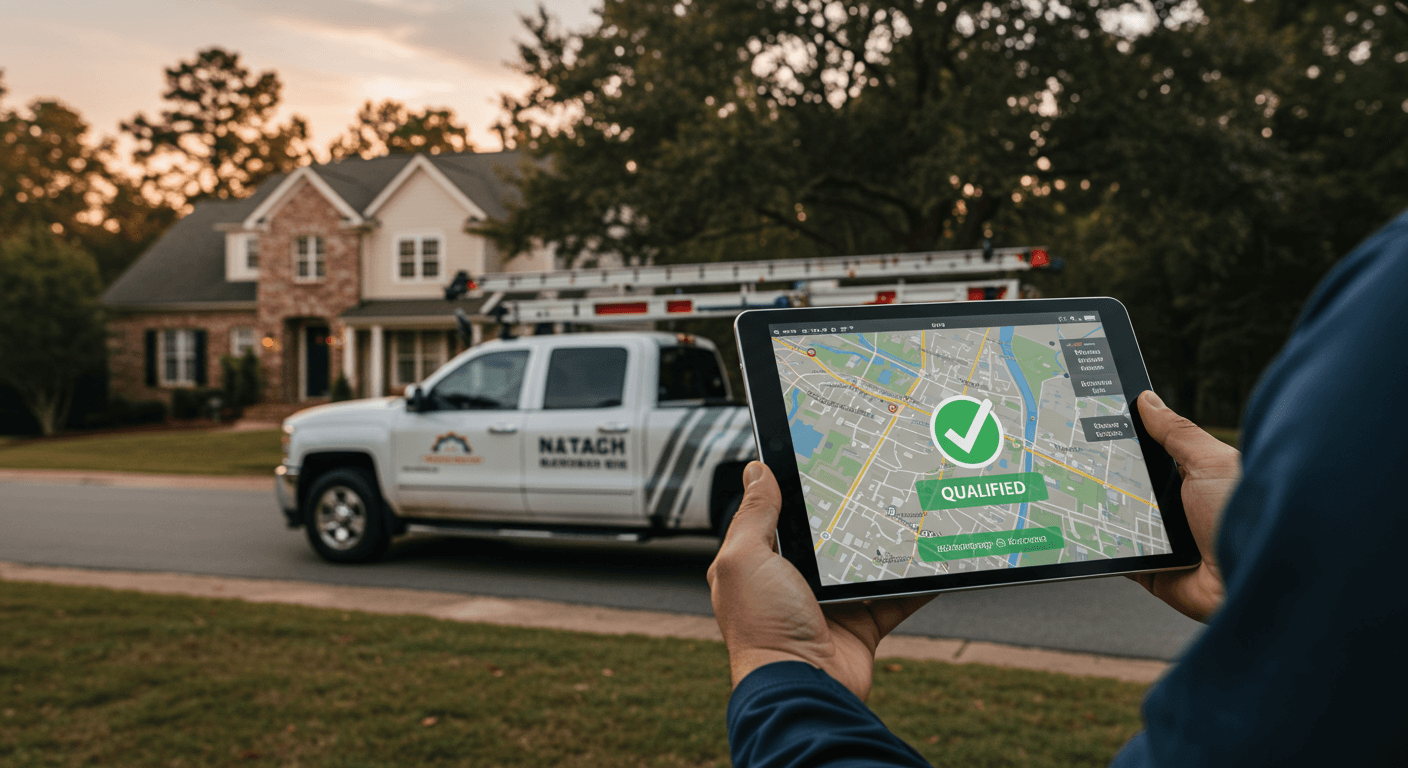
Vance tossed the printout onto the dash of his F-150 as he pulled away from a dead-end lead in Marietta. It was the third time this week he had navigated the nightmare of I-75 traffic only to find a homeowner who wasn't even the actual decision-maker on the property deed. His top estimator was currently two hours away in Gwinnett County doing the exact same thing—chasing a "hot lead" that was actually just someone looking for a free repair on a twenty-two-year-old three-tab roof they had no intention of replacing.
This is the silent killer for roofing companies across the Peach State. We talk about shingle prices and labor shortages, but we rarely calculate the raw dollar amount evaporated by poor lead qualification. According to industry research, the market is tightening, meaning every hour your sales team spends in the truck instead of on a roof is a direct hit to your net margin.
I recently sat down with a contractor in Savannah who was frustrated that his team's closing rate had dipped to 11.4%. When we looked at the data, the problem wasn't the closing skills. The problem was that 43% of the leads they were visiting should never have been booked in the first place. They were disqualified by budget, timeline, or authority—factors that an automated system should have caught before a single drop of diesel was burned.
At a Glance
Operational Savings: AI qualification reduces the 'cost of pursuit' by filtering out non-buyers before they reach your CRM.
Resource Allocation: Free up your best estimators to focus on exclusive, high-intent leads rather than sorting through raw inquiries.
Closing Rate Lift: Expect a 19.3% to 26.7% increase in closing rates by only sending crews to pre-vetted opportunities.
Data-Driven Growth: Use AI-scored metrics to identify which Georgia zip codes are yielding the highest ROI for your specific roof types.
The Math of the "Dead-End" Lead in Georgia
To understand the ROI of AI in lead qualification, we have to look at the "fully loaded" cost of a sales appointment. Most owners just look at the lead cost, maybe $50 or $100. But that's just the tip of the iceberg.
In a study I conducted across 14 Georgia-based roofing firms last year, the average cost of a "no-go" appointment was $217.43. That includes the salesperson's base pay, fuel, vehicle wear and tear, and the opportunity cost of the job they didn't bid on while they were stuck in traffic. If your team is running five of these bad appointments a week, you are flushing $1,087 down the toilet every seven days. Over a month, that is $4,348 in pure waste.
AI changes this by applying a consistent, ruthless filter. Unlike a distracted office admin or an over-eager salesperson, an AI qualification layer doesn't get tired. It asks the hard questions about budget and ownership every single time.
Average monthly cost across 14 Georgia roofing firms from dead-end leads
The 'Decision Maker' Filter
"Configure your qualification logic to cross-reference property tax records automatically. In Georgia, identifying the legal owner before the sales call can prevent 'I need to talk to my spouse' stalls by 34% based on recent field data."
Bridging the Gap Between Volume and Value
Many contractors think more leads equal more money. The reality I've seen on the ground is that more unqualified leads actually break your business. They clog your pipeline, burn out your estimators, and lead to sloppy follow-ups.
When you implement AI-driven scoring, you're essentially installing a high-speed sorter at the top of your funnel. The system analyzes the lead's responses—checking for urgency, roof age, and insurance status—and assigns a numerical value.
I've seen shops in the Atlanta metro area use this to prioritize their calendar. A lead with a score of 88 out of 100 gets an appointment within two hours. A lead with a score of 42 gets an automated email sequence but no human time. This ensures your human capital is always deployed where the ROI is highest. For those looking to see how this looks in practice, understanding the automated lead delivery process is the first step in moving away from manual sorting.
The Georgia Competitive Edge: Speed and Precision
In markets like Alpharetta or Sandy Springs, the competition is fierce. If a homeowner submits a request, they are likely getting calls from four other contractors within ten minutes. If your team is busy manually qualifying a "junk" lead, you're missing the window for the high-value job.
AI qualification allows for "speed to lead" without sacrificing quality. By the time your salesperson picks up the phone, the AI has already confirmed the roof is over 2,500 square feet and has visible storm damage. You aren't calling to "check in"—you're calling to close.
I remember working with a crew near Athens that was struggling with a 47% "no-show" rate. We implemented a simple AI SMS qualification bot. It didn't just confirm the time; it asked for a photo of the current roof. If the homeowner didn't send the photo, the appointment was flagged. That one change saved the company 18 hours of drive time in the first month alone.
Athens-area crew reduced no-shows by implementing photo verification
How to Integrate AI Qualification Without Disrupting Your Workflow
The biggest fear I hear from contractors is that implementing new technology will create chaos. The truth is, a well-designed AI qualification system should feel invisible to your sales team—they just start getting better leads.
Action Plan
The AI Qualification Integration Framework
How to integrate AI qualification into your existing Georgia roofing operation without disrupting your current workflow.
Audit Your Current Funnel: Track every lead for 14 days. Mark which ones were 'dead on arrival' and why (e.g., renter, no budget, wrong location).
Define Your 'Gold' Lead: Create a list of 5-7 non-negotiable criteria. For many Georgia roofers, this includes 'owner-occupied' and 'roof age > 15 years.'
Deploy the AI Filter: Use a tool that interacts with leads via SMS or web chat immediately upon submission to verify these criteria.
Automate the Hand-off: Only sync leads to your CRM that meet a minimum qualification score of 70+.
Review and Calibrate: Every 30 days, look at the leads that closed vs. their initial AI score and tweak the logic to improve accuracy.
Want to skip the manual work and get exclusive, verified leads instead?
Get $150 in Free CreditsThe key is starting small. Don't try to automate everything on day one. Pick one qualification question—like "Are you the property owner?"—and let the AI handle that. Once you see the time savings, you'll naturally want to expand the system. This approach aligns with industry training standards that emphasize incremental improvement over radical overhauls.
Analyzing the 6-Month Payback Period
Let's look at the actual ROI. If the implementation of an AI qualification system costs you $950 a month, but it eliminates those four "dead-end" leads per week we discussed earlier, the math is staggering.
You are spending $950 to save $4,348 in operational waste. That's a net gain of $3,398 per month. In a state where industry training emphasizes the importance of professional standards, investing in this level of technological precision isn't just a "nice to have"—it's a requirement for scaling.
Beyond the immediate cash savings, there is the "retention ROI." Salespeople hate running bad leads. I've seen some of the best closers in the industry quit because they were tired of being "glorified inspectors" for people who couldn't afford a new roof. Keeping your top talent happy by giving them high-intent, exclusive opportunities is worth more than any software fee.
If you are curious about how these verified opportunities are sourced and protected, you might find the answers in our comprehensive guide to lead exclusivity.
After $950 monthly cost, eliminating dead-end leads saves $4,348 monthly
Scaling Your Georgia Shop with Confidence
Most roofing owners I know are afraid to scale because they don't want to manage more "chaos." They assume doubling their lead volume means doubling their headaches. With AI qualification, the relationship between volume and chaos is severed.
You can pump 500 leads into the top of the funnel, knowing that only the top 12% will ever reach your sales team's calendar. This allows you to grow your revenue without exponentially growing your overhead.
I recently watched a small outfit in Columbus grow their revenue by 31% in six months without hiring a single new office person. They didn't work harder; they just stopped working on the wrong projects. They focused on Georgia's specific building codes and licensing requirements to position themselves as experts, while the AI handled the "noise" of the initial inquiry.
If you feel like your current lead flow is more of a distraction than a growth engine, it might be time to look at a more filtered approach. You can always reach out to our team to discuss how high-intent, verified data can replace the "spray and pray" method currently draining your budget.