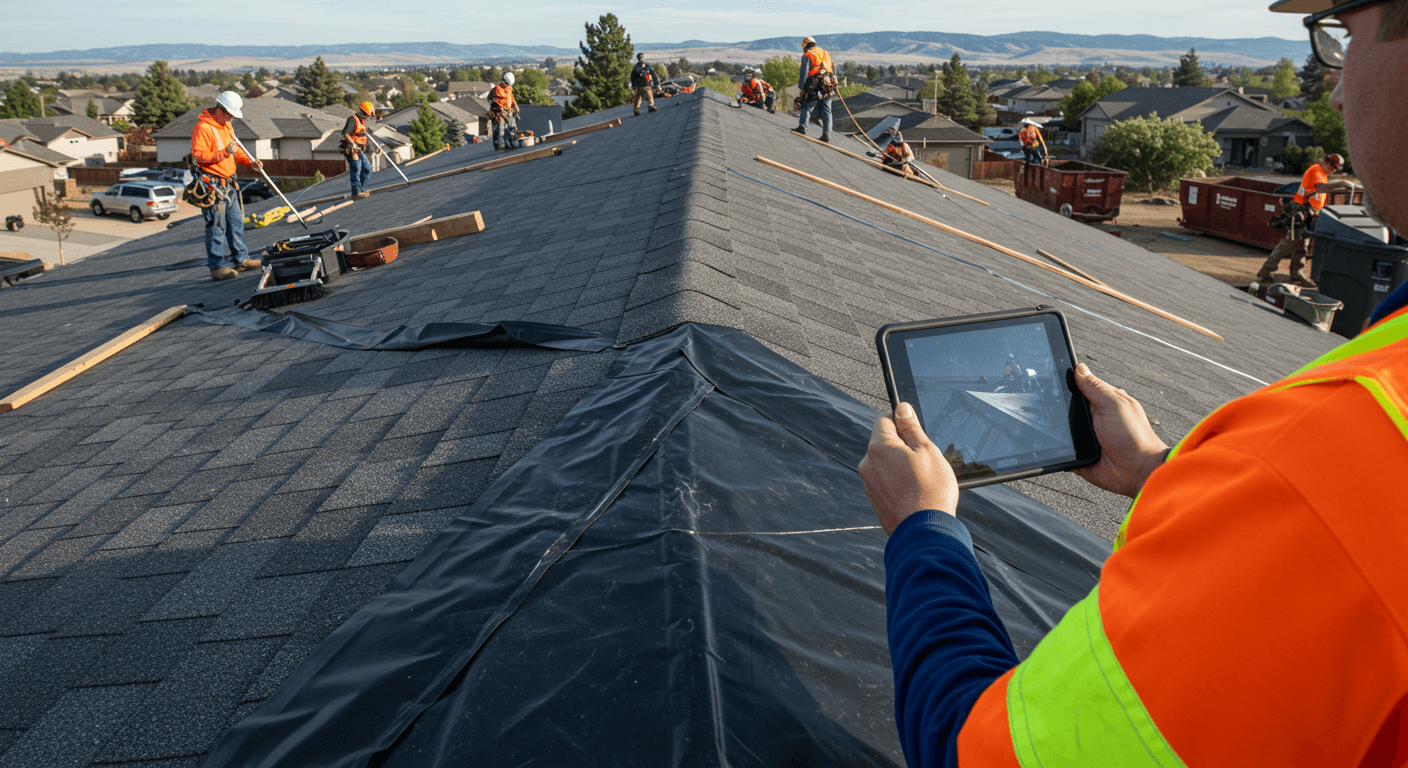
Roughly 38.6% of roofing companies operating in high-growth corridors like Boise and Meridian are leaking approximately $13,240 every single year on labor and fuel costs tied directly to avoidable rework. This isn't just a guess; it is a pattern I have observed while auditing the sales-to-production handoff for shops across the Treasure Valley. When a crew has to head back out to a finished job in Nampa because a counter-flashing wasn't tucked or the magnetic sweep missed a handful of nails in the driveway, you aren't just losing the $450 in "nuisance costs" for that trip. You are losing the three hours that lead estimator could have spent closing a $22,000 architectural shingle upgrade.
I was recently walking a job site in Idaho Falls with a contractor named Jaxon. He was frustrated because his referral rate had dipped by 14.3% over two quarters, despite his sales team hitting their numbers. We spent the morning watching his crew finish a steep-slope residential project. Jaxon realized that while the shingles looked great from the curb, the small details—the stuff homeowners notice three months later during a heavy rain—were being left to chance. We sat down in his truck, away from the noise of the compressors, and mapped out a quality control (QC) protocol that didn't just check boxes but actually drove profit. This article breaks down the exact tactical steps we implemented to turn his production line into a referral machine.
At a Glance
Eliminate the "Ghost" Callback: Standardized photo documentation reduces non-billable truck rolls by 22% or more.
Drive Referral Velocity: High-quality job site exits increase the "Net Promoter Score" without spending a dime on marketing.
Lower Insurance Risk: Proper safety and QC documentation can lead to better premiums and fewer liability disputes.
Crew Accountability: Clear, visual standards remove the "I didn't know" excuse from sub-contractors and in-house teams.
The Hidden Cost of "Good Enough" in the Idaho Market
In the roofing business, we often talk about top-line growth. We celebrate the $5 million or $10 million year. But if your callback rate is hovering around 8% or 9%, you are effectively running a charity for your least efficient crews. In a state like Idaho, where weather windows can be tight between the late spring rains and the early winter snows in Coeur d'Alene, every hour of rework is an hour you aren't billing for new squares.
I remember talking to a sales rep, Willow, who was losing her mind because she'd spend weeks nurturing a high-end lead in Eagle, only for the production crew to leave a mess of shingle scraps in the client's prize-winning flower beds. The roof was watertight, but the "customer experience" was a 2-star disaster. This is where QC moves from a production headache to a sales strategy. When your production is flawless, your sales team sells with a level of conviction that you simply can't fake.
Reactive vs. Proactive Quality Control
| Factor | Reactive Quality Control | Proactive Tactical QC |
|---|---|---|
| Primary Trigger | Customer complaint or leak | Internal milestone inspections |
| Documentation | Paper receipts and "after" photos | Multi-stage digital photo verification |
| Cost Impact | $1,100+ per significant callback | $85 - $120 in admin/inspector time |
| Sales Impact | Defensive, apology-based selling | Aggressive, evidence-based selling |
| Crew Perception | "The boss is mad again" | "This is how we get our bonuses" |
Primary Trigger
Documentation
Cost Impact
Sales Impact
Crew Perception
Building a Six-Point Strike System for Job Site Audits
To fix Jaxon's shop, we didn't just tell the crews to "work harder." We implemented what I call the Six-Point Strike System. This is a tactical framework designed to catch errors before the ladder is even loaded back onto the truck. In Idaho, where wind uplift is a major concern in the flatter regions, the way a shingle is nailed is the difference between a 30-year roof and a 3-year headache.
Action Plan
The Six-Point Strike System
A tactical framework designed to catch errors before the ladder is loaded back onto the truck, ensuring quality at every critical stage of the installation process.
The Decking Verification: Before a single underlayment square is rolled out, the foreman must take a photo of the cleared deck. Are there rotted sheets? Is the nailing pattern compliant with local Idaho codes? If you cover a problem, you own it forever.
The Flashing Audit: 93% of leaks I've seen in the field happen at the transitions. We require a "macro" photo of every chimney, valley, and wall-to-roof transition before the final shingles are laid over them.
The Perimeter Check: Drip edge and starter strips are the most neglected components. We check for proper overlap and fastening.
The Safety Compliance Sweep: Quality isn't just about the shingles; it's about the humans. We ensure all fall protection is engaged. Consistent safety audits are the foundation of a professional job site. If a crew is cutting corners on their own lives, they are cutting corners on your customers' roofs.
The Ventilation Math: We double-check the intake vs. exhaust calculation. Idaho attics can reach brutal temperatures; if the roof isn't breathing, the shingles will blister, and your warranty is worthless.
The "Barefoot" Cleanliness Walk: The foreman walks the perimeter of the house looking for nails and debris. If he wouldn't walk it in his socks, it isn't clean enough.
According to OSHA roofing safety requirements, consistent safety audits are not just compliance—they're a competitive advantage. When your crews follow proper safety protocols, they work more methodically, which naturally improves quality outcomes.
Contractors who implement a photo-based multi-stage QC process typically see this improvement within the first 7.5 months.
Leveraging Quality as a Competitive Sales Wedge
When I'm coaching sales teams, I tell them that their biggest competitor isn't the guy down the street with the lower price. It's the homeowner's fear of a bad experience. If you can show a prospect in Twin Falls a digital "Quality Portfolio" of a job you did three blocks away—showing the decking, the ice and water shield, and the final sweep—you have effectively neutralized the low-bidder.
You are no longer selling a roof; you are selling a documented process of excellence. This is how you move your close rate from 22% to 37% or higher. Customers will pay a premium (usually about 11% to 14% more) for the peace of mind that comes with a verified process. This starts with the leads you bring into the funnel. If you are starting with verified homeowners who actually value quality, the sale becomes an education session rather than a price war.
The 15-Minute Magnetic Sweep
"Don't trust a single pass with the magnet. Have your crew lead perform a "double-cross" pattern—walking North-to-South and then East-to-West—across the driveway and high-traffic lawn areas. This 15-minute investment prevents the $250 "flat tire" complaint that kills your referral momentum."
The Role of Safety in Quality Control
You cannot separate quality from safety. I've seen shops try to run a "high-quality" production line while ignoring basic fall protection. It doesn't work. A crew that feels unsafe is a crew that rushes. A crew that rushes is a crew that misses the small details.
Integrating the OSHA Stop Falls Campaign framework—Plan, Provide, Train—into your daily morning huddle is a game changer. When you plan the job for safety, you are also planning the job for quality. You are setting a standard of "no shortcuts." If you have questions about how these standards impact your business model or lead costs, our FAQ page covers many of the logistical hurdles contractors face when scaling.
Managing Subcontractors with the "Third-Party Eye"
Many Idaho roofers rely on sub-contracted crews. The common complaint I hear is, "I can't control the quality if they don't work for me directly." That is a myth. You control the quality through the "Price of Admission."
The Price of Admission is your QC checklist. If the crew doesn't upload the required 18 photos to your project management software, the check doesn't get cut. It sounds harsh, but it is the only way to ensure consistency. When I worked with a shop in Meridian, they implemented a "Quality Bonus." If a crew went four weeks without a single valid callback, they got a $650 bonus. The callback rate dropped by 42% in ninety days. The bonus paid for itself four times over in saved labor.
Action Plan
The Idaho Post-Build Audit Process
A systematic approach to ensuring quality before customer handoff, turning your production team into a referral-generating engine.
Internal Walk-Through: The Project Manager or Foreman completes a 22-point checklist before calling the customer.
Photo Upload: All critical areas (valleys, penetrations, ridge vents) are documented in the company portal.
The Customer "Value Walk": Invite the homeowner to walk the ground level with you. Point out the specific ways you went above code.
Safety Gear Audit: Confirm all company-provided safety equipment is accounted for and in good repair.
Signed Completion Certificate: The customer signs off not just on the roof, but on the cleanliness of the site.
Referral Ask: Since the site is pristine and the roof is perfect, this is the psychological peak to ask for a referral.
Turning QC Data into Marketing Gold
Most roofing business owners sit on a goldmine of data and never use it. Every QC photo you take is marketing content. Every "zero-callback" month is a statistic for your sales deck.
Imagine a sales rep in Nampa showing a prospect a tablet: "Mr. Henderson, here are the 25 photos our foreman took of your neighbor's roof last week. We check the decking, the flashing, and the ventilation at every stage. We did this on 147 roofs last year and had zero leaks reported."
That is how you kill the competition. It turns your production department into a lead-generating engine. If you're looking to scale that engine and need a consistent flow of new opportunities to feed your now-efficient crews, contact our team to see how we can help you dominate your local Idaho market.
The False Economy of Skipping Site Photos
The most expensive photo is the one you didn't take. Without "before" and "mid-process" photos of the decking and flashing, you have no defense against a homeowner claiming you "covered up rot" or "didn't install the ice and water shield." This lack of evidence can cost you thousands in legal fees or unnecessary rework just to prove your work.
Maintaining the Momentum: The Noah Parker Approach
Quality control is not a "set it and forget it" system. It is a muscle. In my years of sales coaching, I have found that the best-performing reps are those who know the production team has their back. When there is a rift between sales and production, the business plateaus.
Jaxon, the contractor from Idaho Falls, saw his revenue jump by $843,000 the year after he implemented these protocols. Why? Not because he spent more on ads, but because his "cost of doing business" plummeted and his referral rate spiked. He stopped being a "firefighter" and started being a CEO.