Operational levers that move the needle
Speed to lead is not enough on its own—the clock that matters is time to a clear, professional proposal.
A disciplined "one-call close" approach can lift margins by roughly 9.2% by cutting wasted follow-up labor.
In Indiana, transparent licensing and local proof separate you from out-of-state storm chasers faster than any discount.
Stage-by-stage funnel data shows where revenue leaks so you fix process—not blame the lead vendor.
Most roofing owners in the Hoosier State assume a weak close rate means bad leads. They picture “better” homeowners walking through the door and reps suddenly clearing 40% or 50% benchmarks. Last month I toured a warehouse in Fishers with a contractor I will call Preston. His team had closed only 13.7% of October appointments, and he was ready to fire his lead provider and double spend on a brand-new ad channel.
When we mapped the real workflow, the issue was not lead quality. Reps were averaging 3.4 days to deliver a formal quote after the inspection. In Indianapolis, Carmel, or any competitive corridor, that gap is enough to lose the job. Chasing volume while your process leaks is like bailing a boat with a sieve—more water just means a bigger mess on the deck.
The high cost of Indiana sales inefficiency
Presentation and process matter as much as lead source when homeowners compare you to the next crew on the list.
When I review roofing operations, I hunt for the slow drip in the sales path. Indiana homeowners—from Greenwood suburbs to fields outside Kokomo—tend to reward punctuality and paperwork that looks intentional. A rep who rolls up in a rough truck and hands over a scrap-paper sketch is fighting an uphill battle no matter how the lead was sourced.
I ran the math on Preston’s 13.7% close at roughly $184 per lead. On 100 leads, thirteen jobs signed. Moving the same book of business to about 22%—still below elite territory—would add close to $110,000 in revenue without another dollar of media. That is why tightening operations often beats constantly swapping lead-generation tactics every few quarters.
The failure point is frequently the handoff. Reps who behave like order-takers quote a number and leave. In a hail- or wind-prone state, stressed homeowners need a project consultant who can explain insurance, code, and next steps—not someone who disappears after a price. If growth feels stuck, revisit how you prioritize the calendar and which plays you repeat on every roof; our business growth articles cover several ways to stress-test that side of the business without buying more traffic.
Roofing companies that take more than two days after inspection to deliver a proposal typically see materially lower close rates than teams that close the loop on site or same day.
Why your “speed to lead” is still too slow
Industry talk focuses on calling within sixty seconds. I also watch “speed to site.” I have seen Fort Wayne shops lose deals because a competitor’s ladder hit the roof two hours earlier. In residential roofing, the first professional who builds trust on the deck—and shows the homeowner what is actually wrong—often earns the contract.
If crews sit idle while reps zigzag the state, cluster work geographically. Driving from Bloomington to Muncie in one day can burn three and a half hours that should go to inspections and presentations. Tighter routing puts more minutes with the homeowner and fewer on I-65.
Traditional selling vs. operations-first selling
| Factor | Traditional sales model | Systematic operations model |
|---|---|---|
| Initial response | 2–4 hours | Under 10 minutes |
| Quote delivery | 3–5 days post-inspection | On-site digital proposal |
| Follow-up cadence | Manual / random | Automated 7-touch sequence |
| Success metric | Total revenue | Profit per lead (PPL) |
Initial response
Quote delivery
Follow-up cadence
Success metric
Mastering the on-site consultation
One costly habit is treating the inspection like a manual marathon. A crew near South Bend was still pulling every measurement by hand on a standard gable—almost three quarters of an hour on the roof before a real conversation with the owner. By the time they sat at the kitchen table, they looked rushed and defensive, not consultative.
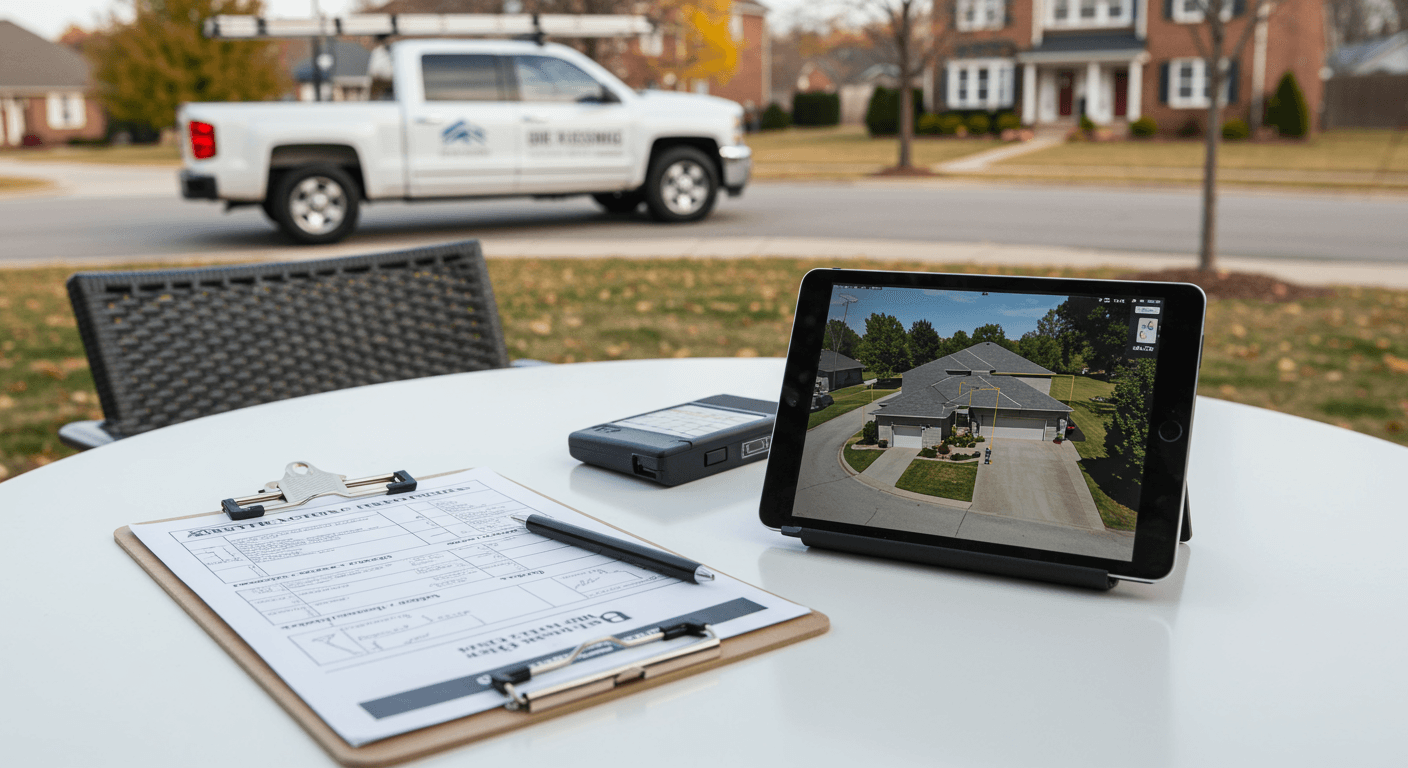
Aerial measurements, digital photo sets, and a structured presentation flip the dynamic. Sitting with the homeowner while reviewing high-resolution images of their own granular loss builds credibility fast. As IKO’s guide on modern lead generation notes, buyers now expect a tech-forward experience; when you can pair documentation with a clear visual story, the emotional buy-in to the project rises sharply.
The 15-minute “pre-flight” check
"Before each appointment, spend fifteen minutes on property age and permit history. Knowing a roof was last replaced in 2008—or that a documented hail event hit the neighborhood fourteen months ago—gives your rep immediate authority in the kitchen."
Closing the gap with systematic follow-up
Preston’s team treated “no signature at the table” as the end of the road: one late follow-up, then silence. That pattern is where a huge share of revenue quietly dies. High-ticket Indiana work—metal, designer shingles, slate—often needs several thoughtful touches before a homeowner commits.
We replaced random pings with a simple sequence: a thank-you text minutes after leaving, an email with warranty and financing clarity, a structured call on day two, and a neighborhood reference list tied to their zip code by day four. The goal is to be the most organized contractor in the running, not the loudest. For platform-specific questions on how follow-ups fit with lead delivery, our FAQ on lead management walks through how teams typically wire this up.
Action Plan
30-day reset for a high-converting sales process
How to implement a high-converting sales process in 30 days without adding headcount—by fixing measurement, quoting, scripting, and follow-up in that order.
Audit your current pipeline: pinpoint whether drops happen on intake, inspection, proposal, or decision.
Deploy digital estimating: tablets plus aerial measurement so quotes do not wait on a back-office typing session.
Formalize the in-home script: roof walk, photo review, insurance or retail track, then financing in one coherent arc.
Automate follow-up in your CRM: no qualified lead sits more than 48 hours without a planned touch until they opt out or sign.
Hold weekly performance reviews: track close ratio by lead source and margin per rep so coaching has numbers behind it.
Want to skip the manual work and get exclusive, verified leads instead?
Get $150 in Free CreditsIndiana licensing and local authority
Indiana does not issue a statewide roofing license. That open door invites fly-by-night operators, so legitimate contractors must over-communicate proof. I have reps carry a “trust folder”: county registrations where they apply, general liability north of a million dollars, workers’ comp where required, and hyper-local references.
In Evansville, Terre Haute, or any river town where out-of-state trucks roll in after storms, a verifiable local address and callback number matter as much as price. Homeowners are buying certainty that you will still be here when the warranty question shows up.
Discounting too early erodes trust
When a rep instantly offers $500 off to "sign today," many homeowners infer the first price was padded. That undercuts credibility and trains buyers to negotiate on every job.
Data-driven sales management
You cannot improve what you do not measure. Busy-looking reps are not the same as profitable reps. In Preston’s shop we compared projected margin to actual margin by salesperson. One rep cleared roughly 30% of appointments but gave away 12.4% margin versus peers through loose supplement promises and soft labor pricing.
Shifting the scoreboard from gross revenue alone to net profit per lead changed coaching overnight. If you want help aligning intake, CRM fields, and reporting, contact our team and we can talk through what to track first.
What actually moves the number
Raising close rate is less about a magic phrase and more about removing friction. Fast, transparent, repeatable experiences make price a smaller slice of the decision. In Indiana’s weather-driven, competitive markets, being the shop that always shows up prepared and follows through is a durable advantage.
Preston finished the year near a 24.8% close rate—almost double where he started—without increasing lead spend. The win came from fixing the system around the appointment, not from shouting for more leads.