Wesley slammed the folder onto his steering wheel, his eyes tracking the competitor's truck pulling away from a driveway in San Marco. He had just lost a $24,850 reroof to a company that bid $2,300 higher than him. It was the third time that month a "sure thing" had evaporated in the Florida humidity. He looked at me, his face a mask of pure frustration, and asked why a homeowner would voluntarily pay more for the exact same shingle package.
I told him the truth, even though it stung. The homeowner didn't buy a roof; they bought the certainty that they wouldn't be scammed. In a city like Jacksonville, where every storm brings out a fresh crop of "tailgate contractors," your reputation is either your greatest asset or your silent killer. Wesley had the skills, but he didn't have the digital receipts to prove it to a skeptical homeowner in a high-stakes ZIP code.
For Jacksonville contractors who maintain a 4.8-star rating with at least 12 recent local reviews.
At a Glance
Social proof functions as a risk-mitigation tool that allows you to maintain higher margins despite local competition.
Integrating review requests into the final inspection process increases capture rates by 63% compared to follow-up emails.
Localized reviews from specific Jacksonville neighborhoods like Riverside or Mandarin carry 4x more weight than generic testimonials.
Strategic use of social proof can reduce your customer acquisition cost (CAC) by nearly 19.4% over a six-month period.
The Jacksonville Trust Deficit
The First Coast market is unique. You have a mix of historic homes in Avondale that require specialized care and massive suburban developments in St. Johns County where homeowners talk to each other on every digital platform imaginable. If you are operating in Jacksonville, you aren't just competing on price. You are competing against the last bad experience that homeowner's neighbor had with a roofer who took a deposit and vanished.
When Wesley and I sat down to look at his sales process, we found a glaring hole. He was still relying on "Solution Sales," a method that focuses on identifying a problem and proposing a fix. However, as noted by Harvard Business Review, the end of solution sales is here because customers are now so well-informed that they often know the solution before you even arrive. They don't need you to tell them their roof is leaking; they need you to prove you are the most reliable person to fix it.
In Jacksonville, that proof needs to be hyper-local. A review from a homeowner in Georgia doesn't move the needle for a resident in Ortega. They want to see that you've handled the specific permitting headaches of the City of Jacksonville (COJ) and that your crews know how to respect a property in a tight-knit neighborhood.
Psychology of the Digital Handshake
Social proof isn't just a marketing buzzword. It is a psychological shortcut called "informational social influence." When people are uncertain, they look to the actions of others to reflect correct behavior. If a homeowner sees 47 of their neighbors praising your cleanup crew, their anxiety about the $18,450 investment drops significantly.
I've seen shops transform their pipeline by shifting the focus from the sale to the story. During our training session, I had Wesley's top rep, a guy who knew the Northside like the back of his hand, role-play a conversation.
"Don't just tell them you're the best," I coached. "Show them the map of the 12 roofs you did on this specific street last year. That's the psychological trigger that kills the need for three other bids."
This isn't just about the number of stars on a screen. It's about the content of those reviews. We started targeting "attribute-based social proof." Instead of a generic "Good job," we trained the team to ask customers to mention specific things like the magnetic nail sweep or the way the crew protected the hibiscus bushes. In the Jacksonville market, those small details are what allow you to command a 12% to 15% premium over the low-ballers.
The Scripted Ask: Capture Reviews in Real Time
The biggest mistake Wesley was making, and one I see across the country, is waiting too long to ask for the review. He was sending an automated email four days after the job was paid for. By then, the homeowner had moved on to their next project. The "Peak-End Rule" in psychology suggests that people judge an experience largely on how they felt at its peak and at its end.
The peak is when the roof is finished and looks beautiful. The end is the final walk-through. That is when you must strike.
Here is the script we implemented for Wesley's production managers:
"Mr. Jones, I've finished the final magnetic sweep of the driveway and checked the flashing on the chimney one last time. My goal was to make sure your yard looks better now than it did before we arrived. On a scale of 1 to 10, how did we do on that cleanup?"
When the homeowner says "10," the manager follows up:
"I'm so glad to hear that. Most people in San Marco are terrified of finding nails in their tires after a roofing project. Would you mind taking 45 seconds to mention that cleanup on our Google profile? It helps your neighbors know who they can actually trust with their property."
By making the ask about "helping neighbors" rather than "helping my business," Wesley's review capture rate jumped from 8% to 41% in just under nine weeks. If your current lead flow isn't keeping your crews busy enough to generate these moments, it might be time to get started with a more consistent source of opportunities.
The "Review Gating" Trap
Never use software that asks customers for a rating and only sends the 5-star winners to Google. This is a violation of Google's terms of service and can result in your entire profile being suspended. In a competitive market like Jacksonville, a "Map Pack" suspension is a death sentence for your organic lead flow. It is better to have a few 4-star reviews with honest feedback than to risk losing your entire digital presence.
Localized Social Proof Beyond the Web
While Google is the king, physical social proof in Jacksonville is still incredibly powerful. We started a "Neighborhood Dominance" program. Whenever Wesley's crew finished a job in a high-visibility area like Beach Blvd or San Jose Forest, we didn't just pull the yard sign.
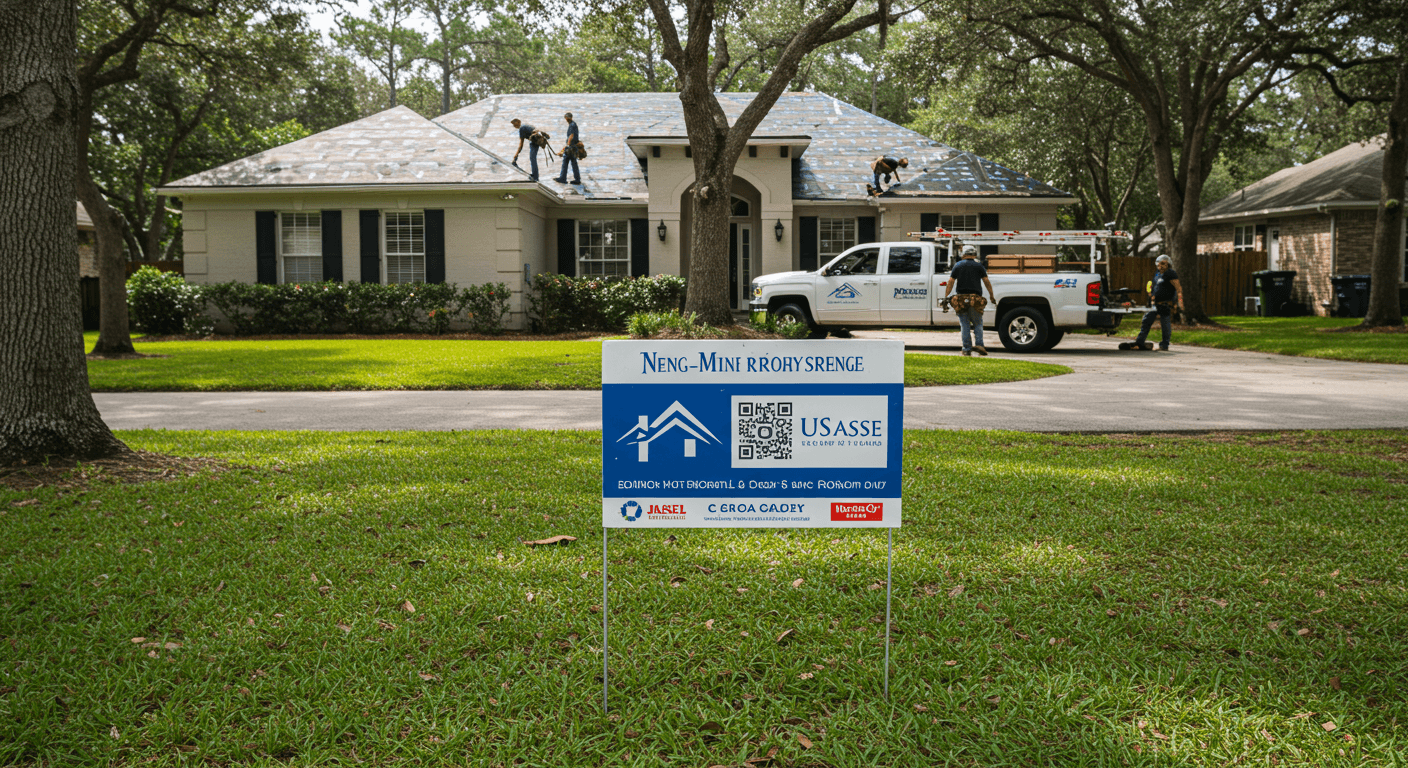
We replaced the "Coming Soon" sign with a "Another Quality Roof by Wesley's" sign that featured a QR code. That code didn't go to the homepage; it went to a dedicated landing page showing photos of that specific house being worked on. This created a loop of local credibility.
When you combine this with the platform's features for targeting specific territories, you can effectively "own" a neighborhood. If every third house in a subdivision has your sign, you stop being a contractor and start being the neighborhood's "roofing partner." This shift is fundamental for long-term sustainability. According to business insights from Harvard Business Review, small businesses that focus on community-level reputation see a much higher lifetime value per customer.
Measuring the ROI of a Review Strategy
I told Wesley that if we couldn't measure it, we weren't managing it. We started tracking the "Social Proof Lift."
We looked at two metrics:
- The Close Rate on Unsolicited Leads: These are people who saw a review or a sign and called in.
- The Sales Cycle Length: How long it took from the first inspection to a signed contract.
After six months of a disciplined review strategy, Wesley's sales cycle in the Mandarin area dropped from 11 days to 6 days. Because the trust was already established before the rep knocked on the door, the "thinking about it" phase was virtually eliminated.
The data backed up what I've seen in the field for years. A strong social proof engine acts as a pre-filter. It attracts the customers who value quality and repels the price-shoppers who are going to grind you down to a 5% margin. Wesley's average net profit per job increased by $1,842 because he stopped discounting his price to "win" the job. He let his reviews win it for him.
Turning Your Crew into Brand Ambassadors
One of the hardest parts of this transition for Wesley was getting his crews on board. They viewed reviews as "office stuff." We had to change the culture. We implemented a "Review Bounty" program. For every review that mentioned a crew member by name, that person got a $35 bonus.
This changed the behavior on the job site immediately. The guys weren't just throwing shingles; they were introducing themselves to the homeowners. They were keeping the staging area cleaner. They were acting like the professionals Wesley knew they were.
I remember one specific job near the Jax Beach pier. The homeowner, a retired naval officer, was notoriously difficult. But because the crew lead, Jaxon, wanted that $35 bonus, he went above and beyond to explain the drip edge installation. The resulting review was a 300-word masterpiece that Wesley now uses in every sales presentation.
That single review has likely been responsible for over $150,000 in referred business in that neighborhood alone. That is the power of a localized, human-centric social proof strategy. Before your next lead purchase, consider how much easier that sale would be if the homeowner already felt like they knew your team.
Scaling Beyond the Referral
Wesley eventually hit a ceiling. His referral network was strong, but it wasn't scalable. He needed a way to take the trust he had built and apply it to a larger volume of prospects.
This is where the synergy between a solid reputation and a verified lead source becomes vital. When you have a high-converting brand, you can afford to be more aggressive in your growth. You know that if you get a lead from a verified source, your "Trust Engine" is going to do most of the heavy lifting for your sales team.
We looked at the numbers together last week. Wesley is no longer slamming folders on his steering wheel. He's currently running four crews and has a backlog that stretches into next quarter. He's not the cheapest roofer in Jacksonville, and he's proud of it. He's the one with the most receipts.
If you're tired of fighting the "price war" in the North Florida heat, it's time to stop selling roofs and start selling proof. The homeowners in San Marco, Mandarin, and the Beaches are waiting for someone they can trust. Be that person.