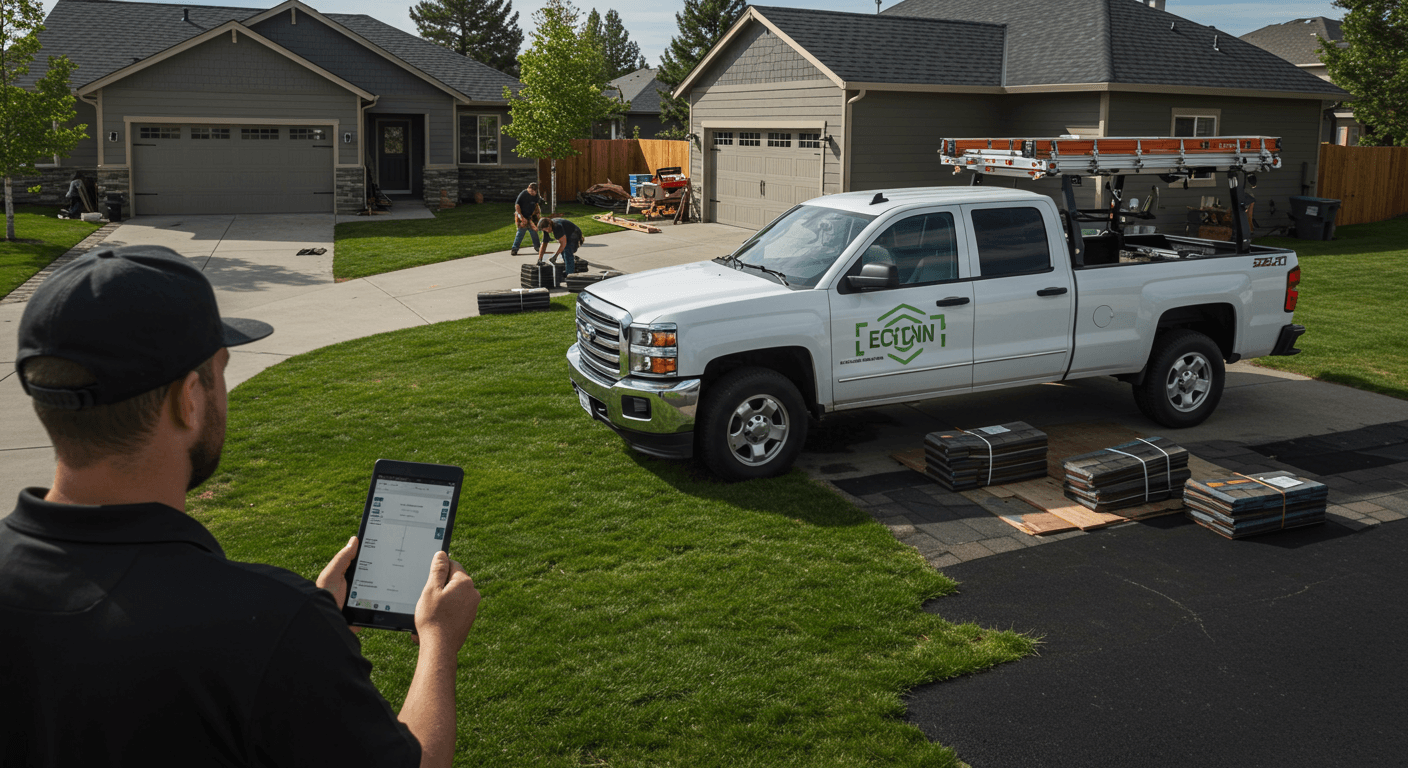
Elias slammed the door of his F-150 near the intersection of Chinden and Ten Mile, the silence of the residential street feeling heavier than a failed closing. He had just spent forty-five minutes walking a roof for a "lead" that turned out to be a tenant who didn't even have the authority to sign a contract, much less the $16,400 for a full tear-off. That was the third time this week a digital lead from a major aggregator had sent him on a wild goose chase. Back at the office, the spreadsheet showed he was spending $4,120 a month on these "opportunities," but his actual conversion rate was hovering at a dismal 7.3%.
I see this exact scenario play out in Meridian roofing shops constantly. Owners think they have a lead generation problem, but what they actually have is an operational efficiency leak. When you're paying for leads that haven't been vetted for intent, you aren't just losing the $150 lead fee; you're burning the $45-an-hour salary of your best salesperson and the fuel in the tank.
Main Points
Stop measuring lead cost and start measuring 'Cost Per Qualified Appointment' to find your true margin leaks.
Learn why generic digital leads in the Meridian-Boise corridor often carry a hidden 18.7% labor tax in wasted sales time.
Discover the specific ROI framework used by high-growth Idaho shops to filter out tire-kickers before they hit the schedule.
The Hidden "Labor Tax" on Unverified Digital Leads
In a market as competitive as the Treasure Valley, the cost of a lead is rarely just the sticker price. To find your true ROI, you have to account for the "Labor Tax." This is the cumulative time your office staff spends chasing ghost numbers and your sales reps spend driving to homes where the "homeowner" is actually just curious about a minor shingle repair they plan to DIY.
According to research from the National Roofing Contractors Association (NRCA), operational inefficiencies can swallow up to 14.2% of a contractor's gross margin. In my experience auditing shops from Kuna up to Eagle, that number jumps significantly when the lead source is a "shared" digital platform.
If your sales rep, like Elias, spends 6.5 hours a week on dead-end leads, that's 338 hours a year. At a modest $35/hour base plus overhead, you're looking at an $11,830 annual loss per rep. That's a leak that no amount of volume can fix.
Analyzing the Meridian Market: Why Your Current Ads Are Failing
Meridian has seen a massive influx of new residents over the last 4.5 years. This has led to a surge in roofing demand, but also a surge in "storm chaser" style marketing that has made local homeowners skeptical. If you are running generic Google Ads or buying from "lead mills," you are competing in a saturated space where the homeowner is often being called by six other contractors within 90 seconds.
The problem with this "speed to lead" model is that it ignores quality. You end up in a price war. To maintain a healthy ROI, you need leads that are exclusive and pre-qualified for actual replacement needs, not just "repair estimates" that clutter the books.
Lead Source Comparison: Meridian Market
| Factor | Shared Aggregator Leads | Verified Exclusive Leads |
|---|---|---|
| Direct Cost | High ($180+) | Moderate ($150-210) |
| Close Rate | Low (8-12%) | High (24-31%) |
| Competition | High (4-6 calls) | Low (1-2 calls) |
| Homeowner Intent | High (Price-shopping) | High (Intent-based) |
Direct Cost
Close Rate
Competition
Homeowner Intent
The Solution: Transitioning to an Intent-Based Lead Model
To fix your ROI, you have to stop the "shotgun approach." I recently worked with a mid-sized crew near the Village at Meridian that was struggling with a 4.2% net profit margin. We shifted their strategy away from raw volume and toward a system of verified roofing opportunities.
Instead of buying 50 leads a month and hoping 5 would close, we targeted 18 high-intent, verified leads. The result? They closed 6 of them. Even though they had fewer "leads," their revenue increased because their sales team wasn't exhausted from chasing garbage.
Step 1: Audit Your Current Acquisition Cost
Don't just look at what you paid the lead provider. Calculate:
- Total Ad Spend / Lead Cost
- Sales Labor Cost (Hours spent per lead x Hourly rate)
- Fuel and Vehicle Wear
- Opportunity Cost (What could that rep have closed instead?)
Step 2: Implement a Filtering System
If you aren't using a platform that lets you preview job details before you pay, you are essentially gambling. You need to know if the roof is asphalt shingle, metal, or flat before you commit your resources. This is especially vital in areas like South Meridian where newer architectural shingles require different estimation precision than the older builds near downtown.
Local Meridian Insight
"With the high wind speeds we get off the Boise Front, emphasize high-wind starter strips in your pitches. Verified leads in this area are often looking for long-term durability, not just the cheapest price."
Calculating the 4.8x ROI Benchmark
A healthy roofing business should aim for a minimum of a 4x to 5x return on lead spend. If you spend $1,000 on leads, they should generate at least $4,000 to $5,000 in gross profit.
Let's look at the math for a typical Meridian tear-off:
- Average Job Value: $15,450
- Gross Margin (38%): $5,871
- Lead Cost (Verified): $210
- Sales Labor (3 hours): $135
- Total Acquisition Cost: $345
- ROI on this specific job: 17x
When you use our mobile lead management tools to claim these jobs instantly, the efficiency goes up even further. You reduce the time-to-contact, which is the single biggest factor in beating the competition in the 208 area code.
Action Plan
The 3-Step ROI Recovery Plan
A systematic approach to eliminating waste and maximizing conversion in your Meridian roofing operations.
Stop all shared lead subscriptions for 30 days to baseline your organic and referral flow.
Reallocate 45% of that budget into verified, exclusive lead sources that provide job previews.
Mandate that sales reps log 'Discovery Time' vs. 'Closing Time' to identify where labor is being wasted.
Operationalizing the Lead Flow
Efficiency isn't just about the lead; it's about the handoff. I've seen shops in Nampa and Meridian lose 11.4% of their potential revenue simply because the office manager didn't have a systematic way to track the lead from "claimed" to "contracted."
According to the Asphalt Roofing Manufacturers Association (ARMA), clear documentation and process management are the hallmarks of contractors who survive market downturns. You need a system where your team gets an instant alert on their phone, views the job preview, and claims it only if it fits your crew's current schedule and expertise.
Final Thoughts on Scaling in the Treasure Valley
The roofing market in Meridian isn't slowing down, but the "easy" leads are gone. To maintain a 20%+ net profit margin, you have to be obsessed with the math of your operations. Stop treating lead generation like a slot machine and start treating it like a supply chain. When you control the quality of the "raw material" (the lead), the output (your profit) becomes predictable.
If your current lead flow feels like Elias's Tuesday—full of miles and empty of signatures—it's time to audit your ROI. Look for the leaks, cut the waste, and focus on the jobs that actually keep your crews busy and your trucks on the road.