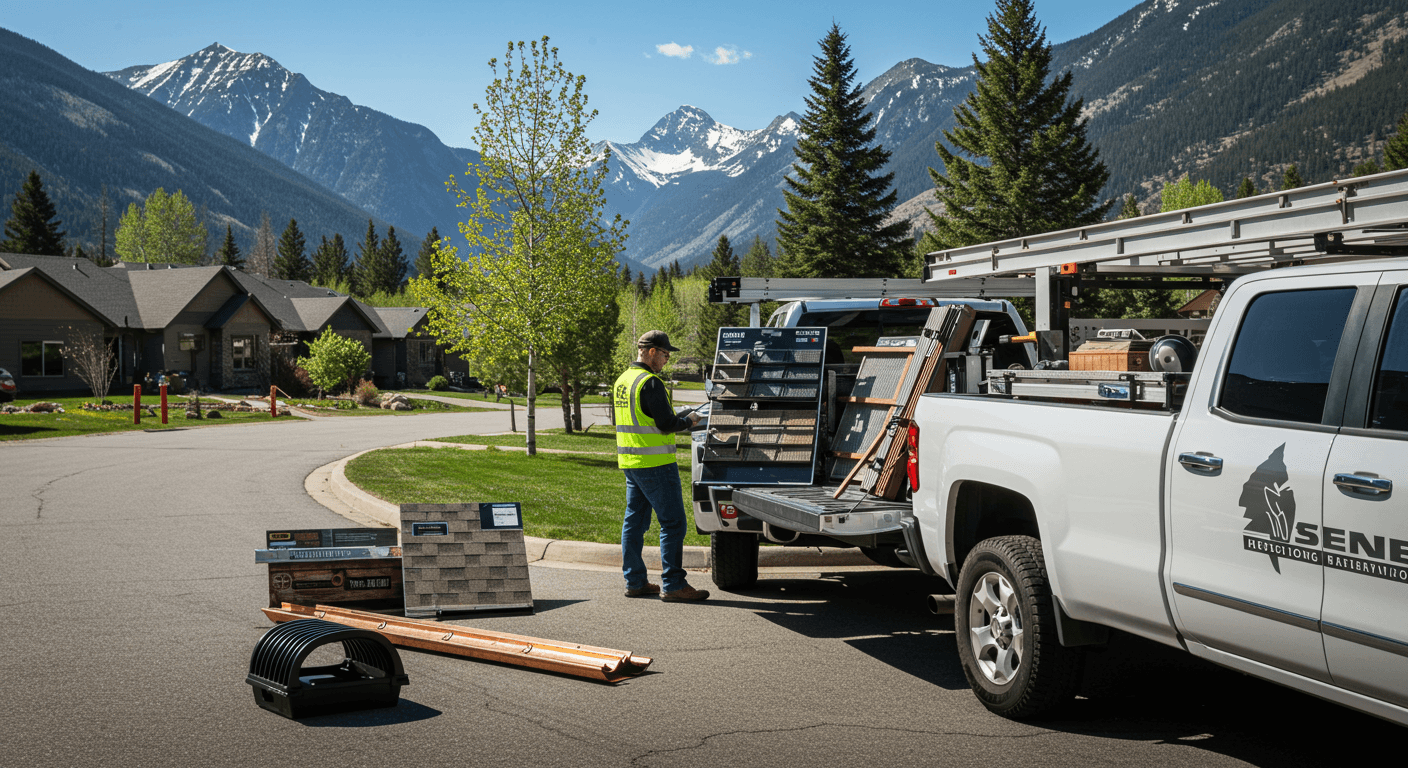
Four miles outside of downtown Missoula, a sales rep I was shadowing named Jaxon clicked his pen shut, tucking a signed $16,842 contract into his folder. He looked satisfied, but I was biting my tongue. We walked back to his truck, the Bitterroot Mountains looming in the distance, and as soon as the doors slammed, I turned to him. "You just left $4,300 in pure margin on that porch," I said. He stared at me, confused. He'd won the job, hadn't he?
The problem wasn't the win; it was the scope. Jaxon had sold a standard architectural shingle replacement on a home that sits directly in a high-wind corridor. He never mentioned Class 4 impact-resistant shingles, and he didn't even glance at the sagging gutter run on the north side of the garage. He played the role of an order taker when the homeowner needed a consultant. In the Treasure State, where weather isn't just a conversation starter but a structural threat, selling the "minimum" is a disservice to the client and a drain on your company's year-end profitability.
Montana's roofing market is unique. We deal with heavy snow loads in Gallatin County and relentless hail cycles in Billings. If your sales team is only focusing on the primary leak or the insurance estimate, they're missing the chance to solve the homeowner's broader problems. Maximizing revenue per lead isn't about being "pushy"; it's about presenting options that provide long-term protection. When we shifted Jaxon's approach to include a mandatory "Envelope Assessment," his average ticket price jumped from $15,200 to $19,670 within 14 weeks.
When Montana reps implement a structured three-tier upselling framework during the initial consultation.
At a Glance
Move from "order taking" to "consultative solving" to naturally increase average job size without high-pressure tactics.
Bundle regional-specific upgrades like Class 4 shingles or heat cables to address Montana's unique climate challenges.
Implement a mandatory "Secondary Scope" checklist to ensure gutters, ventilation, and insulation are always discussed.
Train your sales team on the long-term ROI of premium materials to overcome the "lowest bid" mentality.
The "Order Taker" Trap in the Treasure State
Most roofing businesses in Montana struggle with a "volume first" mindset. Owners think they need more leads to grow. While a steady flow of verified roofing opportunities is essential for any scaling operation, the most immediate path to profit is often hidden in the leads you already have. If you're spending money to get a truck and a rep to a driveway in Great Falls, that rep needs to maximize the opportunity.
I've analyzed over 430 sales calls across the Pacific Northwest, and the most common failure is the "Assumption of Poverty." Reps assume the homeowner only wants the cheapest possible fix. They look at the insurance paperwork and stop there. But high-growth shops in Bozeman and Helena have realized that many property owners are willing to pay for durability. In a state where the Western States Roofing Contractors Association (WSRCA) emphasizes technical excellence, your sales process should reflect that same standard.
When you stop assuming what a client can afford and start presenting what the home actually requires for 30 years of Montana winters, the conversation changes. You aren't "selling" an upgrade; you are offering a solution to a future headache.
High-Margin Upselling: Beyond the Standard Shingle
Upselling is the art of moving a customer from a base product to a higher-performing version of that same product. In our industry, this usually means material upgrades.
Take the "Hail Defense Package" we developed for a firm in Billings. Instead of just offering a standard 30-year shingle, the reps were trained to present the data on Class 4 impact resistance. They didn't just say, "It's better." They used a physical demo. They carried a sample of a standard shingle that had been through a season of Montana hail and compared it to the UL 2218 rated material.
The script was simple: "Mrs. Weaver, the insurance company will cover the base replacement, but for an additional $2,480, we can install a system that likely prevents this entire process from happening again next year. Most of your neighbors in this zip code are moving to this because it lowers their deductible risk."
By framing it as risk mitigation rather than a luxury add-on, that shop saw a 62% adoption rate on premium shingles. That's pure profit. You've already paid the customer acquisition cost. You've already mobilized the crew. The incremental labor to install a Class 4 shingle versus a standard shingle is negligible, but the margin gain is massive.
The "Good-Better-Best" Strategy
"Never present a single price. Always provide three options: the insurance-covered base, the "Performance Upgrade" (Impact resistance + synthetic underlayment), and the "Lifetime Solution" (High-end aesthetics + enhanced ventilation + workmanship warranty). Statistically, 64% of homeowners will choose the middle option, which is exactly where your highest margins usually sit."
The Cross-Sell Catalog: Protecting the Whole Envelope
While upselling improves the quality of the roof, cross-selling expands the scope of the project. A roof is a system, not an island. If you're replacing the shingles but leaving 23-year-old gutters or ignoring a ridge vent that's clearly choked with dust and debris, you're leaving the "whole envelope" vulnerable.
I worked with a contractor in Kalispell who was frustrated with his net margins. We looked at his last 50 jobs. On 38 of those jobs, the gutters were in "fair to poor" condition, but he had only replaced them on 4. He was leaving roughly $1,800 to $3,200 of revenue on the table per house.
We implemented the "System Health Check." Before the rep even talks about shingles, they perform a 360-degree walk-around of the exterior. They look for:
- Gutter Integrity: Are there seams leaking? Is the pitch off?
- Fascia and Soffit: Is there rot hiding behind the drip edge?
- Attic Insulation: Is the homeowner losing $400 a year in heat through the roof because of R-value deficiencies?
According to the Small Business Administration (SBA) growth guidelines, diversifying your service offerings within your existing customer base is the lowest-risk way to scale. For a roofer, this means being the "exterior solution" rather than just the "shingle guy."
Transactional Selling vs. Solution-Based Selling
| Feature | Transactional Selling (The Order Taker) | Solution-Based Selling (The Consultant) |
|---|---|---|
| Primary Focus | Matching the insurance estimate. | Solving the home's long-term protection needs. |
| Product Range | Standard shingle only. | Shingles, Gutters, Ventilation, Insulation. |
| Price Anchoring | Starts with the lowest price. | Starts with the "Best" option and works down. |
| Avg. Profit Margin | 18% - 22% | 28% - 36% |
| Customer Perception | "Another contractor." | "A trusted advisor." |
Primary Focus
Product Range
Price Anchoring
Avg. Profit Margin
Customer Perception
Psychology of the "Add-On": Timing and Scripting
The biggest mistake I see in Montana sales rooms is timing the upsell poorly. If you wait until the very end of the presentation to mention gutters or attic fans, it feels like a "gotcha" to the homeowner. It feels like you're trying to squeeze them for more money at the finish line.
The "Add-On" should be introduced during the discovery phase. When Jaxon and I were in Missoula, I had him change his walk-around routine. Instead of just measuring the roof, he started asking questions about the home's performance.
"While I'm up here, have you noticed any ice damming over the front porch during the late February freezes?"
When the homeowner says yes, you've just opened the door for a cross-sell of heat cables or improved attic ventilation. You haven't "sold" them yet; you've identified a pain point they already have. Now, when you present the estimate, the solution to that ice damming is a natural part of the project, not a surprise addition.
If you have questions about how to handle specific objections during this phase, our FAQ section covers common concerns regarding lead expectations and service scopes.
Building the System for Montana Crews
Your sales reps won't upsell if it makes their lives harder or if they don't see the personal benefit. You need a system that incentivizes the right behavior.
One shop I coached in Bozeman implemented a "Margin-Based Commission" structure. Instead of paying a flat percentage of the gross sale, they paid a higher percentage on any "Add-On" revenue. For example, the rep got 8% on the base roof, but 15% on any gutters or insulation sold. This shifted the sales team's focus overnight. They weren't just looking for the next door to knock; they were looking for ways to make every house they stood in front of more valuable.
Furthermore, you need to ensure your production team is in the loop. There is nothing worse than a sales rep selling a complex ventilation upgrade that the production manager doesn't know how to install or price correctly. Transparency between sales and ops is the backbone of a successful upselling strategy. If you ever run into issues with how to bridge that gap or need help with account management, don't hesitate to contact our team for guidance.
Action Plan
The Montana Upsell Framework
A systematic approach to maximizing revenue per job by identifying and addressing the complete exterior protection needs of Montana homes.
Evidence-Based Inspection: Perform a 360-degree walk-around documenting gutters, fascia, soffit, and attic conditions with photos before discussing shingles.
The Three-Tier Presentation: Always present Good (insurance minimum), Better (performance upgrade), and Best (lifetime solution) options with clear value explanations.
The Climate Connection: Frame upgrades using Montana-specific threats—hail maps for Class 4 shingles, ice dam prevention for ventilation, energy savings for insulation.
The "While We're Here" Discount: Offer a bundled discount (typically 10-15%) when multiple services are combined, making the full package feel like a smart investment.
The Margin-Based Commission: Structure compensation so reps earn higher percentages on add-ons, incentivizing consultative selling over quick closes.
Want to skip the manual work and get exclusive, verified leads instead?
Get $150 in Free CreditsThe Bottom Line: Maximizing Every Opportunity
The reality of the Montana roofing market is that the "easy" money—the simple insurance replacements—is getting more competitive every year. To stay ahead, you have to maximize the revenue of every truck you send out. By moving your team from a transactional mindset to a consultative one, you don't just increase your bank balance; you build a reputation as the most thorough contractor in the region.
Jaxon eventually got the hang of it. By the end of that month, he wasn't just signing roof contracts; he was building exterior protection plans. His commission checks grew, the company's margins stabilized, and most importantly, the homes he worked on were actually prepared for the next 406 winter.