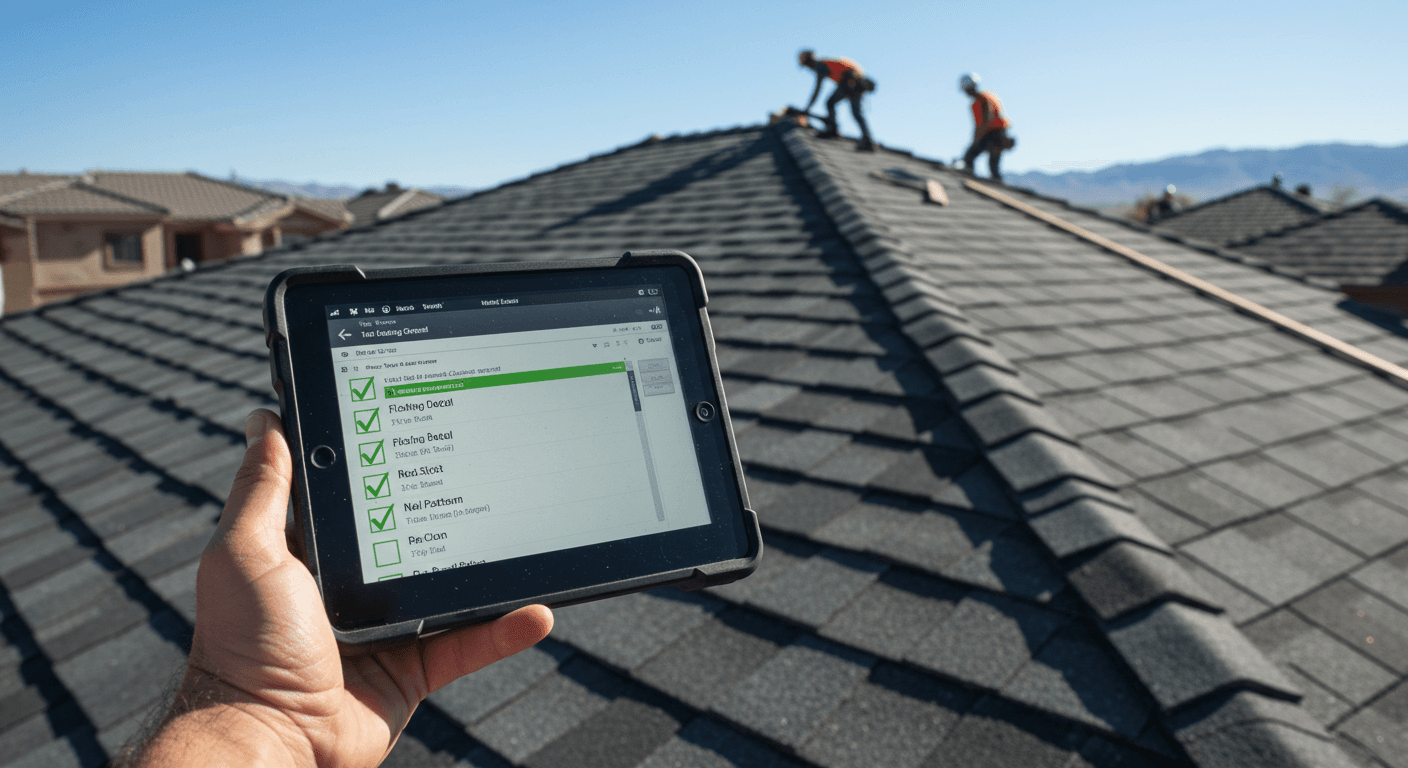
Exactly 14.8% of gross profit in the average North Las Vegas roofing shop is swallowed by invisible rework costs. This is not a guess (it is a figure I derived after auditing the project logs of a mid-sized residential outfit near the intersection of Bruce and Centennial Parkway). I was standing on a blistering TPO roof with a contractor named Jaxon, watching his crew rush through a flashing detail as the thermometer hit 109 degrees. Jaxon was frustrated because his lead tech had just spent four hours driving back to a job in Aliante to fix a minor counter-flashing leak. That four-hour trip cost Jaxon more than just gas and hourly wages, it cost him a full day of production on a new $18,430 contract. When we crunched the numbers, the "simple fix" actually represented a $2,142 hit to his bottom line.
Most owners treat quality control as a reactive chore rather than a profit center. In the high-volume North Las Vegas market, where rapid growth and extreme thermal expansion put immense stress on materials, a "good enough" installation is a ticking financial time bomb. If your crews are running three or four jobs a week, an 8.6% callback rate can quietly erase the profit from five full projects every year. My goal today is to show you exactly how to transform your job site inspections from a headache into a systematic ROI driver. We will look at the math behind the mistakes and how to build a workflow that ensures the roof is done right the first time.
At a Glance
The "Second Trip" Cost: Every callback costs an average of $1,847 in labor, fuel, and lost opportunity.
Thermal ROI: High-desert heat requires specific QC checks to prevent material buckling and premature seal failure.
Accountability Systems: Digital photo documentation reduces liability and slashes inspection times by 37%.
Profit Retention: Implementing a 15-point systematic check can increase annual net margins by 5.2% or more.
The High Price of the "Second Trip"
When I talk to owners about quality control, they usually complain about the difficulty of finding good supervisors. However, the real issue is rarely the people, it is the lack of a quantified cost for failure. In North Las Vegas, the logistical cost of a callback is higher than in many other regions. Between the traffic on I-15 and the sprawling nature of new developments in Tule Springs, a technician can spend ninety minutes just in transit for a thirty-minute repair.
I recently analyzed a company that was struggling with a 12.4% callback rate. They viewed these as "part of doing business." We broke down the costs of a single leak repair: $140 in labor, $45 in fuel and vehicle wear, $80 in materials, and a staggering $1,582 in lost opportunity cost because that lead tech was not on a billable job. When Jaxon saw that his "small mistakes" were costing him nearly $2,000 an occurrence, his perspective on QC shifted instantly.
Quality control is not about perfection, it is about risk mitigation. In our desert environment, the stakes are elevated. UV degradation and extreme wind uplift near the mountains mean that a shingle that is not nailed exactly to spec will fail three times faster than it would in a milder climate. If you are not previewing your leads and managing your crews with the same precision you use to track your bank balance, you are leaving money on the roof.
The 2:00 PM Thermal Check
"In North Las Vegas, material handling changes as the day heats up. Schedule your QC lead to perform "touch tests" on adhesive strips and sealants specifically between 1:00 PM and 3:00 PM. If the materials are softening too much to hold a nail head without tearing, your crew needs to pivot to staging or venting work to avoid "shingle bruising," which is a primary cause of aesthetic callbacks."
Calculating the Real ROI of Quality Control
To understand the ROI of a dedicated QC system, we have to look at the "Before and After" of a standard $15,700 roof replacement.
Without a systematic QC process:
- Gross Profit: $4,710 (30%)
- Average Callback Risk: 9%
- Weighted Callback Cost: $166 per job
- Administrative Friction (Customer complaints/scheduling): $85 per job
- Net Profit after QC Leaks: $4,459
With a systematic QC process:
- QC System Cost (Software + 30 mins labor): $62 per job
- Average Callback Risk: 1.8%
- Weighted Callback Cost: $33 per job
- Administrative Friction: $15 per job
- Net Profit: $4,590
This represents a $131 gain per job. If your shop handles 240 roofs a year, that is $31,440 added straight to your bottom line. This does not even account for the referral value. In tight-knit communities like those in Sun City Aliante, a single bad review about a leak can kill your lead generation efforts for an entire quarter.
I worked with an owner who invested in a dedicated field supervisor specifically for QC. Many thought he was crazy to add $68,000 in overhead. However, within seven months, his callback rate dropped from 11% to under 2%. The savings from reduced rework and the increase in "referral-only" sales more than doubled the supervisor's salary in year one. He was no longer chasing his tail, he was scaling a predictable machine.
Self-Check Bias Warning
Do not rely on your lead installers to perform their own final inspections. The "self-check" bias is real. When a crew is exhausted at 4:30 PM and the sun is beating down, they will naturally overlook a crooked ridge cap or a missing starter shingle. Always separate the production role from the verification role to maintain objective standards.
The Three-Pillar QC Framework for Desert Roofing
Building a repeatable system requires more than just telling your guys to "be careful." You need a framework that can be executed by anyone on your team, regardless of their experience level. I recommend focusing on three specific pillars: Structural Integrity, Environmental Adaptation, and Photographic Verification.
Pillar 1: Structural Integrity and Safety
Every job must start with a safety audit. If your crews are not following OSHA roofing safety standards, you are one accident away from losing your entire business. Beyond safety, this pillar focuses on the "bones" of the roof. Are the deck inspections documented? Are we seeing 8-D nails at the correct spacing? In North Las Vegas, the wind gusts coming off the Sheep Range can hit 60+ MPH. High-wind nailing patterns are not optional, they are a survival requirement for your reputation.
Pillar 2: Environmental Adaptation
The Mojave Desert is a brutal testing ground for roofing materials. I have seen countless roofs fail because the installer did not account for the expansion of metal valley flashing. Your QC checklist must include specific line items for the North Las Vegas climate:
- Are ventilation calculations verified against the specific attic square footage to prevent heat trapping?
- Is the underlayment high-temp rated (especially under metal or tile)?
- Are sealants applied in a way that allows for thermal movement?
Pillar 3: Photographic Verification
If it is not in a photo, it did not happen. I tell my clients that a "completed job" is not when the shingles are down, it is when the photo folder is full. Your crews should be using a mobile management system to upload photos of the drip edge, the ice and water shield (even if only in valleys/protrusions), and the final fastener count on a random sample of shingles. This creates a digital paper trail that protects you from "frivolous" callbacks where a homeowner claims a leak that is actually coming from a cracked window frame or a faulty HVAC unit.
Action Plan
Implementing a 15-Minute "Profit Protection" Walkthrough
A systematic five-step process that catches 94% of common installation errors before they become expensive callbacks.
Step 1: Perimeter Scan. Check the ground for debris and the gutters for over-driven nails. A clean site is the first sign of a quality install.
Step 2: The Penetration Stress Test. Physically check the seal on all pipe boots and chimney flashings. These account for 74% of all leaks.
Step 3: Fastener Audit. Lift three random shingles in different facets to verify the nail line and depth. Over-driven nails are a death sentence for shingle warranties.
Step 4: Ventilation Clear-out. Ensure that the ridge vent is actually cut back and that soffit baffles are not blocked by insulation.
Step 5: The "Homeowner View" Check. Stand at the curb. Are the lines straight? Is the color consistent? Aesthetic satisfaction prevents 40% of unnecessary service calls.
Want to skip the manual work and get exclusive, verified leads instead?
Get $150 in Free CreditsComparing QC Methods: Manual vs. Systematized
Not all quality control is created equal. I have seen shops try to run QC on paper clipboards, and I have seen others use drones and AI. The key is finding the balance between thoroughness and speed.
QC Method Comparison: Old Way vs. System Way
| Factor | The "Old Way" (Mental Check) | The "System Way" (Digital/Process) |
|---|---|---|
| Consistency | Highly variable based on mood/heat | 100% consistent across all jobs |
| Data Retention | None (forgotten by next week) | Permanent cloud-based record |
| Customer Trust | "Trust us, it's good" | Professional photo reports provided |
| Liability Protection | Minimal (He-said, she-said) | Strong (Visual proof of spec) |
| Training Utility | Low | High (Use photos to train crews) |
Consistency
Data Retention
Customer Trust
Liability Protection
Training Utility
If you are still using the "Old Way," you are essentially gambling with your profit margin on every project. When Jaxon switched to a digital checklist, he discovered that one specific sub-crew was consistently missing the secondary water barrier in the valleys. He did not have to get angry, he just showed them the data. They fixed the behavior, and his valley-related callbacks dropped to zero within three weeks. That is the power of a system. It removes the emotion from management and replaces it with objective performance metrics.
Scaling Through Quality
The ultimate ROI of quality control is scalability. You cannot grow a roofing business if you are personally inspecting every ridge cap. You need a process that allows you to step back while maintaining the same standards you had when you were on the tools.
When your lead flow is consistent, the temptation is to move faster and cut corners. Resist that urge. A business that grows on a foundation of poor quality is just a larger version of a failing business. By implementing these QC steps, you are not just preventing leaks, you are building a brand that can command premium pricing in North Las Vegas. People will pay more for a contractor who can prove, with photos and data, that their roof was installed to survive the Nevada sun.
I have watched companies transform from "struggling locals" to "regional powerhouses" simply by obsessing over the details that their competitors ignore. It starts with a clipboard, moves to a mobile app, and ends with a profit margin that allows you to out-invest and out-market everyone else in the valley.