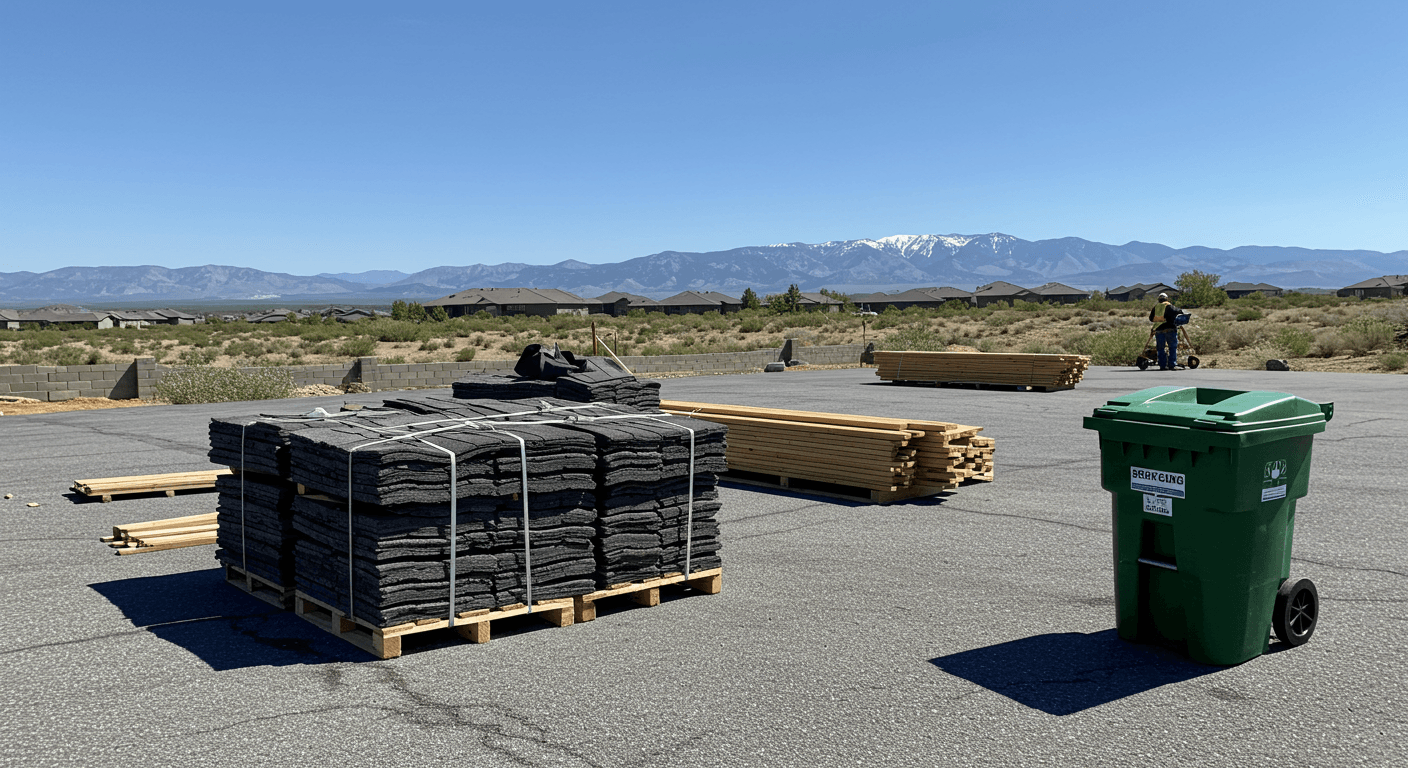
Standing on a steep pitch in Damonte Ranch, I watched Finn's crew toss three unopened bundles of architectural shingles into a dumpster already overflowing with scrap. It was 94 degrees, the Nevada sun was relentless, and honestly, nobody was looking at the bottom line. Finn, who runs a $4.8M operation out of Sparks, was venting to me about his rising material costs. He was looking at a 14% price hike from his supplier and was ready to raise his prices again. I pointed at the dumpster. We did a quick audit right there. Between the over-ordering, the "just in case" bundles, and the damaged flashing from poor staging, he was losing roughly $427 on every single residential square.
In a market like Reno, where logistics and high-desert weather already squeeze your operational windows, letting 12% to 15% of your materials end up in a landfill is a choice to stay small. Most owners think waste is just part of the cost of doing business. It isn't. It is a management failure. When we looked at Finn's books three months later, we found that simply tightening his measurement protocols and changing how his crews staged valley metal saved him enough to buy a new service truck by the end of the year.
At a Glance
Accuracy over assumptions saves roughly $432 per residential job.
Proper staging in high-wind Reno areas prevents $1,200+ in weather-related damage.
Crew incentives tied to waste reduction can improve net margins by 4.2%.
Recycling shingle waste in Washoe County can reduce disposal fees by 18%.
The Scrappage Audit
"Next Tuesday, go to your most active job site and physically count the number of full shingles in the debris trailer. If you find more than five per job, your ordering algorithm is based on fear, not data. Reducing this "fear margin" by just 3.4% can save a mid-sized Reno shop over $21,000 annually."
The High Cost of the "Safety Net" Order
Most Reno contractors order with a 10% waste factor as a default. It is a safety net. You don't want a crew sitting idle on a Friday afternoon because they are two squares short. However, in the high-growth corridors of North Valleys and Spanish Springs, that 10% often turns into 15% because of human error and sloppy staging. If you are doing $3.2M in annual revenue, that extra 5% of "ghost waste" is costing you over $160,000 in pure profit.
The problem is that the "safety net" becomes a crutch. Crews stop being precise with their cuts because they know there is an extra pallet on the truck. I have seen shops verify their job details more accurately before even sending a crew out, which helps them narrow that waste factor down to a lean 6.5%. When you know exactly what the roof requires before the first tear-off begins, you remove the excuse for excess.
Manual Estimates vs. Aerial Intelligence
The first major comparison every Reno owner needs to make is how they calculate their takeoffs. Many old-school guys still swear by the tape measure and the pitch gauge. I get it. It feels more "real." But let's look at the data from a $6.7M firm I consulted for last year.
Manual vs. Aerial/AI Measuring
| Factor | Manual Measuring | Aerial/AI Measuring |
|---|---|---|
| Precision Variance | 8% typical variance | 1.5% to 2% precision |
| Safety Risk | High (rooftop access) | Zero (remote) |
| Documentation | Handwritten notes | Digital proof for adjusters |
| Turnaround Time | 2-4 hours per job | 15-30 minutes per job |
| Cost Per Report | $0 (but high error cost) | $25-$55 per job |
Precision Variance
Safety Risk
Documentation
Turnaround Time
Cost Per Report
Manual Measuring Pros & Cons:
- Pros: Zero software cost, builds "muscle memory" for junior estimators.
- Cons: High risk of math errors, safety liability, and a typical 8% variance in material calls.
Aerial/AI Measuring Pros & Cons:
- Pros: Precision within 1.5% to 2%, documented proof for insurance adjusters, and significantly faster turnaround.
- Cons: Subscription or per-report fees (typically $25 to $55 per job).
The ROI on AI measurements isn't just about saving time. It is about the $1,142 in "over-ordered" materials you stop sending to the site. When your order is precise, your crew treats the material with more respect. If you want to scale, you have to move away from "guesstimates." I often tell owners that if they preview their job opportunities with data-backed precision, the waste handles itself.
This represents pure profit being thrown away through poor measurement, staging, and inventory management.
Staging Logistics in the "Zephyr" Winds
Reno presents a unique challenge: the wind. If you stage your materials on the roof or even in the driveway without a plan, you are asking for waste. I worked with a contractor named Xavier who was losing thousands in cracked shingles and blown-away underlayment. We implemented a "Staging Standard" that required all materials to be tethered or weighted if the wind exceeded 15 mph.
Furthermore, we looked at the placement. Moving materials twice is a recipe for damage. If your crane operator drops the pallets in a spot that requires the crew to haul them across the yard, you're going to see a 3% increase in breakage. We started using a digital site map for every project. The estimator would mark exactly where the shingles, the dumpster, and the portable toilet should go. This reduced site-management time by 19 minutes per day and cut material damage by 9.4%.
Safety also plays a role in waste. A disorganized site leads to accidents, and accidents lead to stopped work. Following the OSHA Stop Falls framework ensures your crew is focused on the task, not tripping over poorly staged bundles. A safe site is an efficient site.
Crew Incentives: Making Waste Their Problem
You can have the best software in the world, but if your crew doesn't care about waste, you'll still see it in the dumpster. One of the most successful strategies I've implemented with Reno shops is the "Profit Share Waste Bonus."
We established a baseline waste factor of 7%. If a crew finished a job with a waste factor of 5% or less, without sacrificing quality, we split the savings with them. For a typical $18,400 roof, a 2% saving is about $368. Giving the crew $180 of that keeps them motivated to use every starter strip and cap shingle effectively.
Training is the backbone of this. Utilizing resources like the National Center for Construction Education to standardize how your teams handle materials can create a culture of professional craftsmanship rather than just "getting it done." When your guys see themselves as technicians, they stop treating your shingles like trash.
The Disposal Dilemma: Trash vs. Treasure
In Washoe County, disposal fees are a constant thorn in the side of profitability. However, I've seen contractors turn this around by sorting their waste. Instead of one giant 30-yard dumpster for everything, they use a smaller bin for clean shingle scrap that can be recycled into asphalt road base.
The math works like this:
- Standard Dumpster Fee: $485 to $620 per pull.
- Recycling Drop-off: $125 to $210 (often based on weight).
By diverting just 40% of their waste to a recycling facility, one shop in South Reno saved over $8,400 in six months. It takes a bit more coordination, but the ROI is undeniable. It also serves as a great marketing angle for the eco-conscious homeowners in areas like Montrêux or Caughlin Ranch.
Technology and Inventory Management
If you are still tracking your inventory on a whiteboard in the warehouse, you are losing money to "shrinkage." Items like coils of nails, rolls of ice and water shield, and high-end flashing have a way of disappearing.
I helped a shop implement a simple QR-code system for their warehouse. Every time a lead man loaded his truck, he scanned the materials out. This created accountability. Suddenly, the "missing" rolls of underlayment stopped being an issue. If you're looking to get started with better systems, start with your inventory.
Managing waste is not about being cheap. It is about being disciplined. The most profitable roofing companies I know in Northern Nevada aren't the ones doing the most volume; they are the ones with the tightest operations. They know that every dollar saved in the dumpster is a dollar that goes directly into their pocket or back into their growth budget.