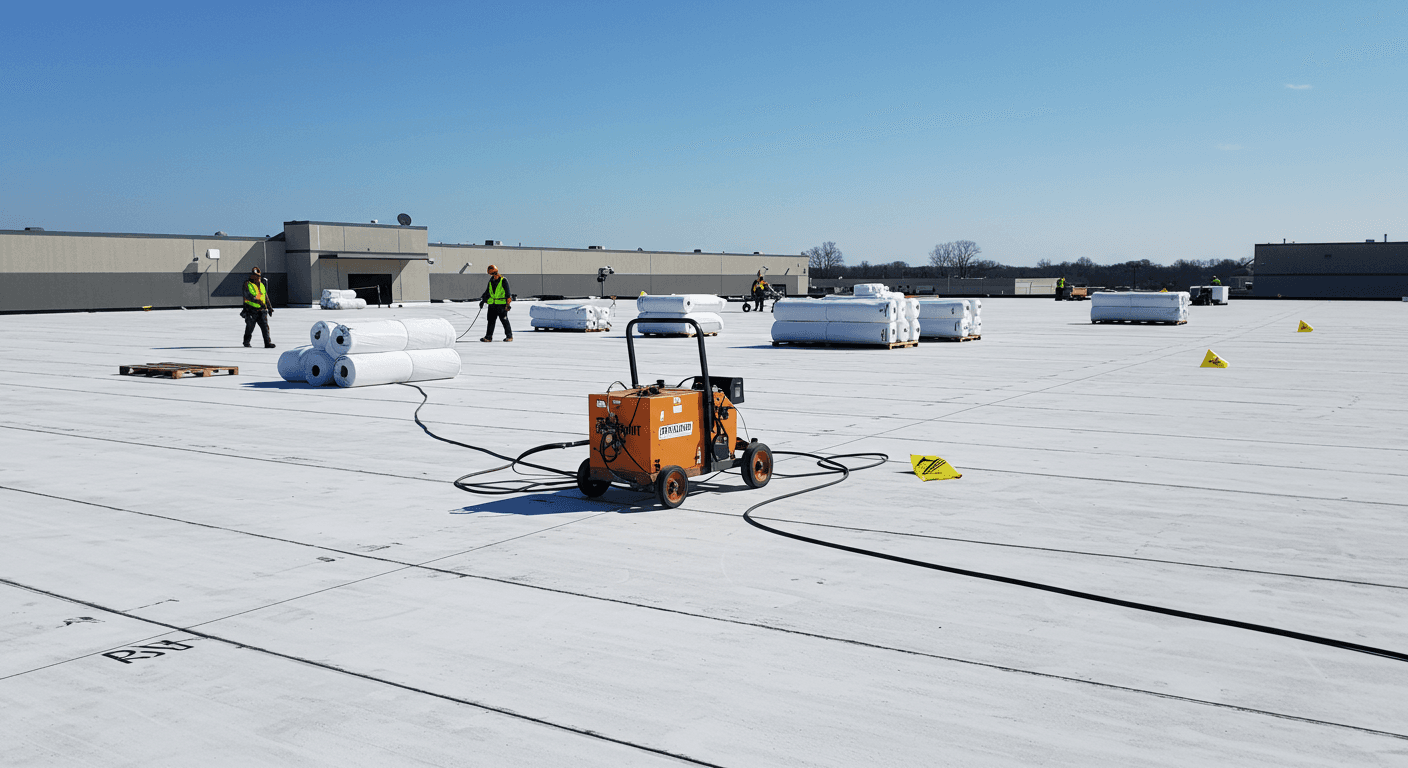
Ignoring the 38.4% swing in mobilization cost between a residential tear-off and a flat commercial install is one of the fastest ways to choke a growing roofing company. Plenty of owners see a $140,000 warehouse bid and think payday, then forget the 92-day average accounts receivable cycle that many commercial contracts quietly assume. If you cannot float material and labor for a quarter while a GC or property manager processes pay apps, you are not ready for the work. The shift is not only a different welder or a bigger roll of membrane. It is a rebuild of how cash moves through the business.
This piece walks through liquidity, crew design, procurement, and a paced rollout so you can grow into TPO and EPDM without torching the residential engine that still pays Friday payroll.
Table of Contents
Residential reps often miss tapered crickets, fastener patterns, and uplift math, which shows up later as buyouts, re-inspections, or donated change orders.
The liquidity gap
Commercial roofing rewards patience on contract value and punishes impatience on working capital.
When I review balance sheets for shops trying to bridge into commercial work, the loudest gap is almost always the mobilization fund. Residential can feel like quick turns: deposit early in the week, material midweek, final check before the weekend. Commercial is slower money. The SBA Grow Your Business guide keeps calling out cash timing during expansion, and roofing is a blunt example. You need enough cash to run at least two active projects without inbound checks for 60 to 90 days, which is a different muscle than chasing homeowner draws.
I audited a Midwest shop where Nolan landed three retail strip malls in one month. Booked revenue looked like $480,000. In practice he was three weeks from missing payroll because suppliers were on 30-day nets while owners paid on 60-day terms. We forced progress billing the moment materials hit the lot, plus a simple draw schedule tied to dry-in milestones. Without that discipline, the headline win would have become a liquidity crisis.
If AR outruns your line, you still owe the crew
Treat Net-60 like a normal condition, not an exception. Build a weekly AR review, align supplier terms where you can, and keep a defined cash buffer before you chase industrial envelopes that look glamorous on a proposal cover.
What has to be true before commercial work pays
Hold a mobilization reserve that covers roughly ninety days of operating load, not just one big material ticket.
Hire or contract a commercial estimator who lives in submittals, uplift, and drainage details instead of reusing a shingle rep.
Use progress billing and documented draws so outstanding AR does not silently outpace payroll.
Upgrade general liability and umbrella limits before you chase industrial sites that gate access on certificates.
Specialized crews beat the jack-of-all-trades story
Heat-welded TPO and EPDM layups punish guesswork in a way steep-slope production never will.
Your fastest shingle crew is not automatically your best commercial crew. Residential rewards rhythm and throughput. Low-slope work rewards documentation, tolerances, and patience under third-party inspectors. A leak on a starter home might mean drywall and paint. A leak above a cold storage roof line can spiral into consequential losses nobody priced on the first bid.
I have had better luck hiring one seasoned commercial foreman and growing a green crew beside them than forcing three veteran steep-slope teams to fake fluency in heat welders and seam probes. The safety stack is different too: crane signals, perimeter control, and tie-off rules that site supers actually enforce. Build the roster for that reality, not for bragging rights on squares per day.
Residential steep-slope versus commercial low-slope realities
| Factor | Residential (shingle or metal) | Commercial (TPO, EPDM, modified) |
|---|---|---|
| Average sales cycle | Often 3 to 14 days | Often 3 to 9 months |
| Payment terms | Deposit plus final | Net 30 to Net 90 with retainage |
| Crew profile | High production and pace | Technical precision and safety paperwork |
| Margin profile | Roughly 25% to 35% gross on smaller tickets | Roughly 15% to 25% gross with larger volume |
| Warranty exposure | Manufacturer plus workmanship on steep slope | Long-horizon NDL and performance language |
Average sales cycle
Payment terms
Crew profile
Margin profile
Warranty exposure
Procurement is a documentation sport
Facility directors buy risk reduction. Price is only one line on a long scorecard.
Nobody closes a million-dollar low-slope package on the first walk. You earn it through EMR, experience letters, insurance towers, and financials that prove you can finish and stand behind the work. Expect EMR under 1.0 on serious industrial RFQs, umbrellas in the five- to ten-million range on tighter campuses, and bonding references when public work appears. Strong Harvard Business Review small-business coverage on leadership keeps repeating the same point: vendors win when they operate like operators, not like crews hoping nobody reads the fine print.
When intake is messy, estimators burn hours on tours that were never a fit. Teams that want cleaner commercial signal often tighten how they qualify demand up front. If you want the plain-language version of how verification, previews, purchase, and delivery line up, read how LeadZik routes roofing demand. It is the same idea as a tight submittal: show the facts early, then commit resources when the job matches your capacity.
- 01Safety records: keep OSHA logs, near-miss reviews, and training hours where a GC can audit them without a scavenger hunt.
- 02Insurance certificates: load accurate endorsements before the portal deadline so you are not the reason access badges stall.
- 03Financial proof: keep bonding letters, bank references, and work-in-progress schedules ready for owners who underwrite vendors like banks.
Seventy-two hour follow-up
"After you submit a commercial package, call within seventy-two hours with a tight agenda: confirm receipt, clarify any RFIs, and offer a short window for a technical walk. Organized follow-up reads as operational maturity, which matters more than another five cents a square on day one."
Action Plan
Ninety days to launch a commercial roofing lane
A phased build keeps your residential cash engine intact while you stand up insurance, estimating, and field systems that flat work expects.
Weeks 1 to 4, infrastructure: add commercial insurance riders, hire or contract a commercial project manager, and open a dedicated line of credit for membrane and insulation buys so supplier terms do not collide with Net-60 pay apps.
Weeks 5 to 8, soft launch: chase smaller commercial-lite envelopes such as dental offices or shallow retail boxes. Use them to rehearse TPO seams, daily logs, and photo packs without betting the whole brand on the first industrial roof.
Weeks 9 to 12, scaling: move toward larger assets with realistic bonding and cash buffers. Pair outbound targeting with intake filters so estimators only model jobs that match your crew depth and equipment plan.
Tighten intake before you widen the funnel
Bad commercial tours cost real money in fuel, lift rentals, and estimator hours.
One loose intake habit I still see is sending senior estimators to sites that were never commercial-ready. If a lead cannot confirm membrane type, rough size, and decision timeline, you can burn about $475 in overhead per wasted visit once trucks, lifts, and prep time roll in. Shops that stabilize growth pair disciplined field standards with a clear view of the job before boots hit the gravel. When you want that visibility without spamming your sales team, start from LeadZik onboarding with credits so previews line up with the crews and systems you already have.