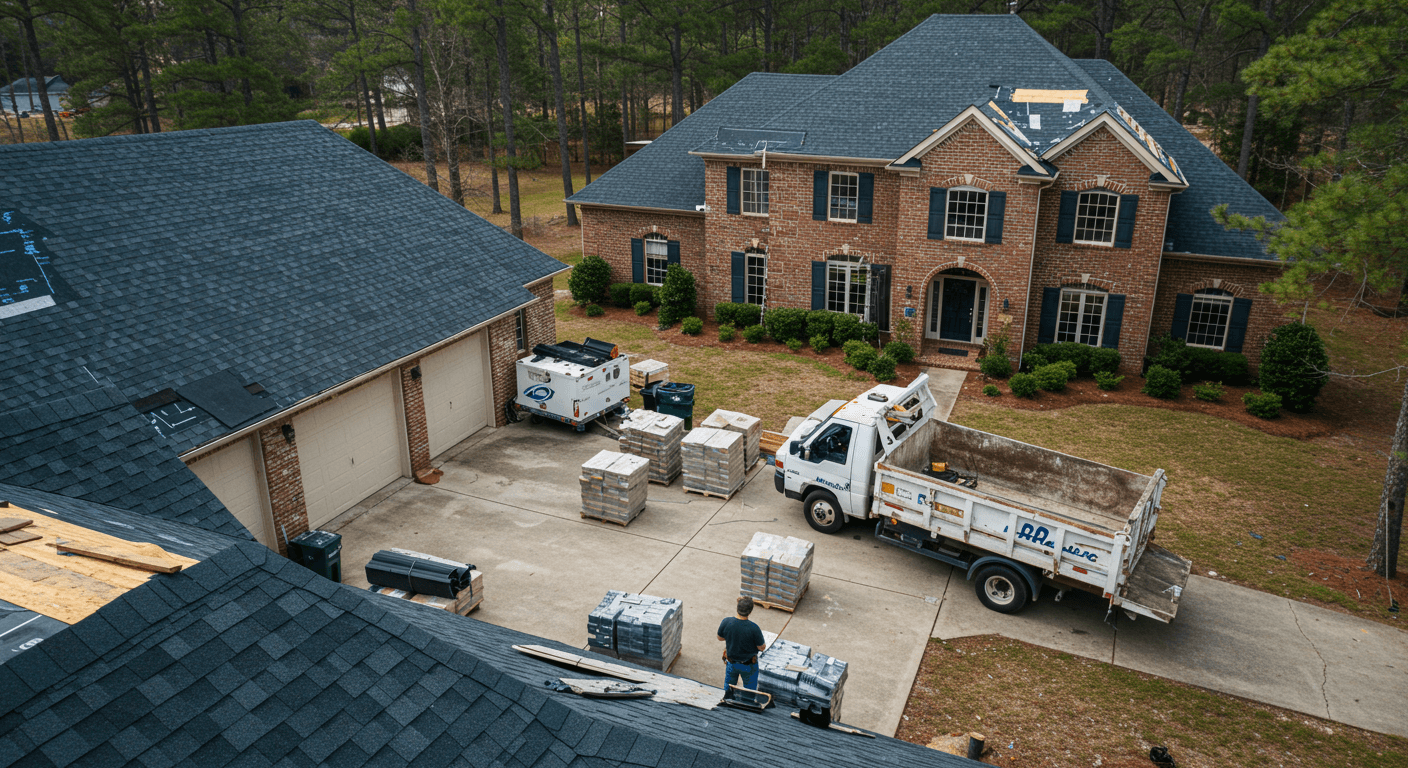
Standing in the middle of a sprawling residential job site in Evans, I watched Devin stare at a digital spreadsheet with the kind of expression usually reserved for a funeral. He had just finished a premium architectural shingle install on a $28,450 contract, yet he was sweating a $9,200 supplier invoice due the following Tuesday. On paper, his company was thriving. In reality, his operating account was hovering dangerously close to triple digits.
This is the "Augusta Gap," a phenomenon I've seen haunt contractors from Summerville to North Augusta. It happens when your production speed outpaces your collection cycle, leaving you wealthy in accounts receivable but insolvent in liquid cash. Devin's struggle wasn't a lack of work; it was a lack of velocity. We spent the afternoon digging into his last 14 months of data, and the leaks were staggering. He was carrying the financing for his customers for an average of 24.5 days after the final nail was driven. For a high-volume shop, that's a recipe for a heart attack.
Managing cash flow in the CSRA (Central Savannah River Area) requires more than just "selling more jobs." It requires a clinical approach to capital allocation, billing milestones, and lead quality. If you are tired of the Friday afternoon scramble to cover payroll despite having a million-dollar pipeline, this breakdown is for you.
At a Glance
Implementing a 13-week rolling cash forecast prevents "blind-spot" insolvency during slow periods like the post-Masters Week lull.
Shifting to a 40/40/20 billing structure reduces the contractor's "float" and places the financial weight back on the project.
High-quality, exclusive leads reduce the "cost of pursuit," which is a silent drain on operating liquidity.
Establishing a dedicated "Tax and Reserve" account (aiming for 8.2% of gross revenue) creates a buffer against Augusta's unpredictable storm-season delays.
The Lethal Illusion of the Growing Pipeline
Most roofing owners in Georgia mistake a busy calendar for a healthy business. I've analyzed internal P&L statements for shops where revenue climbed by 34% year-over-year, yet their net profit margin actually compressed. Why? Because as you scale in Augusta's competitive market, your overhead—fuel for the trucks on Washington Road, workers' comp premiums, and warehouse rent—scales linearly, but your cash collection often lags.
According to the National Roofing Contractors Association (NRCA), one of the primary reasons for small business failure in the trade is not a lack of profit, but a lack of liquidity. You can be profitable on every job and still go bankrupt if the timing of your outflows doesn't align with your inflows.
When Devin and I looked at his books, we saw that his "cost to acquire" a customer was $1,150, but he wasn't recouping that cost until the final insurance check cleared, sometimes 45 days later. He was essentially giving his customers interest-free loans while paying 18% interest on his own revolving credit lines to keep his crews in the field. To fix this, we had to stop looking at "Sales" and start looking at "Cash Velocity."
The 13-Week Forecast: Your Financial Early Warning System
You cannot manage what you do not measure with granularity. Most contractors look at their bank balance today to decide if they can buy a new RAM 2500 tomorrow. That is reactive management. Instead, you need a 13-week rolling forecast.
This isn't a complex accounting maneuver. It's a simple spreadsheet where you plot every expected inflow (confirmed jobs, expected insurance payouts) and every mandatory outflow (payroll, materials, taxes, rent) for the next 91 days. In Augusta, this is particularly vital around April. While the rest of the world is focused on the golf at Augusta National, local roofers often deal with logistical nightmares, permit delays, and a temporary dip in residential access. If you haven't forecasted that dip in production, your May cash position will suffer.
When we built this for Devin, we discovered a "death zone" in his third week of every month where three major supplier bills hit simultaneously. By seeing it 8 weeks in advance, he was able to negotiate a staggered payment plan with his vendor, moving $14,000 of liability 10 days further down the line. That breathing room saved him from dipping into his personal savings to hit payroll.
The 8.4-Day Rule
"I've found that the most successful shops in the Southeast maintain a "Collection Velocity" of 8.4 days or less from job completion to final payment request. If your office staff waits until Monday morning to mail invoices for jobs finished on Wednesday, you are losing thousands in potential interest and liquidity. Automate your invoicing the moment the crew lead uploads the final "site clean-up" photo."
Action Plan
A Tactical Workflow for Stabilizing Your Cash Position
A structured approach to managing your roofing shop's weekly cash position through strategic billing, forecasting, and account segmentation.
The 40/40/20 Deposit Transformation: Stop taking 10% deposits. Move to a structure where 40% is paid upon contract signing (covering all materials), 40% is paid when the materials hit the driveway, and the final 20% is due upon substantial completion. This ensures you are never "out of pocket" for the hard costs of the job.
Segment Your Bank Accounts: Open three distinct accounts: Operations, Tax, and Reserve. Every time a check hits, immediately move 15% to Tax and 5% to Reserve. If you can't pay your bills with the remaining 80%, your overhead is too high or your pricing is too low.
Audit Your Lead Acquisition Costs: Stop burning cash on shared leads that turn into "price-shopping" wars. I've seen Augusta contractors spend $4,000 a month on leads only to close 4% of them. Switching to exclusive, verified leads—like those offered by LeadZik's platform—can drop your CAC (Customer Acquisition Cost) by 22% because your sales team isn't fighting five other hungry contractors for the same Summerville roof.
Implement a "Weekly Cash Huddle": Every Thursday at 8:00 AM, review your 13-week forecast. Identify any week where the projected balance dips below your "Minimum Operating Floor" (which should be 1.5x your average weekly payroll).
Want to skip the manual work and get exclusive, verified leads instead?
Get $150 in Free CreditsWhy Material Volatility is an Augusta Cash Flow Killer
We all remember the supply chain chaos of a few years ago, but even now, localized price fluctuations can wreck a quote made three weeks prior. If you are quoting jobs in Martinez and Grovetown based on "last month's prices," you are gambling with your net margin.
As noted in Roofing Contractor Magazine, proactive material management is a cornerstone of financial health. I recommend my clients in Georgia build a "Material Escalation Clause" into every contract. If the cost of shingles or aluminum flashing rises by more than 4.5% between the contract date and the delivery date, the customer covers the difference. Most homeowners understand this when explained as a way to keep their project on schedule.
More importantly, look at your "Inventory Drag." Are you keeping $20,000 of excess materials in a shed "just in case"? That is $20,000 of stagnant cash. In a high-humidity environment like Augusta, stored materials can also degrade or disappear. Move to a "Just-In-Time" delivery model where materials arrive no more than 24 hours before the tear-off begins.
The Hidden Cost of "Cheap" Leads
Let's talk about the marketing side of cash flow. Most owners treat marketing as a flat expense, but it's actually a variable investment with a massive impact on liquidity.
Think about it: if you buy 50 shared leads for $35 each, you've spent $1,750. If those leads are low-quality, your sales rep spends 40 hours driving all over Columbia County only to close two jobs. Your "Real Cost Per Lead" isn't $35; it's $35 plus the $25/hour you pay the rep, plus the fuel, plus the opportunity cost of the jobs you didn't bid on.
I recently worked with a shop near Fort Eisenhower that was struggling with this. Their "Lead-to-Cash" cycle was 58 days because they were chasing "tire-kickers." We shifted their strategy to focus on exclusive, verified opportunities. By paying a bit more upfront for exclusivity, they reduced their sales cycle to 19 days. That 39-day difference meant they were getting paid for their work more than a month sooner. That is how you solve a cash flow crisis without increasing your debt. If you're curious about how this works for other Georgia shops, checking our blog for more tactical breakdowns is a good start. For specific questions about lead quality guarantees and refund policies, our FAQ covers the details.
Switching to exclusive leads reduced the sales cycle from 58 days to 19 days, dramatically improving cash velocity.
Dealing with Insurance Delays
In Augusta, storm restoration is a massive part of the business. However, insurance companies are not in the business of paying you quickly. They are in the business of holding onto their cash as long as possible.
If you are waiting on a supplement for a job in West Augusta, don't let it sit. I've seen contractors leave $85,000 in supplements "pending" for six months. That is negligent cash management. Assign a specific person in your office to "Insurance Recovery." Their sole job is to call adjusters every 48 hours until the check is cut. A 12.5% increase in supplement recovery speed can literally double your available operating capital in a single quarter.
Creating a "Weather Buffer"
The Georgia climate is a silent thief. A week of heavy rain in July doesn't just delay jobs; it delays the "Cash In" date for those jobs while your "Cash Out" (overhead, rent, vehicle notes) remains constant.
Your "Reserve" account mentioned in the Strategy Breakdown isn't for a rainy day—it's for a "Rainy Week." I tell my clients to aim for a cash reserve that covers 43 days of fixed operating costs. Why 43? Because in the roofing industry, that's usually the length of a "worst-case" disruption cycle plus one billing period.
When Devin finally reached his 43-day buffer, his entire management style changed. He stopped taking "junk" jobs just to keep the lights on and started focusing on high-margin, high-velocity residential projects. He moved from a state of survival to a state of strategic growth.
Common Questions
The Path Forward for Augusta Contractors
Cash flow management isn't about being a "math person." It's about discipline and visibility. It's about realizing that every day a check sits on a customer's kitchen table in North Augusta, your business is losing money.
Start by auditing your last 10 jobs. How many days passed between the contract signing and the first dollar hitting your account? How many days between the final shingle and the final payment? If those numbers are creeping up, your business is at risk, regardless of how many "leads" you have in the hopper.
By implementing the 13-week forecast and the 40/40/20 billing model, you take back control. You stop being a bank for your customers and start being a profitable roofing enterprise. Devin did it, and within 7 months, he wasn't just hitting payroll—he was funding his expansion into the Savannah market with cash, not debt.
Understanding how LeadZik was founded by roofers who faced these exact cash flow challenges can provide additional context on why lead quality matters so much to your bottom line. When you're not wasting time and money on shared leads that turn into bidding wars, your entire financial picture improves.