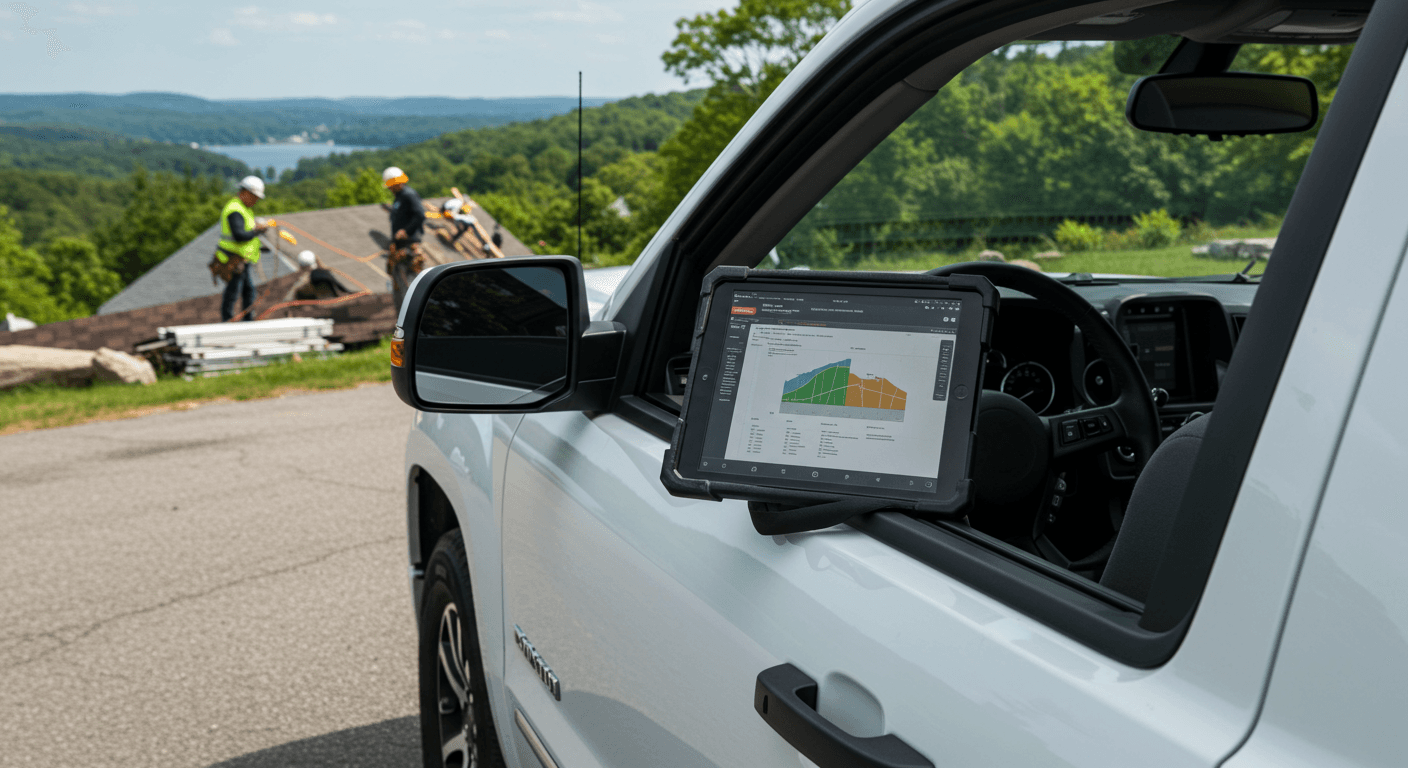
Watching Wesley pull over on the shoulder of the Merritt Parkway to finalize a $24,350 contract on his tablet while his lead installer was still finishing the flashing in Greenwich changed how I looked at overhead. At that moment, Wesley's "office" was a late-model pickup truck and a cloud-based CRM, yet his closing rate was 12.4% higher than the brick-and-mortar shop I had visited in Hartford the previous day. We sat there, the engine idling, as he showed me his P&L statement on a cracked screen. He was outperforming guys with 3,000-square-foot showrooms because he wasn't paying for the privilege of sitting in a chair.
Most contractors in Connecticut are terrified of "going remote" because they think it means losing control of their crews or violating Department of Consumer Protection (DCP) standards for physical record-keeping. The reality I have seen in the field is that a physical office is often just an expensive monument to the way things used to be done. In a state where gas prices hover well above the national average and traffic on I-95 can eat three hours of a project manager's day, every minute spent "checking in" at a central hub is a direct hit to your net profit.
At a Glance
Eliminate Fixed Overhead: Transitioning to remote management can save an average CT roofing firm $4,100 to $6,400 monthly in lease and utility costs.
Recapture Billable Hours: Remote syncs eliminate the "commute to the office" trap, adding roughly 9.5 hours of production time per employee every week.
Enhanced Data Accuracy: Digital-first workflows reduce the $2,300 annual "re-work" cost associated with lost paper files and miscommunicated job specs.
Retention via Flexibility: Remote-friendly shops in the Nutmeg State report 18.2% lower turnover among top-tier project managers.
The Brutal Math of the Connecticut Showroom
Let's look at the numbers. In areas like Fairfield County or the tech-heavy corridors near New Haven, commercial rent isn't just a bill, it is a burden. I recently sat down with a roofer who was paying $4,850 a month for a small warehouse and office space. When we audited his team's actual usage, the office was empty 84% of the time. His sales reps were at kitchen tables, his crews were on pitched roofs, and his admin was working from a desk that could have easily sat in her spare bedroom in Waterbury.
When you factor in the $620 monthly utility bill, the $315 cleaning service, and the "office snacks" that nobody actually eats, that shop was bleeding nearly $6,000 before a single shingle was nailed. If your average net margin is 10%, you have to sell an extra $60,000 of roofing every single month just to keep the lights on in an empty building. That is a massive sales hurdle that vanishes the moment you pivot to a decentralized model.
Average reduction in net profit for CT contractors who maintain large physical offices that remain unoccupied during peak production hours.
According to Roofing Contractor Magazine, the industry is rapidly shifting toward lean operations, but many owners struggle with the psychological transition. They feel that if they can't see their employees, they aren't working. I tell my coaching clients the opposite. If I see your project manager sitting in your office at 10:00 AM on a Tuesday, I know you're losing money. He should be at a job site in Danbury or running a lead in Milford.
Compliance and Remote Documentation in CT
One of the biggest hurdles for Connecticut roofers is the Home Improvement Contractor (HIC) registration and the strict paperwork requirements enforced by the state. You might think a physical office is necessary for compliance, but the National Roofing Contractors Association (NRCA) emphasizes that digital record-keeping is not only legal but often more secure for audit purposes.
In Connecticut, your contracts must include specific language about cancellation rights and your HIC number. By moving to a remote system, you ensure that every rep is using the exact same, updated template. I've seen shops get fined because a junior rep used an old paper form he found in the bottom of his glove box. Digital-first teams don't have that problem. Every contract is pushed from the central "virtual" office, ensuring 100% compliance across the board.
The Paper Trail Trap
Relying on physical folders for job sites in Connecticut leads to a 14.8% higher rate of missing HIC-required documentation. Digital backups are no longer optional for liability protection.
When you're ready to scale your operations, having a reliable source of verified leads becomes critical, and a remote team can handle that volume much faster than a centralized one. Instead of waiting for a rep to come back to the office to grab a lead sheet, they get a notification on their phone, preview the job details, and can be at the homeowner's door in Norwalk before the competition has even checked their voicemail.
The Tech Stack ROI: Spending Hundreds to Save Thousands
To go remote, you need a tech stack. I've seen guys get sticker shock when they see a $350-a-month bill for a high-end CRM or a $200-a-month bill for drone measurement software. But let's do the ROI analysis. If that $550 monthly tech investment allows you to close your $5,000-a-month office, your ROI is roughly 809% in the first month.
Beyond rent, the real savings come from fuel and vehicle wear and tear. A project manager driving from a job in Stamford back to an office in Bridgeport just to "turn in paperwork" is wasting 45 minutes and $12 in gas and maintenance. Do that twice a day, five days a week, and you're looking at $5,760 in wasted labor and fuel per year, per employee.
The 15-Minute Sync Rule
"Replace morning office huddles with a 15-minute standing Zoom call at 6:45 AM. It keeps the team aligned without wasting 2 hours of statewide travel time."
I coached a rep named Xavier who was struggling with his closing rate. We realized he was exhausted by 3:00 PM because he was spending half his day fighting traffic on the Wilbur Cross Parkway just to get to the office for "admin time." We moved his admin work to his home office and gave him a mobile scanning app. His energy stayed higher, he scheduled two extra appointments per week, and his close rate jumped from 22% to 29.4% within two months.
Sales Psychology: Closing the Deal from the Truck
The old-school mentality says you need a showroom to build trust. In 2024, the "showroom" is your digital presence and your ability to provide an instant, professional estimate. Homeowners in wealthy CT enclaves like New Canaan or Ridgefield value their time above all else. They don't want to visit your office; they want a PDF sent to their phone while you're still standing on their lawn.
I teach a specific script for remote-first reps that builds more authority than a physical building ever could:
"Mrs. Thompson, because our team operates entirely in the field, we don't carry the $50,000-a-year overhead of a fancy showroom. That means I'm able to put that money back into the quality of your GAF shingles and a 10-year workmanship warranty that most of my competitors can't afford to match. You're paying for the roof, not my rent."
This positioning turns your lack of an office into a competitive advantage. It frames the competition as "bloated" and your company as "efficient." When you preview job details before even driving to the site, you can even show up with a pre-printed satellite report, further establishing your tech-forward approach.
Action Plan
How to transition your CT roofing shop to a high-ROI remote model in 4 steps
A systematic approach to eliminating office overhead while maintaining compliance, team cohesion, and operational efficiency.
Audit Physical Necessity: Review your last 90 days. Identify every task that "required" the office. You'll likely find 92% could have been done via cloud software or a phone call.
Standardize the Tech Stack: Select one CRM, one measurement tool, and one communication platform (like Slack or Teams). Eliminate any "shadow IT" where reps use their own personal apps.
Implement Field Reporting: Require crews to upload 10 "milestone" photos per job (teardown, decking, underlayment, etc.). This replaces the need for an owner to visit every site daily.
Reallocate the Savings: Take 20% of the saved rent and put it into performance bonuses for your remote managers. This ensures they stay disciplined without "eyes-on" supervision.
Want to skip the manual work and get exclusive, verified leads instead?
Get $150 in Free CreditsThe Talent War: Why Remote Wins in Connecticut
The labor market in Connecticut is tight. Finding a project manager who knows the difference between a starter strip and a ridge vent is hard enough; finding one who is willing to commute an hour to sit in your office is nearly impossible. By offering remote flexibility, you expand your hiring pool from a 15-mile radius to the entire state.
I recently worked with a shop owner who was about to lose his best salesperson to a competitor. The competitor offered $5,000 more in base salary. My client couldn't match the cash, but he offered a "Work from Home Friday" and eliminated the requirement to come into the office for Monday morning meetings. The salesperson stayed. To him, the three hours of saved traffic and the ability to pick up his kids from school in Fairfield was worth more than the $5,000 pre-tax raise.
Increase in job application volume for roofing companies that list 'Remote-First Admin' in their hiring advertisements.
If you're worried about productivity, look at the data. Remote workers often put in more hours because the lines between "home" and "work" blur. While you need to manage that to prevent burnout, the initial bump in output is usually around 13.5%. You aren't paying for "water cooler talk" anymore. You're paying for results.
Calculating Your Payback Period
If you decide to shut down your office and go remote, what does the timeline look like?
- Month 1: Exit lease (you may have a buyout fee, typically 2-3 months' rent). Initial tech setup costs.
- Month 2: Personnel training. You might see a slight 5% dip in efficiency as people learn the new CRM.
- Month 3: The "Break-Even" point. Savings on utilities and travel begin to outpace the lease buyout costs.
- Month 6: The "Pure Profit" phase. Your overhead has dropped by a permanent $3,000-$5,000, and your team is fully adapted.
For a mid-sized CT shop, the total payback period on a remote transition is usually around 4.5 to 5 months. After that, it is pure margin. This extra cash flow can be reinvested into growth. Instead of paying a landlord, you could be spending that money to get started with fresh leads that keep your crews busy through the winter months.
Managing the Culture Shift
The biggest "cost" of going remote isn't financial; it's cultural. You have to learn to manage by metrics, not by "vibes." You can't just walk over to someone's desk and ask for a status update. You have to look at the dashboard.
I tell my students to focus on three "North Star" metrics for their remote teams:
- Lead Response Time: Must be under 8 minutes.
- Photo Documentation Rate: 100% of jobs must have a full set of digital photos before the final invoice is sent.
- Customer Satisfaction Score: Measured via a digital survey sent immediately upon job completion.
If those three numbers are green, it doesn't matter if your office manager is working from a beach in Old Saybrook or a kitchen in Enfield. The work is getting done, the customers are happy, and your bank account is growing.