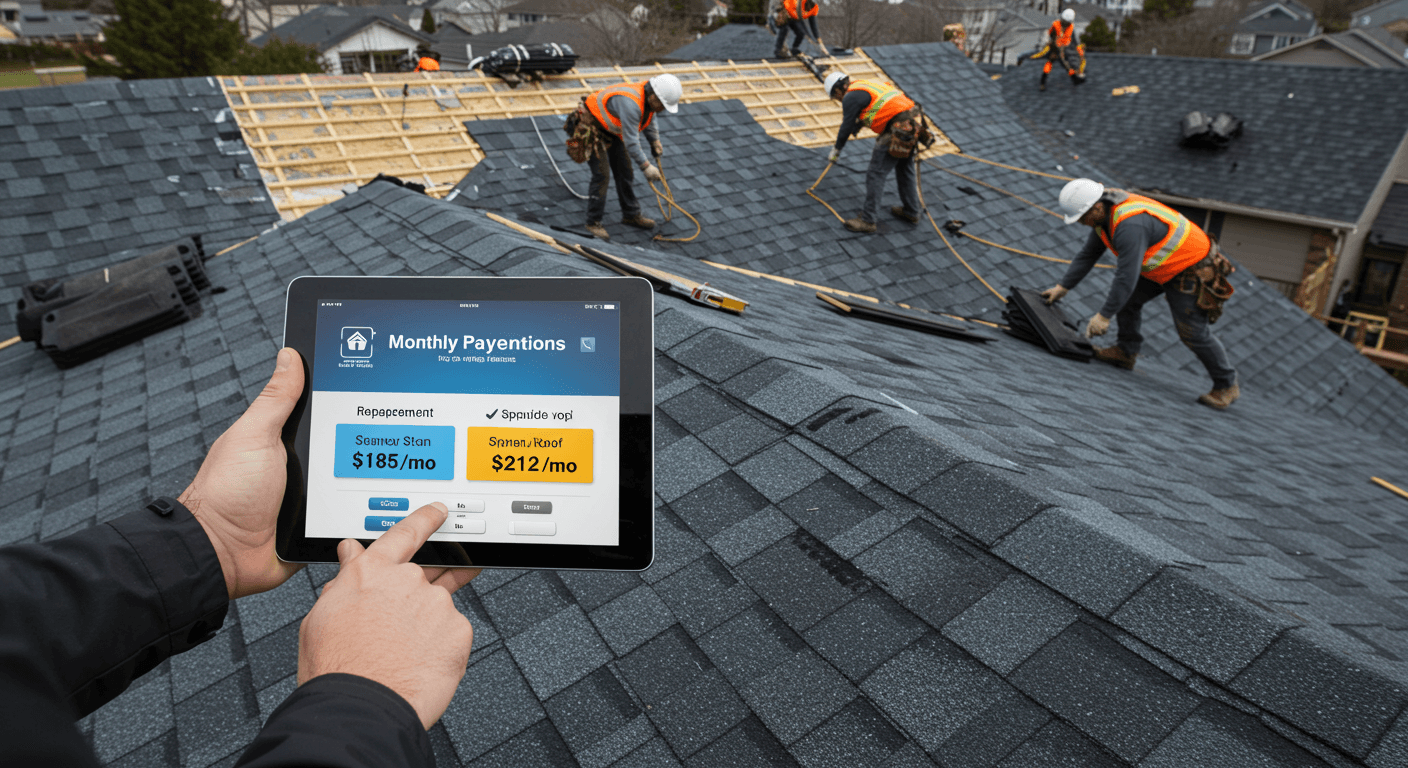
$12,847 is the average cash threshold where a full replacement bid often turns into a hard no, yet shops with integrated financing are closing about 28.6% more often on the same ticket sizes. The split is not about shingle brand or crew reputation. It is a shift in how homeowners treat big home projects as monthly expenses instead of one-time capital. A cash-only shop sees steep-slope replacement as a giant liability for the customer to fund. A financing-ready team reframes the same scope as a $195-a-month investment in the asset. The data also suggests that for every dollar of friction added by a messy credit application, contractors give up roughly $242 in potential upsell margin. Below is where that friction shows up, and how to move the talk toward liquidity without sounding like a lender.
When monthly options lead, homeowners compare packages instead of fixating on the biggest lump sum.
The liquidity gap: why $10k+ cash bids stall
In coaching, reps love to blame homeowners for shopping or waiting until next year. Most of the time they are not hunting for a better roofer. They are hunting for a way to pay for a $14,600 shingle job without wiping out savings.
National pricing pressure has been real. Residential roofing has climbed roughly 19% over the last three years from materials and labor. A job that used to land near $9,500 now pushes $12,000. For a typical household, that extra $2,500 is the line between yes and maybe later. Financing is the bridge across that gap.
I recently worked with a rep, Jaxon, who could not move designer shingle upgrades. He quoted cash for standard architectural, then tried to jump to premium. The upgrade looked like a $3,400 wall. We switched the story to monthly math. The add-on was not $3,400 anymore. It was about $24 more per month. His close rate on premium systems went from 14% to 37% in six weeks.
Cash-first vs. liquidity-first on the same scope
| Moment in the sale | Cash-first pitch | Liquidity-first pitch |
|---|---|---|
| First number the homeowner hears | Full replacement total | Approved monthly range |
| How upgrades feel | Another large lump sum | A small payment delta |
| Mental model | One massive hit to savings | A planned budget line |
| Typical objection timing | Late, after sticker shock | Earlier, while comparing tiers |
First number the homeowner hears
How upgrades feel
Mental model
Typical objection timing
Same crew, same scope. The payment frame changes whether the conversation stays in the kitchen or ends at the driveway.
When financing becomes friction
Speed, timing, and rep confidence matter as much as the lender logo.
Financing is not automatic lift. Done wrong, it adds administrative weight that kills a one-call close. I have watched deals die because an application took 20 minutes to load or asked for three years of tax documents.
Friction tends to stack when:
- The application path is slow, paper-heavy, or clunky on mobile.
- The rep cannot explain the buy-down or dealer fee in plain English.
- Financing only appears at the end as a rescue offer.
If your rep is wrestling a laptop or asking invasive questions before rapport exists, the homeowner feels like they are at a high-pressure finance desk. That is especially risky on smaller repairs or simple flashing work under $1,800, where the overhead of financing can outweigh the benefit and create second guessing about whether the repair is even necessary.
Action Plan
The monthly liquidity sequence
A simple kitchen-table flow that normalizes project funding without turning your estimator into a loan officer.
Diagnostic intro: note that many clients keep cash in the bank and use project funding for the roof. Plant the idea early.
Triple-option bid: present good, better, best as monthly payments. Instead of $11k, $13k, and $16k, show $145, $178, and $210 per month.
Soft qualification: ask if a premium system under $200 per month fits the budget better than a lump sum.
Digital bridge: use a mobile-first tool that can return a soft-pull decision in under 90 seconds.
The insurance claim tension
Storm work creates its own financing confusion. Some teams assume insurance checks mean financing does not matter. That assumption costs supplement and upgrade revenue.
Deductibles often land at $1,000 or $2,500 the homeowner did not budget. Add a code-plus upgrade such as high-impact shingles or a ridge vent package aligned with Western States Roofing Contractors Association technical guidance, and out-of-pocket grows fast. Financing the deductible plus upgrades can turn a $22,000 roof into a $45-a-month plan instead of a $3,000 cash headache.
Stay disciplined. If the pitch leans toward financing the deductible in a way that smells like deductible waiving, you are in legal territory you do not want. The point is to fund the gap between carrier scope and what the homeowner wants for long-term protection, not to shortcut policy rules.
The 90-second rule
"If approval takes longer than 90 seconds, you are bleeding impulse closes. Move to a lender with instant soft pulls and a QR-led flow the homeowner can finish on their phone."
The math of the buy-down
Owners often miss the hidden cost of promo rates. A dealer fee or buy-down on a zero-percent plan can quietly carve your margin. If you run 35% gross but pay 8.5% to the lender, you just gave up a large slice of profit on paper you thought was strong.
Build the fee into price, not as a surprise later. A $15,000 roof with a 10% dealer cost behaves like a $13,500 roof economically. If estimators ignore that, you can grow revenue while net margin slides.
Avoid the credit trap on small tickets
Skip 12-month same-as-cash on jobs under $3,000. Dealer fees and admin time often eat the profit on small repairs. Card-on-file or COD is usually cleaner.
Training reps to speak liquidity
The real blocker is often rep discomfort, not customer demand. Veterans tell me offering a loan feels wrong. They identify as tradespeople, not money people.
I walk them back to the facts. Many homeowners want liquidity. In inflationary stretches, using today’s dollars for the roof while payments stretch out can be rational for the household budget. When reps see themselves as protecting savings, not pushing debt, the tone changes.
Teams that preview verified leads also walk in with clearer expectations. If they know it is a 45-square steep job with dormers, they know the number will be big before they sit down. They can lead with payment options instead of apologizing for the total.
Safety, quality, and monthly math
Doing the job right costs money. Better underlayment, solid flashings, and crews trained on OSHA roofing safety expectations will price you above operators who cut every corner.
Financing lets you defend that number. When a competitor quotes $8,000 cash and you are at $12,500 with $165 a month, you are not always more expensive in the homeowner’s mind. You moved the talk from price to payment.
Common Questions
Before you change lenders, fix the conversation
Introduce payment options early so financing feels normal, not like a last-second rescue.
Model dealer fees inside the bid so net margin stays honest as financed volume grows.
Use fast, mobile-friendly approvals on retail and storm upsells; keep tiny repairs on simple pay paths.
The strategic path forward
The shops that win this decade sell calm: a dry home and a bank account that still breathes. Remove the giant cash hurdle and you remove the main growth brake.
LeadZik exists because we got fed up with the old shared-lead scramble that trains contractors to race on price alone. If you want a calmer pipeline story, read why we built a different marketplace on our about page. Exclusive, verified demand gives your team room to run a professional payment conversation instead of a discount sprint.