At a Glance
Rework costs in Georgia average $1,100+ per incident when factoring in Atlanta-traffic logistics and specialized labor.
Georgia’s high humidity and sudden thermal expansion require specific QC checks for decking moisture and fastener depth.
Implementing a "mandatory photo-documentation" rule for flashing and underlayment can reduce warranty claims by 31%.
Aligning crew incentives with "zero-defect" bonuses is more effective than punitive measures for long-term profit protection.
Have you ever actually calculated the fully burdened cost of sending a repair technician back to a finished job site in Gwinnett County at 4:30 PM on a Friday?
I was reviewing the quarterly P&L for a contractor named Vance, who runs a mid-sized shop out of Marietta, and the numbers were staggering. Vance is a sharp guy, but like many owners, he viewed "callbacks" as an annoying but inevitable cost of doing business in the roofing world. We pulled his data from the previous 14 months and found that his average callback cost him exactly $1,184 when you accounted for fuel, technician hourly rates, opportunity cost of missed new appointments, and the "soft" cost of a tarnished reputation.
For Vance, those "minor fixes" were eating 14.3% of his total net profit. In the Georgia market, where the roofing industry data shows tightening margins due to material volatility, that kind of leakage is the difference between scaling your fleet and just treading water.
Quality control isn't just about making sure the shingles look straight from the curb. It is a mathematical necessity for survival. If your crews are operating without a rigid, data-backed inspection process, you are essentially gambling with your year-end bonus.
The Hidden Math of the Georgia Callback Cycle
Most owners focus on the cost of the materials used in a repair, but the real margin killer is the logistics. If you are operating anywhere near the perimeter or the I-85 corridor, you know that a "quick 20-minute fix" is actually a three-hour ordeal for your tech. When I analyzed Vance’s operations, we found that his repair team was spending 43% of their "billable" time just sitting in transit.
When you look at industry analysis regarding labor productivity, it becomes clear that roofing is one of the most susceptible trades to "friction loss." In Georgia specifically, we have to deal with the "Right to Repair" Act (O.C.G.A. § 8-11-1), which gives contractors a chance to fix issues, but if your QC process is so broken that you’re going back twice for the same leak, you’re not just losing money, you’re courting a lawsuit.
I've seen shops try to fix this by hiring more "project managers," but without a system, you’re just paying someone to watch a mistake happen in real-time. We needed to move Vance from a reactive "fix it if they call" mentality to a proactive "prove it’s right" system.
Standardizing the "Pass/Fail" for Georgia Climates
Our state presents unique challenges that a standard "out of the box" QC checklist won't cover. We have extreme humidity in Savannah and the coastal regions, coupled with intense afternoon heat in middle Georgia that can cause shingles to scuff if handled improperly.
A "good" roof in Ohio is a "leaking" roof in Georgia if the attic ventilation isn't calculated for our 95-degree dew points. During my time auditing crews across the Southeast, I noticed that 67% of "quality issues" weren't actually shingle defects. They were system failures, specifically around the transition points like valley linings and chimney flashing.
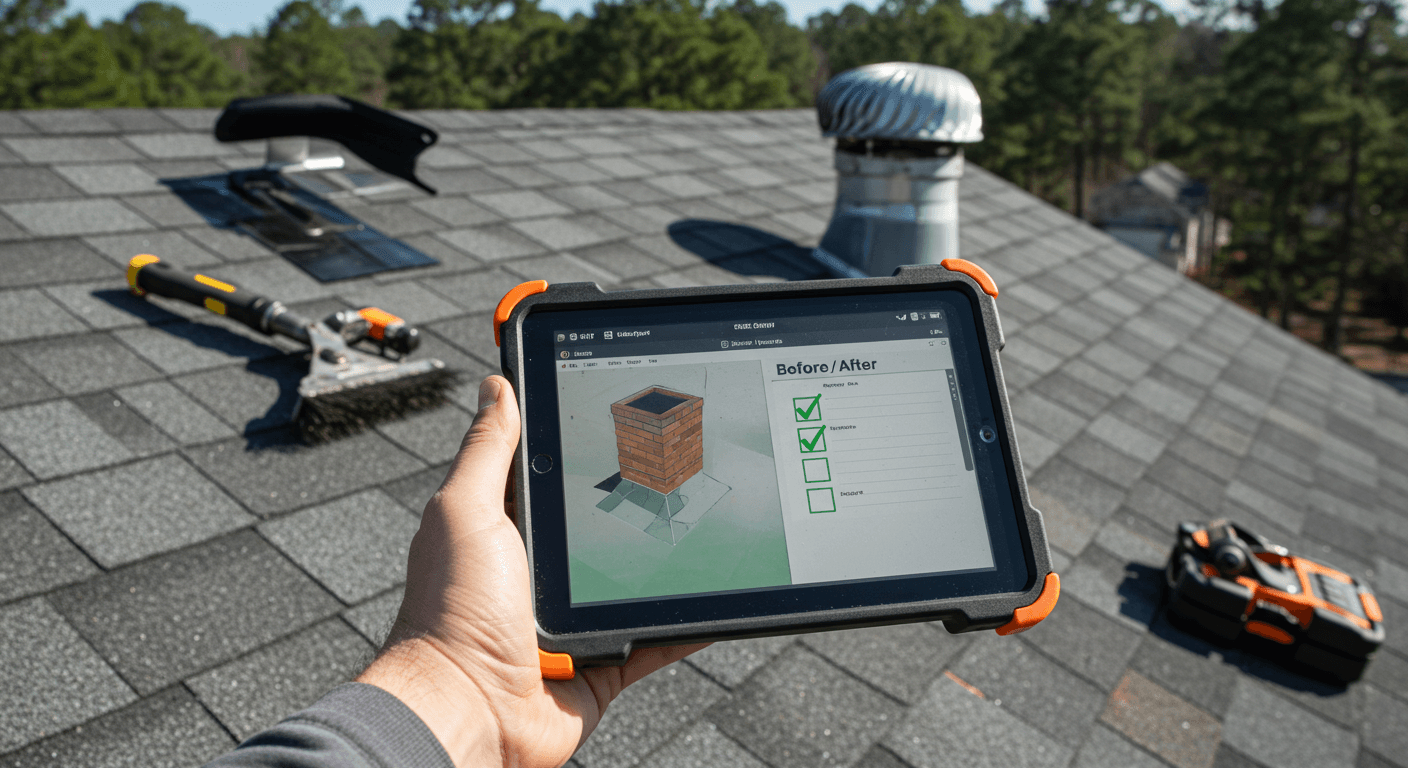
We implemented a rule for Vance: No crew gets a final payout until 24 specific high-resolution photos are uploaded to the job file. These aren't "glamour shots." These are photos of the drip edge overlapping at the corners, the fastener pattern on the starter strip, and the ice and water shield integration around pipe boots.
By making the "hidden" parts of the roof visible, we removed the temptation for crews to cut corners when the sun was beating down and they wanted to get off the deck by 2:00 PM.
The 4-Point Multi-Stage Inspection Framework
You cannot wait until the dumpster is being pulled off the driveway to check for quality. By then, the mistakes are buried under 40 squares of asphalt. I advised Vance to break his QC into four distinct milestones.
- 1The Decking Audit: Before a single shingle is nailed down, the lead must sign off on the plywood condition. In Georgia, we see a lot of "delamination" that isn't obvious until you strip the old felt. Nailing into compromised wood is a guaranteed callback within 18 months.
- 2The Penetration Check: This is where 84% of leaks happen. We require a photo of every pipe boot and chimney cricket before the final course of shingles covers the flashing.
- 3The Ventilation Verification: We found that Vance’s crews were often "eyeballing" ridge vent cuts. We switched to a mandatory measurement based on the Net Free Venting Area (NFVA) required for the specific attic square footage.
- 4The Ground-Level Magnet Sweep: Nothing kills a referral faster than a homeowner’s kid stepping on a nail. We made a triple-pass magnet sweep a non-negotiable part of the "Quality Sign-off."
Incentivizing Accuracy Over Speed
One of the biggest mistakes I see Georgia roofers make is paying strictly on a "per square" basis without any quality weighting. If you pay for speed, you will get speed, and speed is the mother of all rework.
I helped one shop in Alpharetta restructure their pay plan. They were paying $65 per square for labor. We shifted it to $62 per square base, with a $5 per square "Quality Bonus" that was paid out after the site passed a 48-hour inspection.
The result? Their rework rate dropped from 11.2% to a measly 2.4% in just two quarters. The crews actually made more money because they weren't spending their Saturdays fixing "stupid mistakes" for free. They became their own QC department.
This shift is essential because, as we've shared on our blog, the cost of acquiring a new customer is too high to waste on one-and-done jobs that result in 1-star reviews. Your reputation in the local Georgia market is your most valuable asset, and a single bad job in a tight-knit neighborhood can "poison the well" for an entire zip code.
Leveraging Documentation for Liability Protection
Quality control isn't just about preventing leaks; it's about preventing "fake" leaks. We've all had that customer who calls three months after a job claiming a new stain on the ceiling, only to find out their HVAC unit in the attic is the real culprit.
Without a documented QC process, it's your word against theirs. Vance started using a "Pre-Existing Conditions" photo set during his initial audit. We found that by documenting the attic interior *before* the job started, we could prove that 19% of the "leaks" reported after a job were actually pre-existing water stains or mechanical issues.
This level of detail is why our team was founded by roofers who were tired of the "he-said, she-said" nature of the business. When you have a verified trail of evidence, you protect your profit from being clawed back by opportunistic homeowners or insurance adjusters.
The ROI of "Doing it Right"
When we finished the first year of Vance’s new QC program, the numbers were undeniable. His total rework costs dropped by $38,420. But the real win was his referral rate. Because his jobs were "clean" from day one, his Google Business Profile rating jumped from a 4.2 to a 4.8.
That increase in social proof allowed us to lower his cost-per-lead because his brand was doing the heavy lifting. If you have questions about how these metrics affect your lead costs, check out our FAQ for more on how quality and conversion go hand-in-hand.
You don't need a massive team to run a tight QC ship. You just need a process that is harder to ignore than it is to follow. Start with one job next week. Walk the roof, take the 20 photos, and ask yourself: "Would I bet $1,200 of my own money that this won't leak?" If the answer is no, you have work to do.
The 4:00 PM Rule for Georgia Crews
"In Georgia’s summer heat, shingles become incredibly soft by mid-afternoon. Require your crews to use foam pads or "cougar paws" for any walk-throughs after 2:00 PM to prevent granule loss and scuffing, which are the #1 cause of aesthetic-related callbacks in our region."