At a Glance
Eliminate Mobilization Waste: Stop sending crews to sites where work is impossible, saving an average of $385 per avoided "dry run."
Hyper-Local Precision: Use site-specific monitoring to differentiate between a washout in Oak Creek and a clear roof in Germantown.
Improved Crew Retention: Crews hate standing in the rain for two hours only to be sent home; better data builds trust with your labor force.
Automated Client Comms: Use weather triggers to update homeowners automatically, reducing "Are you guys coming?" phone calls by 43%.
Roughly 19.4% of scheduling conflicts in the Great Lakes region stem from hyper-local microclimates that standard smartphone weather apps miss entirely. I was standing in a shop near the Menomonee Valley with an owner named Jaxon last April. He had three crews staged and ready to head out to Wauwatosa, but a sudden cell off Lake Michigan turned a "clear day" into a constant drizzle. By the time he called the day, he’d already burned $1,142 in mobilization costs and idle labor. That wasn't a one-time fluke; it was a systemic leak in his margins. In Milwaukee, where the weather changes faster than a Bucks lead, relying on a generic seven-day forecast is a recipe for operational bankruptcy. We're going to dive into how integrating site-specific weather monitoring transforms your bottom line from reactive to surgical.
The High Cost of the "Wait and See" Method
Most contractors in Southeast Wisconsin treat weather like a gamble. They look at the morning news, see a 30% chance of rain, and tell their guys to "show up and see." This indecision is expensive. When you factor in fuel, vehicle wear, and the "minimum show-up pay" many skilled subs require, a single bad call costs more than a month's worth of premium software.
According to data shared by Roofing Contractor Magazine, operational efficiency is the primary differentiator between shops that scale and those that plateau. In my experience, a shop running four crews that tightens its weather-response protocol can recover about 6.3 hours of billable time per man, per month. That adds up to thousands of dollars in "found" revenue that was previously evaporating into the humid Wisconsin air.
Beyond the Smartphone: Building a Tech Stack
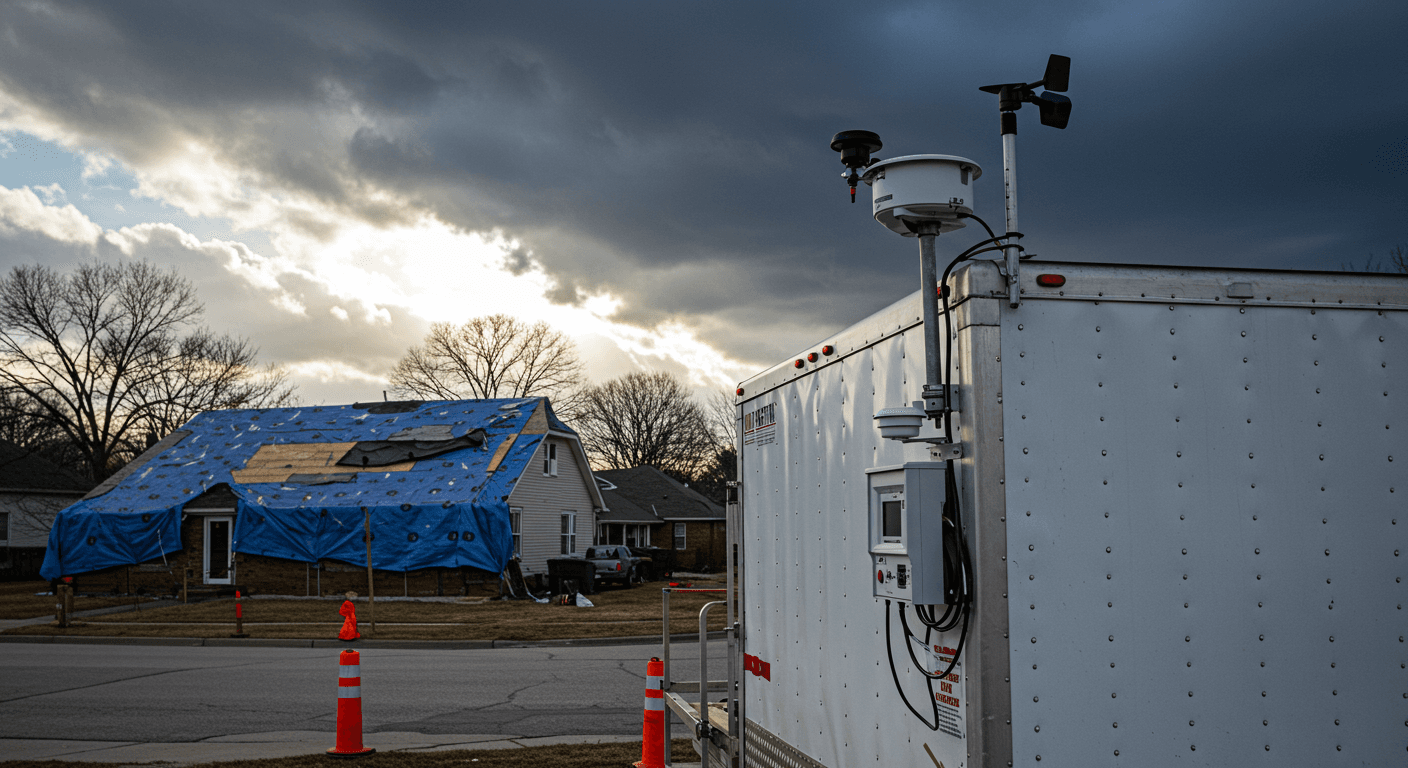
Generic apps use "zone" forecasting. They tell you what's happening at General Mitchell International Airport, not what's happening on a steep-slope tear-off in Brookfield. To fix this, you need tools that offer "ground-truth" data.
I recently helped a mid-sized shop in West Allis implement a three-tier monitoring system. We moved away from manual checks and toward automated alerts based on the specific GPS coordinates of their active jobs. This allowed the production manager to see that while it was pouring at the warehouse, the job site twelve miles north was perfectly dry. If you want to see how this level of precision impacts lead flow, you have to look at how it stabilizes your production calendar.
Implementing the Weather-Response Protocol
Technology only works if your team knows how to react to it. You need a documented "Go/No-Go" framework. Without it, you’re just looking at pretty maps while your money walks out the door. Jaxon, the owner I mentioned earlier, eventually set a hard threshold: if the site-specific probability of precipitation (PoP) hit 40% between 7:00 AM and 11:00 AM, the crew was diverted to a "dry-work" list—interior repairs or warehouse maintenance—by 6:00 AM.
This proactive approach requires a steady stream of work to keep the crews busy regardless of the sky. When your schedule is optimized, you can focus on fueling that engine with exclusive roofing leads with locked previews that let you choose jobs based on location and roof type.
Protecting Your Margins and Your Reputation
Weather integration isn't just about saving labor costs; it's about professionalizing the customer experience. Homeowners in neighborhoods like Whitefish Bay or Shorewood expect high-touch communication. If you can text a client at 6:30 AM saying, "Our site-specific radar shows a 60% chance of rain at your address this morning, so we are rescheduling for tomorrow to protect your home's interior," you aren't a "flaky contractor." You're a proactive professional.
Resources from the Western States Roofing Contractors Association often highlight that risk management is the backbone of a profitable roofing business. Even though we're in the Midwest, the principle remains: controlling the variables you can—and having a plan for the ones you can't—is how you maintain a 38% gross margin instead of settling for 22%.
When you have the operational side locked down, you can afford to scale. If you're ready to test a more efficient way to feed your crews, starting with $150 in free lead credits is a low-risk way to see how a stabilized schedule handles increased volume.
The 30-Minute Radar Rule
"Don't just check the percentage of rain. Monitor the "velocity" and "direction" of lake-effect cells. In Milwaukee, a cell moving over the Hoan Bridge often dissipates before hitting Waukesha. Assign one person to check high-resolution radar 30 minutes before crews depart."