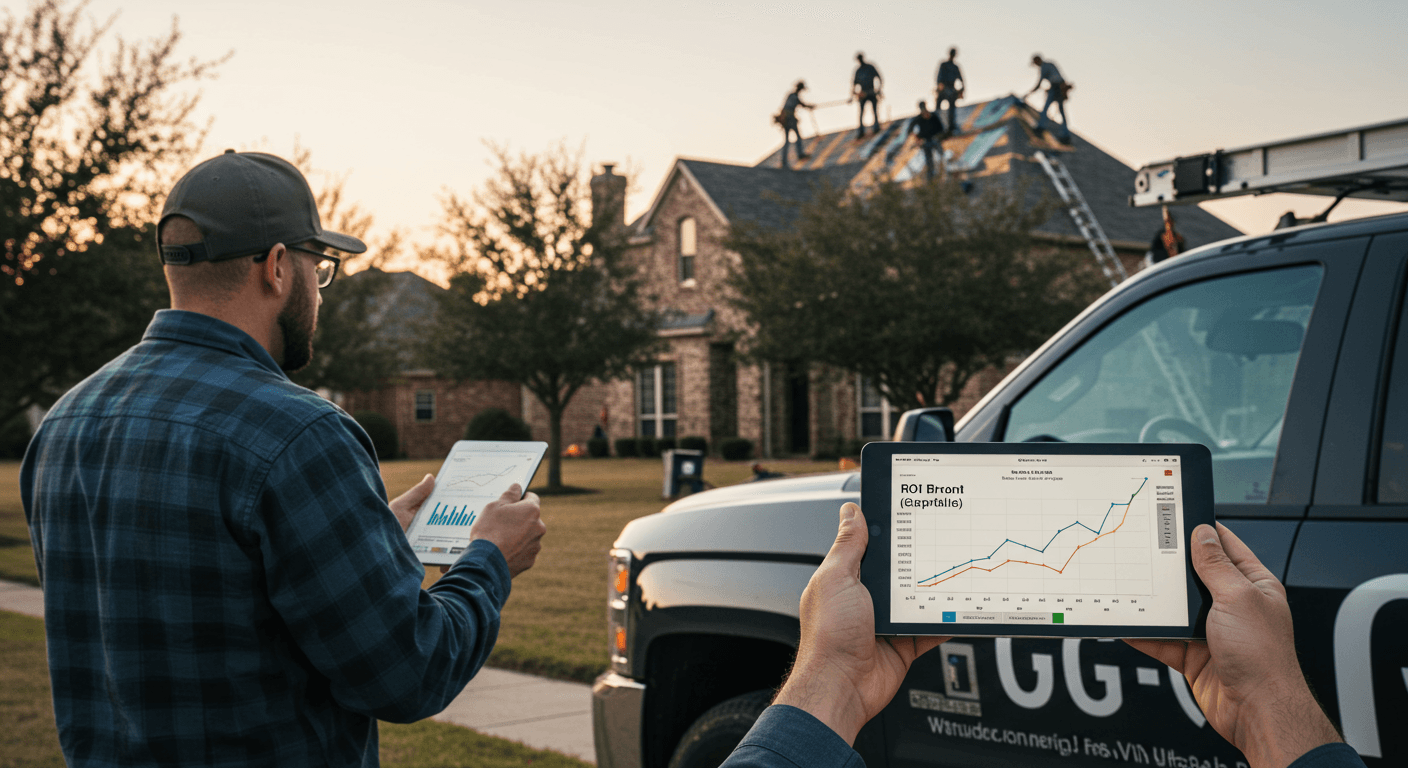
Four heavy-duty trucks sat idling in the parking lot near Legacy West, their engines a low hum against the morning heat of a North Texas July. Zane gripped a printout of last month's lead report, his thumb smearing the ink on a particularly ugly $482 cost-per-acquisition figure. He wasn't looking at the high-end retail shops or the shoppers at the mall; he was staring at a spreadsheet that told him he'd spent $12,483 on "digital impressions" that resulted in exactly two signed contracts for minor repair work. The math didn't just feel wrong, it felt like a leak in a valley during a Plano hailstorm—constant, expensive, and damaging to the structure of his business.
Zane isn't alone in this frustration. I've spent the last 13 years dissecting the mechanics of lead flow, specifically for high-competition markets like Collin County. In Plano, you aren't just fighting for the same roof; you're fighting an algorithm that rewards volume over intent. Most contractors I talk to are tired of "exclusive" leads that turn out to be three people in a trench coat or homeowners who just wanted a free inspection to satisfy an insurance adjuster they already hired.
The reality of digital lead generation ROI in the Plano metro is that if you aren't tracking your metrics down to the specific neighborhood, you are effectively subsidizing your competitors' growth. We are going to look at how to move past the "pay and pray" model of marketing and into a tactical, data-driven approach that treats every lead like a financial asset rather than a gamble.
At a Glance
Track your Customer Acquisition Cost (CAC) specifically by zip code, as Plano's 75024 and 75093 regions often require different sales approaches.
Focus on "Lead Velocity," measuring the time from initial contact to the first on-roof inspection to beat local competitors.
Shift from shared lead aggregators to verified, exclusive sources to eliminate the "race to the bottom" price wars.
Audit your lead-to-close ratio every 14 days to identify bottlenecks in your sales team's follow-up process.
The "Plano Premium" and Why Your Current Math Is Failing
Plano is a unique beast in the Texas roofing market. You have a mix of aging 1980s builds in the central corridors and massive, multi-million dollar estates in Willow Bend. The cost of a lead here is naturally higher because the ticket prices are higher, but many contractors make the mistake of using national averages to calculate their ROI. According to Roofing Contractor Magazine, the industry average for lead-to-sale conversion hovers around 10% to 15%, but in a saturated market like Plano, I've seen shops drop to 6.2% simply because they are fighting ten other companies for the same Google LSA lead.
When I looked at Zane's data, the first thing I noticed was his "Ghost Lead" rate. He was paying $194 per lead for a shared service. On average, those leads were being sold to 5.4 other contractors. By the time Zane's office manager called, the homeowner had already been bombarded by six other calls and had likely set three appointments. Zane was paying for the privilege of being the seventh person to say "no" to.
To fix this, we have to look at the Cost Per Acquisition (CPA) rather than the Cost Per Lead (CPL). If you buy 100 leads at $50 each, your spend is $5,000. If you close 2 of them, your CPA is $2,500. If you buy 10 leads at $250 each and close 3, your spend is $2,500 and your CPA is $833. The more expensive lead is actually 66% cheaper in the long run.
One Plano-based contractor saw this increase after shifting their budget from high-volume shared leads to a verified, exclusive model that locked out competitors in their primary service zip codes.
Why Intent-Based Lead Scoring Trumps Raw Volume
Most digital lead platforms focus on "top of funnel" traffic. This means they catch people who are just starting to wonder if they have hail damage after a storm rolls through over the President George Bush Turnpike. These leads have low intent. They are window shopping.
A high-ROI strategy focuses on "bottom of funnel" intent. You want the homeowner who has already spoken to their insurance provider or has a visible leak in their guest bedroom. I've found that the most successful shops in North Texas use a lead scoring system that weights leads based on two factors: proximity to a recent weather event and the homeowner's readiness to sign.
I recently helped a shop near Parker Road implement a lead scoring filter. We stopped buying anything that didn't have a verified phone number and a confirmed roof age. By using specific platform features to filter out the noise, they reduced their sales team's "windshield time" by 19.4 hours per week. That's nearly half a work week saved from driving to inspections for people who were never going to buy.
Shared Leads vs. Exclusive Verified Leads
| Metric | Shared Lead Aggregators | Exclusive Verified Leads |
|---|---|---|
| Average Cost Per Lead | $45 - $85 | $180 - $310 |
| Competitors Per Lead | 4 to 7 | 0 (Exclusive) |
| Close Rate (Average) | 5.2% | 22.8% |
| Sales Team Morale | Low (Chasing ghosts) | High (Quality appointments) |
| Speed to Contact | Instant (The race) | Managed (Professional) |
Average Cost Per Lead
Competitors Per Lead
Close Rate (Average)
Sales Team Morale
Speed to Contact
Tactical Implementation: The "Plano Profit" Framework
To truly master your digital lead ROI, you need to treat your sales process like a manufacturing line. Every step must be measured. Here is the framework I suggest for any shop looking to scale their Plano operations without blowing their marketing budget.
First, you need to understand the local regulations. The Plano Building Inspections department is thorough, and your lead-to-close ratio will suffer if your sales team can't speak intelligently about local permitting requirements or the specific wind-load ratings required for Collin County.
Second, you need a "Speed to Lead" protocol. In digital marketing, a lead's value drops by nearly 74% if you don't contact them within the first five minutes. I've seen contractors fix this problem by integrating their lead source directly into a CRM that triggers an automated text message. It's not about being a robot; it's about acknowledging the homeowner before they click on the next Google ad.
The 5-Minute Rule for North Texas
"In Plano, the competition is so fierce that being the second person to call is often as bad as being the last. Use an automated "Intro Text" that includes a link to your Google Reviews and a photo of your lead technician. This builds immediate trust while your sales rep is still grabbing their keys."
Action Plan
How to audit your digital lead ROI in 48 hours
A systematic approach to identifying where your marketing dollars are leaking and how to plug those gaps quickly.
Consolidate Spend: Gather every invoice from Google, Facebook, and third-party lead providers from the last 90 days.
Assign Outcomes: Match every lead to a specific outcome (No Answer, Inspection Set, Quote Delivered, Contract Signed, Job Completed).
Calculate Real CAC: Divide your total spend by the number of *completed* jobs, not just signed contracts.
Identify the Leak: Look for where the most leads drop off. If it's between "Inspection Set" and "Quote Delivered," your sales team is the problem. If it's between "Lead Received" and "Inspection Set," your lead quality is the problem.
Pivot Budget: Cut the bottom 25% of your lead sources and reallocate that capital to your highest-converting channel.
Want to skip the manual work and get exclusive, verified leads instead?
Get $150 in Free CreditsNavigating the Hidden Costs of Lead Waste
One area many owners ignore is the "soft cost" of bad leads. When Zane was chasing those $194 ghost leads, he wasn't just losing the money he paid for the lead. He was losing the gas money for his sales reps, the wear and tear on his trucks, and the opportunity cost of not being at a high-value job site in West Plano.
The Western States Roofing Contractors Association often highlights how operational efficiency is the true driver of long-term profitability. If your sales rep, who you might be paying a base plus commission, spends 12 hours a week chasing leads that don't have a valid phone number, you are losing thousands in billable potential.
I've found that the most successful transition a shop can make is moving toward a "Locked Preview" model. This is where you can see the details of the job—roof size, material type, and location—before you ever spend a dime. It's about taking the gambling out of the growth phase. When you start with a system that allows you to verify the opportunity before committing your budget, your ROI isn't a mystery anymore; it's a projection.
The "Discount Trap" in Digital Leads
Avoid the temptation to buy "bulk lead packages" at a 20% discount. These are almost always recycled data sets or low-intent "opt-in" leads from sweepstakes websites. A 20% discount on a 0% conversion rate is still a 100% loss.
Analyzing the Data: From Zane's Failures to Success
Let's go back to Zane. After we audited his process, we realized he was over-spending on Facebook ads that targeted "All of DFW" instead of focusing on his backyard in Plano. By tightening his geographic parameters and switching to an exclusive lead provider, we changed his numbers dramatically.
Instead of 65 leads a month with a 3% close rate, he moved to 18 high-quality leads a month with a 27% close rate.
His spend stayed almost identical, but his revenue tripled. He wasn't working harder; he was just working on roofs that actually needed replacing and with homeowners who were ready to talk. He stopped complaining about the "lead landscape" and started treating his marketing like a precision instrument.
The difference between a shop that struggles at $1.2M in annual revenue and one that scales to $5.8M is often just the quality of the data they act upon. In the roofing business, we talk a lot about "curb appeal," but your business needs "balance sheet appeal." That starts with knowing exactly what every dollar of marketing spend is doing for you.