Where Margin Actually Goes
Shaving waste by even a few points often returns profit comparable to delivering extra jobs without adding sales headcount—because you stop buying materials nobody invoices for.
Digitized measurement and bundle-level ordering replaces the instinct to pad every order; that single habit is what keeps many humid-climate crews perpetually over-stocked.
Layered crew bonuses tied to verifiable utilization convert speed-first installers into partners who protect starter, valley, and ridge math—not just square footage.
Treating nails, flashings, and sealants like tracked inventory—not an open warehouse buffet—closes the accessory gap that quietly adds multiple points of shrink.
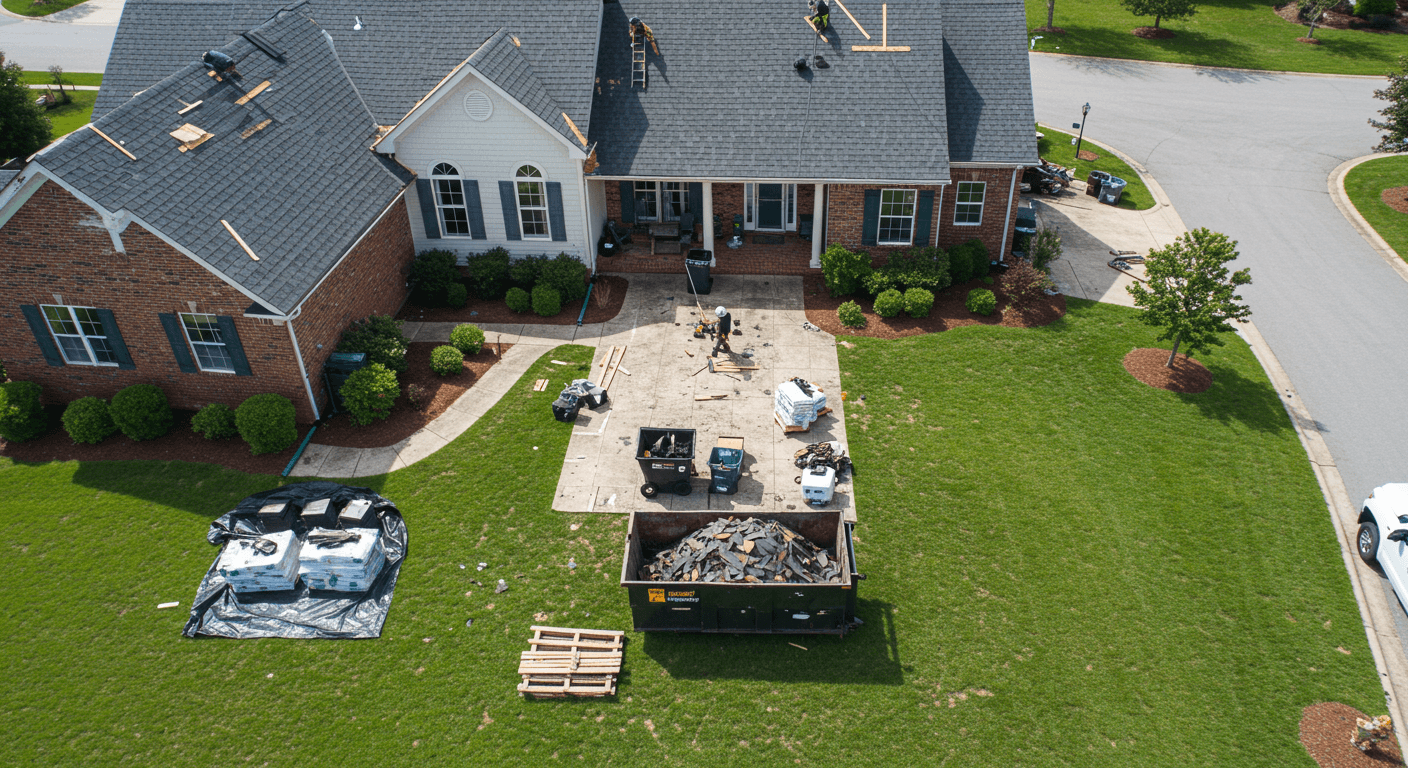
Jaxon stood over a thirty-yard roll-off in a quiet cul-de-sac outside Greenville, pointing at six unopened bundles of architectural shingles buried under felt scraps. One street over, his lead foreman had wrapped a forty-two-square tear-off with four shingles to spare. Pitch and valley complexity were comparable; utilization was not. That roughly fourteen-point-seven percent spread on material efficiency was the difference between protecting net profit and donating about seven hundred forty dollars to the bin on a single job.
That Tuesday we audited trailing-twelve-month purchasing against installs. Sales was winning; operations was quietly paying what I call the safety net margin—extra bundles ordered so nobody risks a dry-in stall in afternoon storms. Across Georgia and the Carolinas that instinct is understandable; it is also how shops fund five ghost jobs a year. When you are not dialed to the square inch, you are not only losing shingles—you are losing the ability to bid tight and still keep decent net.
Table of Contents
The True Cost of the 15% “Buffer”
A comfortable waste line on paper becomes a bet against your own estimating discipline.
In Georgia and the Carolinas, many estimators still default to ten or fifteen percent waste on every pitch. It feels safe until commodity volatility turns that cushion into a standing liability—for perspective on how fast input pricing has moved, follow coverage from Construction Dive. Add fifteen percent to a twelve-thousand-dollar material ticket and you are routinely wagering nearly two thousand dollars that crews will mis-cut enough to justify it.
A Spartanburg shop I reviewed last quarter was profitable on paper yet tight on cash after a huge third quarter. Ridge caps were being pushed out twenty-two percent high because reps used thumb rules instead of linear feet on hip-heavy elevations riding the subdivision boom. Geometry-specific takeoffs would have paid for themselves on the first few closes.
Pair blanket waste factors with humid-week staging issues and accessory slippage, and double-digit erosion stops looking hypothetical.
Layer in Southeast realities—bundles baking on driveways, rushed foot traffic, torn wraps—and damaged squares get tossed instead of downgraded to starters. At forty-five to sixty dollars a bundle, that is not moral failure; it is unmodeled cost.
Why Manual Measurements Still Cost About $420
A two-degree pitch miss ripples through every line item on the delivery ticket.
Shifting from tape measures to accountable digital takeoffs is not only a speed play at the kitchen table; it protects the integrity of every subsequent order. I watched a manager named Kieran in Alpharetta fight a Friday delivery because a handheld pitch gauge was two degrees off—underlayment short, starters long, crews waiting while the supplier reshuffled.
Contextually, ConsumerAffairs roofing market data puts industry scale north of fifty-six billion dollars—winners treat dataset quality like production quality. Aerial imagery and structured 3D facets let you order to the bundle once you understand facet-level waste instead of mythic fifteen-percent slabs. When you are scaling crews across multiple territories, those small deltas compound into real annual variance.
Manual guesswork vs. modeled precision on a typical residential re-roof
| Metric | Manual workflows | Digital precision |
|---|---|---|
| Accuracy variance | 5% to 8% | 1% to 2% |
| Order buffer | 15% safety padding | 3% to 5% calculated |
| Time per roof | 45 to 60 minutes | 5 to 10 minutes |
| Leftover bundles | four to six typical | Under one bundle |
Accuracy variance
Order buffer
Time per roof
Leftover bundles
Dropping modeled buffer from fifteen percent to about five percent on a thirty-square job often returns roughly three squares of material—think mid-three-hundreds in recovered cash before installation starts.
That dollar figure is why I keep repeating precision beats bravado: fewer emergency runs, fewer attic humidifiers running overnight, fewer texts asking whether valley metal was double-ordered.
The Dumpster Audit Nobody Wants—Until It Pays
If you only stare at QuickBooks, you will miss the capital buried under felt.
When waste feels invisible, send production leadership to the roll-off before haul-off—unannounced, weekly if you can stomach it. You are scanning for three culprits:
What a five-minute audit should flag
Unopened bundles that signal over-order terror, not contingency planning.
Straight scraps longer than two feet that should have lived in valleys or starter courses.
Accessory half-waste—partial cement tubes, flashing snippets, nearly full nail coils—often left to avoid reloading the trailer at quitting time.
In Charleston we once pulled more than three hundred dollars in lead boots and coil nails from the bottom of a bin because Friday fatigue beat accountability. Once audits became standard, return discipline mysteriously improved.
The Return-Shelf Credit
"Dedicate warehouse space for clean, sellable returns. Pay the crew lead a modest bonus—think fifteen dollars—when they bring back more than three untouched bundles after documented installs. It is cheaper than repurchasing stock and keeps sites photo-ready for inspectors and neighbors."
Tiered Incentives That Flip the Incentive Curve
Square-pay alone rewards speed, not stewardship.
If installers earn purely by the square, ripping and resetting sloppy tabs beats fiddling them straight. For Jaxon we set a Precision Bonus anchored to historical waste: ten percent baseline, seventy-five dollars per full point the crew finished below, split across the team.
Felix dropped personal waste from twelve point four to six point eight percent inside a month—about three hundred seventy-five extra in his pocket while Jaxon saved north of fourteen hundred in materials on that crew alone. That is the definition of operational efficiency that scales without adding headcount: align economics, then let pride finish the job.
Action Plan
Thirty-day waste reduction sprint
Use this sequence when you need a hard reset between dry-in season peaks—no new software required on day one if you commit to measuring honestly.
Baseline audit: reconcile the last ten jobs by comparing purchased squares to installed squares; print the true waste curve.
Measurement mandate: require aerial or modeled takeoffs on every quote over twenty squares; ban flat buffers without facet notes.
Staging rule: pallets elevated, covered, rotated daily so humidity and foot traffic stop silently degrading granules.
Return protocol: ten-minute closeout checklist logging unopened SKUs before wheels roll—photo optional, signature mandatory.
Monthly forum: publish a waste leaderboard by foreman; celebrate the tightest crews publicly, coach the outliers privately.
Want to skip the manual work and get exclusive, verified leads instead?
Get $150 in Free CreditsThe Small Stuff Is Not Small
Coil nails and tube sealant do not photograph well—which is why they leak margin.
In humid Southeastern bays, half-open nail boxes rust. Flashing coils kink when they slide around uncrated beds. Five percent of fasteners blown into lawns is not only metal cost—it is callback fuel when a homeowner finds steel in a tire tread.
Kit accessories to the job: calculated counts plus a two percent guardrail, staged in labeled bins. When you start your next production push, that discipline doubles as training—new foremen see exactly what “enough” looks like instead of guessing from the truck bed.
Stop flat-rating valleys and hips
Complex Southeastern rooflines punish one-size waste factors. A ten percent add on a simple gable leaves money on the table; the same ten percent on a hip-heavy four-valley plane sends you scrambling mid-week, burning labor faster than materials save. Quote linear detail work with real measurements, not folklore.
Humidity, Heat, and the FIFO Mindset
Your warehouse is a passive crew member—train it like one.
Savannah taught me mold-adjacent losses: four point two percent of annual inventory toasted because underlayment sat in a non-conditioned space until wraps failed. When bundles stick together or foul, upscale jobs reject them outright.
First-in-first-out rotations, priority for stock older than forty-five muggy days, and pallets on gravel instead of bare dirt cut wicking damage dramatically. Climate is not an excuse; it is a specification for how you receive and stage.
Efficiency Is the Quiet Bid Winner
Crowded markets reward the operator who can price confidently.
When lead sources converge and crews get poached weekly, execution separates durable shops from seasonal flyers. A contractor holding six percent all-in waste can drop five hundred dollars on a competitive urban bid and still bank more net than a fourteen-percent crew chasing the same homeowner.
Precision culture also shapes quality—fewer forced overnight dry-ins, tidier punch lists, referrals that mention professionalism instead of driveway debris. That is how waste work becomes brand work.
Data Back to Dollars
Half a year later the roll-offs told a different story.
Six months after dumpster audits plus Felix-style incentives, Jaxon landed at six point three percent average waste versus fourteen point eight. On roughly one hundred eighty roofs annually, the swing cleared more than fifty-four thousand in margin—no incremental closes, just better math and accountability. Reinvestment bought fleet upgrades and a production manager seat that finally let him steer instead of chase.
That progression—from operator with a roll-off horror story to owner with measurable throughput—is what happens when you quit funding fear with bundles. Your next competitive edge might not be a new ad channel; it might be the next bundle your crew does not throw away.