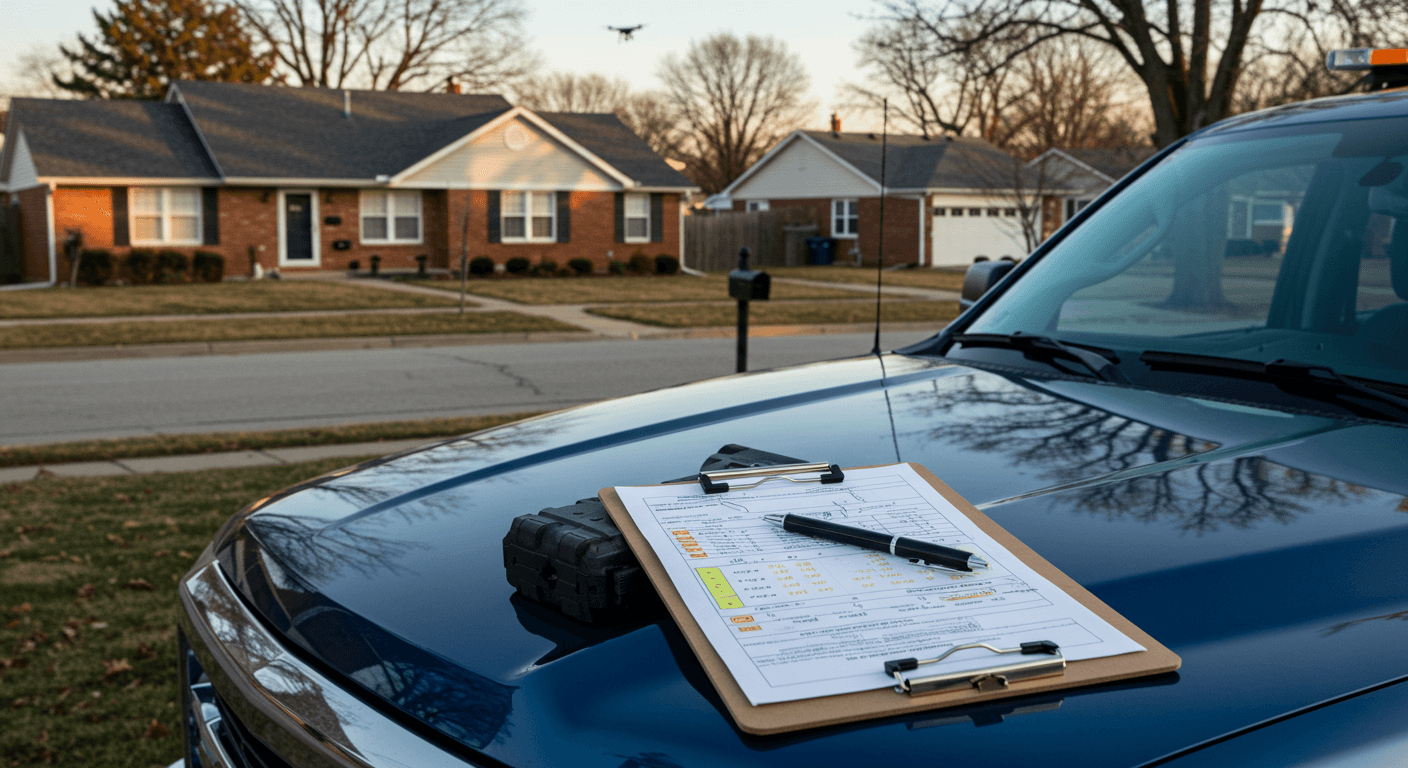
Watching Owen scroll through a list of "hot" leads in the front seat of his Silverado, I could see the frustration mounting. We were parked just off Van Dyke Avenue, the sun reflecting off the glass of the GM Technical Center nearby. He had forty-two leads sitting in his CRM from the previous week. On paper, he was winning. In reality, his sales reps were burning daylight driving from Warren to Sterling Heights for inspections that resulted in "I need to talk to my spouse" or "We're just looking for the cheapest patch job."
"Noah, we're running ragged," he told me, tapping his steering wheel. "My best closer just told me he's tired of being a professional estimator for people who can't afford a bundle of shingles."
That moment wasn't about a lack of hustle. Owen's team had hustle in spades. The problem was a lack of filtration. In the Warren market, where competition is dense and the housing stock varies wildly from post-war bungalows to sprawling estates, treating every lead with equal weight is a recipe for a 14.3% profit margin bleed. We spent the next three hours building a Lead Quality Scoring (LQS) framework that changed his business. By the end of the quarter, his appointment-to-close ratio jumped from 19% to 31.4% without adding a single new lead to the top of the funnel.
At a Glance
Stop Universal Treatment: Treat high-intent leads with premium speed while automating the "tire-kicker" nurturing process to save your sales team's energy.
Geography Matters: Use Warren-specific data, like roof age by neighborhood, to weight lead scores before a rep ever picks up the phone.
Psychological Qualification: Implement a two-minute "Discovery Script" that scores prospect intent based on their answers to three specific financial questions.
ROI over Volume: Shifting focus to lead quality can reduce customer acquisition costs (CAC) by 22.8% while increasing the average job size.
The High Cost of the "Everything is a Lead" Philosophy
In the Michigan roofing circuit, there's a persistent myth that more volume solves every problem. If the bank account looks lean, the gut reaction is to buy more leads. But if those leads haven't been scored, you're just pouring more water into a bucket with a massive hole in the bottom.
I've seen shops in Macomb County spend upwards of $4,850 a month on generic lead aggregators only to realize that 64% of those prospects were either renters, looking for repairs under $500, or outside their service area. Lead quality scoring is the process of assigning a numerical value to every prospect based on the likelihood of them becoming a high-margin contract.
When you don't score, you're forced to treat a "my roof is leaking into my kitchen" lead the same as a "I might want a quote for next year" lead. In a city like Warren, where the weather can turn on a dime and the OSHA Stop Falls Campaign reminds us that every minute on a pitch counts, you cannot afford to have your best guys climbing roofs that will never close.
Building Your Warren-Specific Scoring Matrix
A generic scoring system doesn't work here. You need to account for the local reality of the Metro Detroit market. When I work with contractors in this region, we look at four primary buckets to build their score.
1. The Property Profile (The "Warren 50" Factor)
Warren has a significant amount of housing built in the 1950s and 60s. These roofs often have multiple layers of shingles or decking issues that aren't present in newer developments. If a lead comes in from a neighborhood where the median roof age is 22 years, that lead gets an automatic +15 points. It's a high-probability full replacement. Conversely, a 5-year-old roof in a newer subdivision might only get +2 points, as it's likely just a flashing leak or wind damage.
2. Financial Readiness
I taught Owen's intake person to stop asking "Do you have a budget?" and start asking "Have you already set aside funds for this project, or will you be looking at our Michigan-specific financing options?"
If they mention financing immediately, that's a +10. It shows they've thought about the "how." If they say they "just want a number," that's a -5. You want to prioritize the homeowners who are NCCER certified in their understanding that quality work requires a real investment.
3. Source Attribution
Not all lead sources are created equal. A referral from a previous client in the Heritage Village area should be scored at a 90 out of 100. A cold lead from a generic Facebook ad might start at a 35. This is where exclusive, verified leads become a game changer. When you can see the job details before buying, your scoring happens in real-time. You aren't guessing; you're verifying.
Volume vs. Quality: The Lead Scoring Difference
| Feature | Volume-Based Approach | Score-Based Approach |
|---|---|---|
| Sales Rep Focus | Quantity of appointments | Quality of conversations |
| Lead Prioritization | Chronological (First in, first out) | Intent-based (Highest score first) |
| Closing Rate | Average 12-16% | Average 27-34% |
| Marketing ROI | Often obscured by "junk" data | Transparent and predictable |
| Fuel/Admin Waste | High ($740+ per month/rep) | Low ($215+ per month/rep) |
Sales Rep Focus
Lead Prioritization
Closing Rate
Marketing ROI
Fuel/Admin Waste
Psychological Triggers: The "Two-Minute Drill"
Once a lead passes the initial data filter, the next scoring phase happens in the first 120 seconds of the phone call. I call this the "Discovery Script." I recently sat with a rep named Jaxon who was struggling to hit his numbers. He was friendly, but he was a "yes man." He agreed to every inspection, no matter how shaky the lead felt.
We changed his script to include a psychological "hurdle."
Jaxon: "I'd love to get out there and take a look at the property on Miller Road. Usually, when we do a full tear-off in that area, our projects start around the $9,500 mark for a standard ranch. Does that align with what you were expecting to invest in your home's protection?"
The silence on the other end is the score.
- Response A: "Oh, I was thinking it would be $4,000." (Score: 20/100 - Send to automated email nurture).
- Response B: "That sounds about right, we know the roof is shot." (Score: 85/100 - Book the appointment for the next available slot).
By using price anchoring early, you aren't being rude; you're being a professional. You're protecting your most valuable asset: your time. If you're managing this from the field, using a mobile lead management tool allows you to update these scores and move leads through your pipeline without heading back to the office.
The 'Reverse-Zip' Qualification
"In Warren, the distance between jobs can kill your profit. If your crew is finishing a job near 10 Mile and Dequindre, give a +10 point bonus to any leads within a 3.5-mile radius for that specific week. Reducing travel time by even 18 minutes per day can add $12,450 to your annual bottom line in recovered labor hours."
The Future of Lead Scoring: Trend Analysis
Looking toward 2025 and 2026, the trend in roofing sales is moving toward "Pre-Inspection Intelligence." We are seeing more contractors use satellite data and AI-driven weather history to score leads before the phone even rings.
For example, if a storm cell tracked specifically over the southwest corner of Warren three months ago, and a lead pops up from that exact corridor today, the "Urgency Score" should be maxed out. These people aren't shopping; they are hurting.
I've watched companies transform their entire culture by adopting this "Score First, Drive Second" mentality. One shop I consulted with in the Detroit metro area reduced their total lead buy by 15.7% but saw their total revenue climb by 9.2%. Why? Because their sales team wasn't exhausted. They were walking into every kitchen with the confidence that the person sitting across from them was a 90-point lead.
If you're ready to stop the "ghost chasing," you have to start by getting free lead credits to test a platform that actually gives you the data needed to score effectively. You shouldn't have to pay for a lead just to find out it's a dead end.