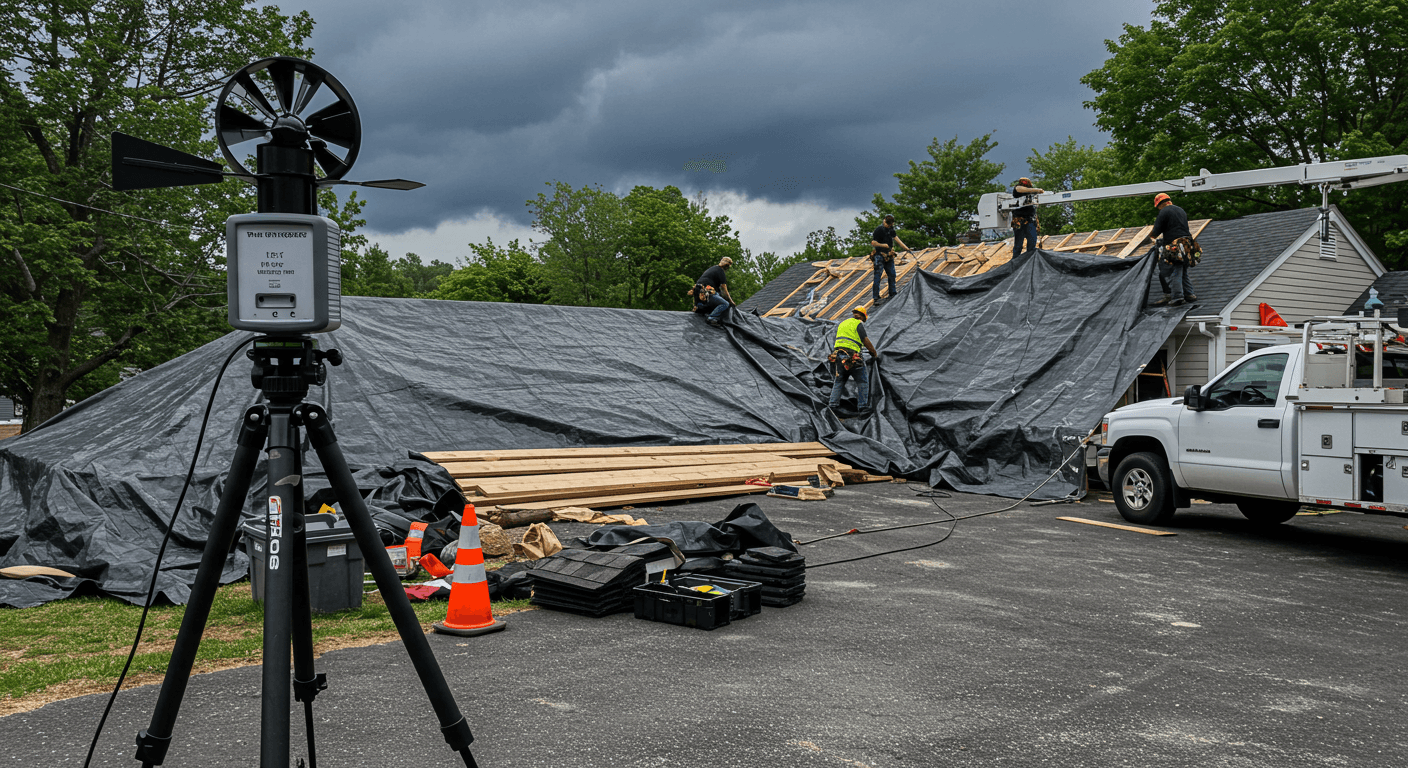
The fork is sharper than most owners admit. You either chase scattered hail chatter across the Hudson Valley, or you build a seasonal production plan that respects New York precipitation for what it is, a constraint on labor hours. Shops I work with between Buffalo and Albany often treat the forecast like a soft suggestion until a Nor'easter is already on the radar. Then the office spends three days in triage mode, and about 14.8% of the quarterly margin disappears in overtime, resequencing, and half-finished crews standing around.
The other path is predictive scheduling, where weather inputs drive the calendar before anyone loads ladders. That tradeoff is not philosophical. It is math. Peak hiring without a buffer bleeds cash in the slush months. Under-hiring without a flex pipeline burns your best people when the sky does not cooperate. I stopped treating this as a morale speech after a volatile April audit in Syracuse, where a shop lost $11,340 in labor overhead because steep-slope crews had no real backfill plan for rain days. New York's roughly 182 wet days per year are not a weather problem alone. They are a scheduling logic problem that needs a written system.
The number moves with crew count and mix, yet the pattern is consistent. Reactive shops pay for payroll that never touches production because the call happens too late.
Table of Contents
The wait-and-see financial drain
In New York, weather is not background noise. It is a line item that shows up as payroll without matching revenue.
I have sat with owners in Westchester who were confused when revenue climbed about 12% while net profit softened. When we traced the week, the culprit was weather-wait, paid time where six people are in a booth waiting for a morning squall to clear because production did not have a Plan B locked the night before.
If you are not watching microclimates near the Great Lakes, or the humidity swings on Long Island, you are basically underwriting guesswork with payroll. A three-tab or architectural shingle job can lose a safe window to a thirty-minute cell that never made the morning broadcast. For four crews, that half hour, plus deck dry time and a fresh safety check, often lands north of $840 in labor and opportunity cost. Run that across a New York spring and the waste is real money that never shows up as a separate invoice line.
Operational weather wins
Run a 72-hour stage-or-stay protocol so morning-of cancellations drop when the decision is already made with thresholds.
Use localized wind and precip data to pivot crews between steep-slope installs and low-slope or ground work when gusts cross your defined limit.
Hold about fifteen percent of monthly volume in repair-first or interior-accessible work so billable hours survive short precip windows.
Standardize moisture checks on decks and underlayment so humidity callbacks do not erase the margin you fought for on the sale.
Predictive logic versus reactive panic
Strong ops teams do not only check the weather. They operationalize it with triggers everyone understands.
The manual I like is simple on paper and hard in discipline. Call it a weather-trigger sheet. Example: if Rochester gusts are forecast above about 18 mph, steep-slope architectural installs drop off the board and ground-level repairs or gutter work moves up. The swap is not random. It is pre-ranked by crew certification and material already staged.
Devin, an operator in the Hudson Valley, was living with a 9.4% callback rate. Crews were rushing dry-ins during humid windows, trapping moisture under underlayment. We added a humidity-hold rule tied to live monitoring, not vibes. Callbacks fell under about 1.8% in one season. The win was not only less rework. Morale improved because Saturdays stopped turning into unpaid fix days for mistakes made on a Tuesday push.
Scheduling approaches in practice
| Factor | Reactive wait-and-see | Predictive weather triggers |
|---|---|---|
| Decision timing | Made at the job at 7:00 a.m. | Made 48 hours ahead with monitoring |
| Average crew downtime | About 4.2 hours per week | About 0.8 hours per week in similar audits |
| Moisture-trap risk | Higher when humidity rules are informal | Hard humidity and temperature thresholds for dry-in |
| Rainy-week utilization | Fixed labor cost with no flex work | Repair-first and short-window jobs fill gaps |
Decision timing
Average crew downtime
Moisture-trap risk
Rainy-week utilization
Exact hours will move with market density and how strict you enforce triggers. Treat the table as direction, not a promise printed on a contract.
Navigating the New York seasonal shift
Seasonality here is a ladder of transitions, not an on-off switch. Each step changes adhesives, safety, and what you can promise on site.
Late fall is where warranty risk spikes. I have watched shops lose about $15,600 in warranty exposure because standard seal-down shingles went on in late November without manual tabbing, then a wind event stripped squares when the sun never gave the strip enough heat. That is not bad luck. It is a calendar decision that needed a hard stop.
Intake becomes strategic when a cold front is sliding across the North Country. Sales should bias toward emergency repairs and interior-accessible scopes that still move when the roof deck is wet. When you can see job-fit up front through LeadZik's verification flow, dispatch stops burning miles on work the weather will not let you finish this week.
Technical literacy on regional climate is part of why some brands scale while others stall. Trade associations that publish climate-aware roofing guidance, including the Western States Roofing Contractors Association, keep repeating the same unglamorous point. Install discipline has to match the environment you are actually working in. A Buffalo roof and a Queens roof do not share the same thermal expansion story, and your production rules should reflect that honestly.
Safety is a balance-sheet item
OSHA exposure and carrier renewals can turn a healthy shop into a break-even grind faster than people expect. When the board is full, it is tempting to keep a steep crew on a 10/12 during a gusty afternoon. Federal fall-protection expectations for roofing work are explicit, and the practical play is to make the safe call before the crew is already invested in the drive. Review OSHA roofing safety guidance regularly and train foremen on the same thresholds you use for scheduling.
Operationalizing safety in volatile windows
Predictive monitoring is how you keep discipline human instead of adversarial.
Following OSHA roofing safety guidance is easier when production is not forcing tradeoffs at the edge of common sense. Triggers let you pause steep work before someone feels pressure to justify the day.
Predictive monitoring also lets you make the call the night before. That matters in Westchester-style traffic, where a crew can burn nearly an hour each way and still get rained out ten minutes after arrival. If you need a second pair of eyes on how to wire alerts into your dispatch stack, you can contact LeadZik support for a practical walkthrough. The goal is a 6:00 p.m. message people trust, not a 6:00 a.m. scramble that trains your best people to expect chaos.
The fifteen percent lead buffer rule
"Keep a rainy-day pipeline of repair-first leads at roughly fifteen percent of monthly volume. When the forecast breaks, those jobs keep utilization steady without asking crews to chase full tear-offs in the wrong window."
The material mix and the New York winter trap
Cold-weather installs are chemistry problems, not comfort problems. Rooftop swings in the city can outrun what the crew feels at street level.
In New York City, rooftop temperatures can swing hard in a few hours. Ventilation and ice-dam prevention are not upsell theater when stack effect and melt-freeze cycles are in play. Your winter playbook should spell which adhesives, primers, and underlayment families are allowed by temperature band, and who signs off when the band is borderline.
Action Plan
Weather-responsive scheduling workflow
A simple workflow you can implement without buying twelve new apps. The win is shared language between sales, production, and the crews.
Connect your CRM or dispatch board to hyper-local weather inputs, not only the default phone widget everyone already ignores.
Write no-go thresholds for wind, temperature, and precip probability, then publish them where foremen can screenshot the rule, not guess at it.
Twice a week, review the forty-eight hour outlook and swap full installs for flex jobs when thresholds are trending wrong.
Every Monday, tally last week's delay minutes and tag the root cause, weather wait, material hold, or customer access. Refine triggers from the total cost of chaos, not from memory.
Scaling through the slush months
January and February are pipeline months if you treat them that way. Hibernate mode is optional.
Historical thaw patterns are surprisingly repeatable for leak-call timing. Shops that keep a steady intake during the slow stretch do not wake up in March fighting for the same late-winter price-shopper quotes as everyone else. Pair maintenance blocks and safety audits with a small on-call repair team so fixed overhead does not eat the summer surplus.
Resilience in the New York roofing market is less about working harder and more about building a system that absorbs climate shocks. When you stop reacting to the sky and start managing thresholds, the seasonal slump becomes something you can plan around instead of something that surprises the P&L every spring.