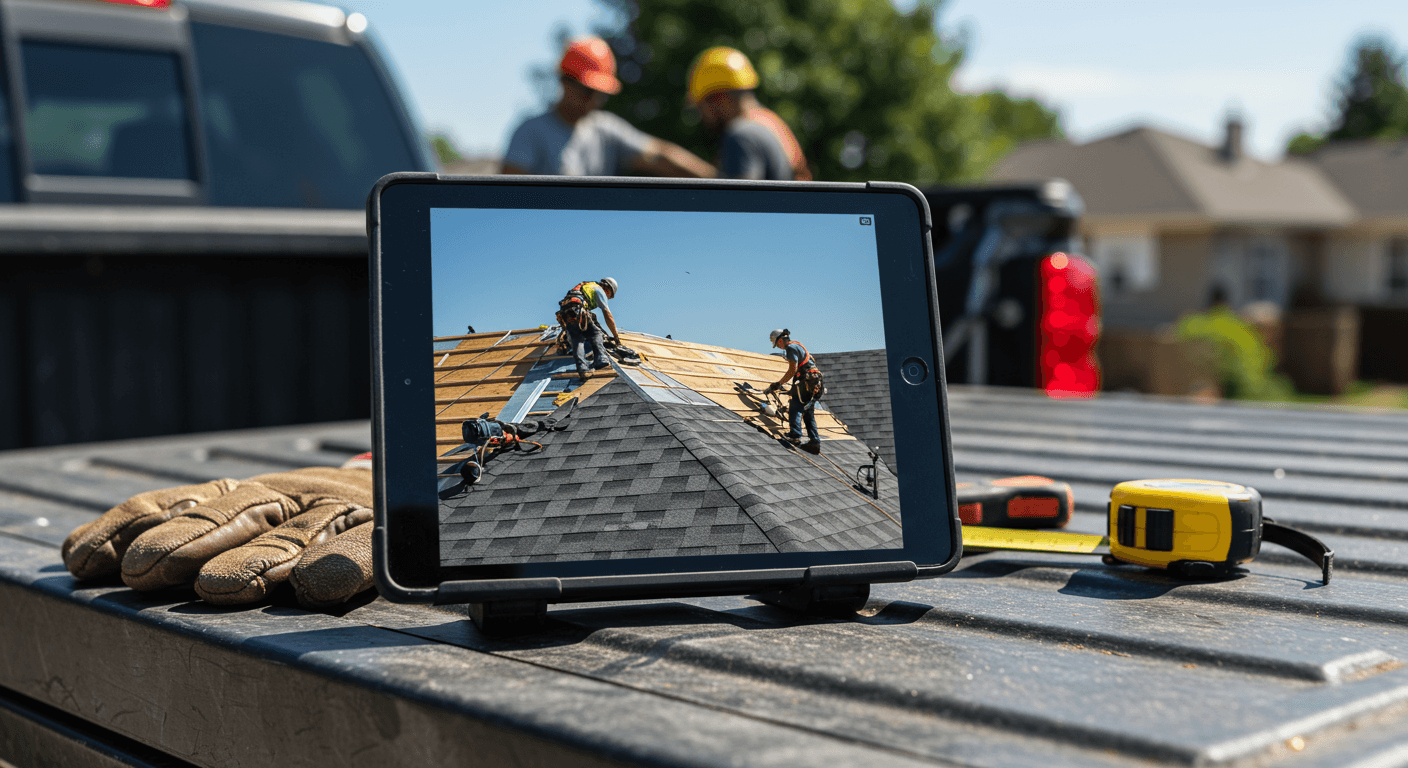
Most owners still size video like a branding line item. They compare a $6,840 monthly tab for social ads that plateau against a one-time $2,150 spend for something cinematic, then wonder why neither move signed contracts. The fork that actually matters is simpler: are you buying perceived authority, or are you building proof someone can replay on a phone at the kitchen table?
A shaky thirty seconds of valley flashing, narrated by a tech who sounds like they mean it, will often beat a fifteen-thousand-dollar lifestyle reel when the goal is a signature. Buyers are not grading your color grade. They are trying to answer whether you understand their deck, their ventilation, and their insurer.
Economics of technical video for roofers
A technical-first capture plan usually pulls customer acquisition cost down about 19.4% to 26.2% inside the first seven months, with a median outcome near 24.3% in my nationwide coaching cohort.
Reps who show site-specific clips during the in-home visit average roughly a 12.8% higher contract rate than teams leaning on static PDFs alone.
Documenting concealed deck damage or airflow issues on video has been tied to about an 18.5% lift in supplement approvals when files are organized.
Culture clips that show real crew standards can shave close to $1,140 off the cost to land an experienced lead installer compared with generic hiring ads.
When the brand goes quiet
Fragmented markets reward the contractor who shows the work, not the one with the prettiest logo reel.
The IBISWorld roofing contractors industry snapshot keeps saying the same thing owners feel in the field: lots of small players, tight bidding, and thin room for vague positioning. In a busy metro, staying the silent expert is an expensive choice. I recently picked apart spend for a Midwest shop that was routing about $9,430 a month through aggregators while publishing almost no first-party video.
Static photos and walls of text create a trust gap. If a homeowner never sees your crew, your hands, or your sequencing, they default to price. In that environment they are roughly a third more likely to push for a straight discount because you have not given them a visual baseline for quality.
Video behaved like a filter. People who watched a two-minute explainer on architectural laminate versus synthetic slate arrived pre-educated, so the first call sounded like a continuation, not a cold pitch.
Once we carved out that slice of budget for a repeatable capture cadence, cost per lead settled where you see above. The mechanism is blunt: clips pre-qualify curiosity. A prospect who already watched your crew walk a valley is halfway through the story before your rep parks.
Why rough footage wins the appointment
Last month I shadowed a rep, Preston, who knew the spec cold but could not break a 19% close rate. His deck was polished and, honestly, a little sterile. We archived the forty-page brochure for a week and gave him three clips he had shot on his phone: ice and water in a valley, a clean nail pattern, and a short voice-over on why skipping starter strips shows up as curl five years later.
Nothing was color-corrected. You could hear the nail gun. Inside twenty-two days his close rate climbed to 27.4%. The reason is not mystic. Roofing is a large, nervous purchase. ConsumerAffairs roofing statistics underline how cautious people are before they commit. When you show the tear-off mess and the rebuild detail, you are not performing. You are handing them evidence.
The fifteen-second flashing habit
"Have project leads record one short clip on every chimney flashing or dead valley. Drop files into a shared proof folder tagged by neighborhood. When price tension shows up, the rep pulls the exact detail you install, not a stock photo from a vendor deck."
Measure ROI in the P&L, not the vanity column
Views on a reel can lie. For owners, video ROI usually sits in three buckets: warmer callbacks because people know your process, shorter presentations because objections die on the screen, and fewer return visits tied to scope misses because crews saw the same clip the salesperson did.
- 1.Lead warmth: the first phone touch feels like a follow-up, not an ambush.
- 2.Cycle speed: reps report trimming twelve to fifteen minutes off the same script once video handles the basics.
- 3.Rework: intake clips align production with what sales promised, which trimmed wrong-material return visits by about 8.4% in the Midwest case file.
Run the contract math on a modest jump. At a $13,840 average job and a 22% close, moving to 25% on the same hundred opportunities is roughly $41,520 in incremental revenue before you change anything else about lead count. If you are already paying up for demand, it helps to confirm how verification and previews work so expensive conversations are not wasted on mismatched scope.
Where the money actually goes
| Factor | Polished brand video | Raw job-site video |
|---|---|---|
| Up-front spend | $5,000 - $12,000 | $0 - $500 (phone / small drone) |
| Time to usable asset | 4 - 8 weeks | Same day |
| Trust signal | Reads like an ad | Reads like documentation |
| Where it earns | Broadcast, hero banners | Sales visits, ads, texts, supplements |
| Typical CAC impact (field composite) | ~4.2% improvement | ~22.8% improvement |
Up-front spend
Time to usable asset
Trust signal
Where it earns
Typical CAC impact (field composite)
Figures aggregate coaching logs across mixed markets; your market will move the percentages, not the direction.
Storm mode without the carnival bark
After hail runs through a block, homeowners are scanning for scams. Flyers stack up. The crews that win trust fastest show the neighborhood, not a generic promise. I watched a Florida-to-Pacific Northwest playbook hold steady: film the street, point out impact marks on a ridge cap, name the homes already in progress.
One lead tech, Aria, recorded a short morning update: actual address, visible bruising, simple language about how many roofs on the block showed the same pattern from the ladder view. They put fifteen dollars a day behind a tight geo fence. Inbound calls rose 31.6% across two weeks because the clip answered the quiet question: is this outfit actually here, working, today?
Action Plan
Field workflow that makes clips inevitable
You do not need a production house. You need guardrails your crews can hit without slowing the deck.
Audit gear: a phone gimbal and a sub-$600 drone beat rented cinema kits. Fancy cases collect dust.
Require three files per job folder: a pre-start walk (property protection), a mid-roof technical detail (sales proof), and a final sweep (clean handoff).
Pay a small spot bonus for clips that are stable, well-lit, and usable in ads. It is still cheaper than agency retainers.
Organize cloud folders by neighborhood so reps can pair footage with the next estimate nearby. When you want demand data next to those clips, layer in a lead preview workflow before you increase spend.
Retarget site visitors with your strongest thirty seconds of technical video so the prospect keeps seeing process while other bids stall.
When you are ready to test demand alongside the library you are building, open a LeadZik account and use the $150 starter credits to validate fit before you scale paid channels.
The kitchen table moment
Training teams, I watch for the instant the homeowner stops optimizing for lowest bid and starts worrying about the assembly hidden under shingles. On a ride-along, a rep faced a sixteen-thousand-four-hundred-dollar proposal against a thirteen-thousand-nine-hundred-dollar competitor. Arguing tab prices would have burned the room.
Instead he played a tear-off from the same ZIP code: skipped plywood replacement, missing starter, soft decking left in place. Then he showed their flashing sequence on a current job. The homeowner signed eight minutes later because the video did the translation work. It was not a hype reel. It behaved like evidence.
Compounding assets versus rented attention
A TPO install you filmed three years ago can still answer a commercial question this quarter. Paid search stops the moment the card declines. A library of local, technical proof keeps working because it is tied to real geography and real faces, even when the faces are mostly off-screen.
Competitors can outbid you on a keyword tomorrow. They cannot download your hundred clips of the same storm alleys, the same vent fixes, and the same crew standards. If you are tired of claiming you are better, give prospects the tape and let them decide.