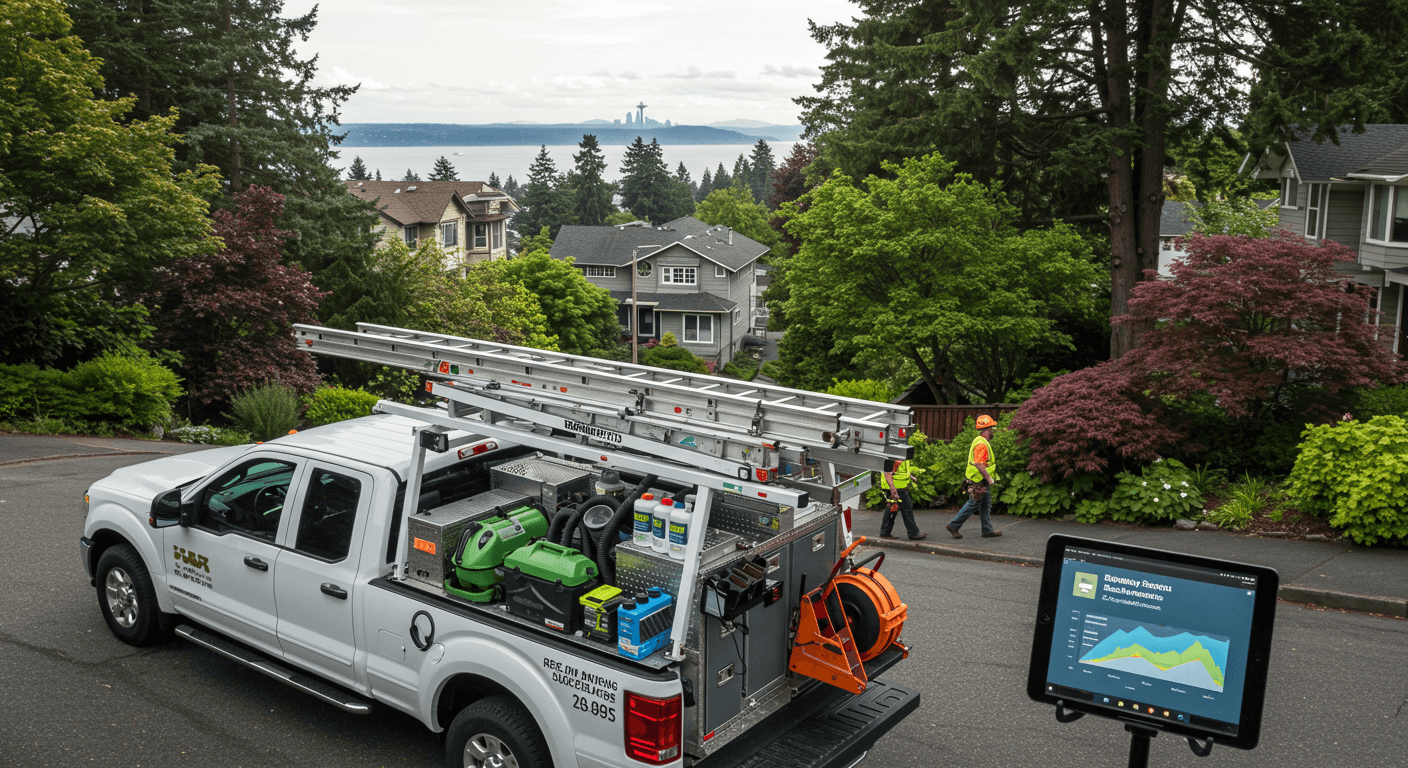
Jaxon stared at the digital whiteboard in his Ballard office, tapping a dry-erase marker against his chin as he looked at the gaping hole in November's schedule. Three weeks earlier, his crews were pulling twelve-hour shifts to keep up with the post-summer rush, but the phone had gone quiet the moment the first real Puget Sound drizzle settled in. He had $84,200 in overhead hitting his bank account every month regardless of whether a shingle was laid. This is the "Contractor's Trap," a cycle of feast and famine that keeps even the most skilled Seattle roofers from ever truly scaling.
I spent six hours with Jaxon last Tuesday reviewing his books. We realized that while his average ticket was $14,850, his customer lifetime value (LTV) ended the moment the final check cleared. He was effectively starting his business from zero every single Monday. To break this cycle, we shifted his focus toward recurring revenue, specifically through preventative maintenance subscriptions tailored for the Pacific Northwest climate.
Main Points
Predictable Cash Flow: Subscription income covers fixed overhead like shop rent and insurance during slow winter months.
Asset Value: Buyers pay a premium for "sticky" revenue; a business with 500 subscribers is worth significantly more than one with just a list of past leads.
Customer Lock-in: You become the "incumbent" roofer, making you the only call they make when it finally is time for that $20,000 replacement.
Companies with predictable recurring revenue streams command significantly higher valuations from buyers and investors.
The High Cost of the Transactional Model
Most owners I talk to are addicted to the "big hit." They want the $30,000 full replacement. While those projects drive the top line, they are expensive to acquire. When you factor in a rising mean hourly wage of $26.85 for roofers, marketing costs, and the time spent bidding against five other guys, your net margin on those big jobs often shrinks faster than a cheap tarp in a windstorm.
Recurring revenue changes the math. By offering a "Seattle Shield" program—including biannual gutter clearing, moss treatment, and a 19-point inspection—Jaxon started charging $49 to $89 per month. It sounds small until you realize he signed up 142 homeowners in the first quarter. That is $9,230 in monthly revenue that requires zero new lead spend.
Designing a Maintenance Plan for the Puget Sound
In Seattle, we have unique environmental stressors. We don't just have rain; we have stagnant moisture, hemlock needles, and aggressive moss growth. A generic maintenance plan won't sell here. You have to solve the specific pains of a homeowner in neighborhoods like Queen Anne or West Seattle.
Jaxon's plan didn't focus on "inspections." It focused on "clog-free guarantees" and "biological growth prevention." We structured his tiers based on the density of the tree canopy around the home. A house in a wooded part of Shoreline paid more than a townhome in Capitol Hill. This ensured his margins remained healthy even when a crew spent three hours blowing out stubborn fir needles.
The "Low-Hanging Fruit" Upsell
"Never leave a job site without offering the maintenance plan. I've found that 38% of customers will sign up for a subscription if it's presented as a "warranty extension" during the final walkthrough of a new roof installation."
The Implementation Timeline
Transitioning doesn't happen overnight. It requires a shift in how your sales team views their roles. They aren't just "closers" anymore; they are "relationship managers."
Action Plan
Building Your Recurring Revenue Engine
A three-month phased approach to transform your transactional business into a subscription-based model that stabilizes cash flow and increases enterprise value.
Month 1 (The Beta): Roll out the plan to your last 50 past customers. Offer a "founding member" rate. Jaxon saw a 14% conversion rate here just by sending a personalized video message.
Month 2 (System Integration): Link your CRM to an automated billing platform like Stripe or Jobber. If you are chasing checks for a $49 service, you are losing money.
Month 3 (Sales Incentives): Give your estimators a $55 bonus for every subscription they sell. This aligns their interests with the long-term health of the company.
Want to skip the manual work and get exclusive, verified leads instead?
Get $150 in Free CreditsIf you find that your sales team is struggling to find the time for these conversations because they are too busy chasing low-quality tire-kickers, it might be time to look at how you are sourcing your primary jobs. I often tell my clients to check our FAQ regarding how verified leads can free up their team's schedule for higher-value activities like building a subscription base.
Transactional vs. Subscription Revenue
| Factor | Project-Based (Old Way) | Subscription-Hybrid (New Way) |
|---|---|---|
| Customer acquisition cost (CAC) | Paid every time | One-time CAC with multi-year payout |
| Revenue volatility | High | Stable monthly floor |
| Referral frequency | Low | 3x higher referral rate |
| Company valuation basis | Value based on last year's sales | Value based on predictable future cash |
Customer acquisition cost (CAC)
Revenue volatility
Referral frequency
Company valuation basis
Impact on Enterprise Value
The roofing industry is a $56B market, and private equity firms are increasingly looking to roll up local shops. However, they aren't looking for the guy who is one bad month away from laying off his crew. They want the business with a "moat."
When we looked at Jaxon's numbers after six months, his monthly recurring revenue (MRR) had hit $12,450. On paper, that doesn't just add $149,400 to his annual top line. Because that revenue is 85% profit and highly predictable, it added roughly $450,000 to his total business valuation. He went from a "job owner" to a "business builder."
If you are struggling to find the "headspace" to implement these systems because you're stuck in the lead-generation rat race, you should read more on our blog about optimizing your operations for better freedom.
Common Questions
Building this stream isn't about the $49 checks. It's about owning the rooftop for the next 20 years. When you have 400 people paying you every month, you don't panic when the clouds clear or the phone stops ringing. You just keep building.
If you have questions about how to integrate this into your current workflow or need help troubleshooting your growth strategy, feel free to reach out to us directly.