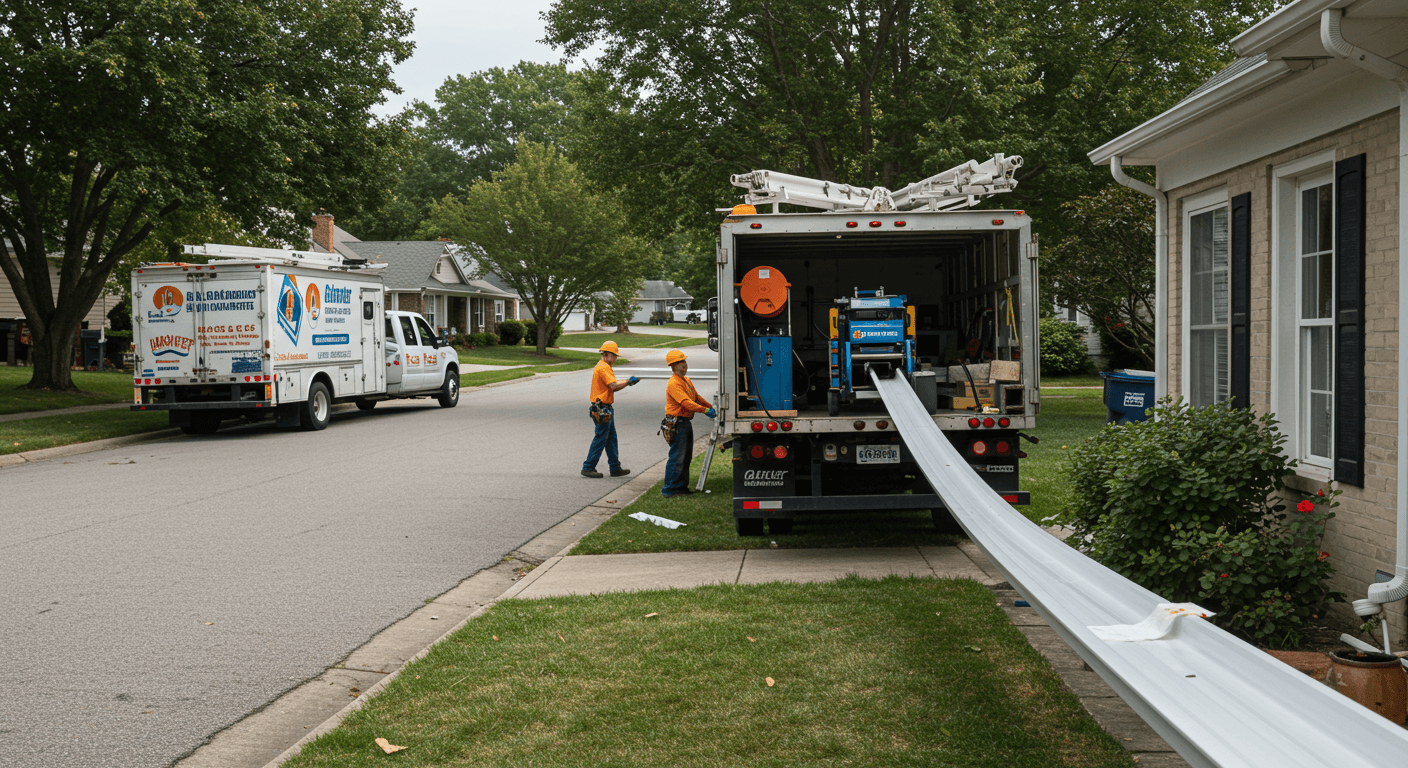
Jaxon had the franchise brochure spread on his desk while one of his rigs idled outside. The crew was waiting on a cell of rain so they could finish a long seamless run in the suburbs. The brand fee line would take 6.3% of top-line revenue before payroll, coil, or fuel, whether his team hung a downspout that week or not.
He had spent more than eight years growing Jaxon's Superior Gutters from a single van into a regional gutter shop. A national logo felt like a shortcut to steadier leads. The pitch leaned on proven systems and territory protection, while the marketing fund language read like a slow leak in a mitered corner. He was not only buying a name. He was trading autonomy for a story about safety, and the math got worse once he layered a 4.2% national advertising levy on every dollar earned.
Franchise fees vs. what independents keep on the books
| Metric | Franchise unit | Independent shop |
|---|---|---|
| Direct royalty | 6% to 10% of gross | 0% |
| Marketing control | Limited by brand rules | Full, localized |
| Tech stack cost | Mandatory monthly fees | Variable, pay for what you use |
| Equity and transfer | Conditional, transfer fees common | You own the asset |
| Typical net margin band | 14% to 19% | 22% to 28% |
Direct royalty
Marketing control
Tech stack cost
Equity and transfer
Typical net margin band
Ranges reflect what we see on gutter P&Ls nationwide. Your market, mix, and labor efficiency will move the numbers.
What matters for gutter enterprise value
Royalties and ad funds are fixed drains on gross. That cash could fund machines, local SEO, or estimator training instead of a logo you already compete without.
Mandated tech rarely beats a stack you can swap when dispatch or intake lags. Speed after storms matters more than a shared login screen.
Owning profiles, reviews, and the customer database protects exit optionality. Franchisors often control the digital front door you rely on daily.
The hidden weight of the royalty anchor
Franchise overhead is not a one-time buy-in. It is a recurring slice of every invoice.
On a roughly $1.2 million gutter business, the gap between a sharp independent and a strained franchise unit often shows up as overhead first. If you bill $98,400 in a strong month, a 7.5% royalty is about $7,380 gone before installers, coil, or insurance picks up the next line.
Stack that over six years and you are not talking about pocket change. You are talking about machines, crews, or hyper-local search work that compounds in your own name. In market after market, owners tell me the brand recognition pitch did not move homeowners who mainly want drainage that works and a crew that respects the beds along the foundation. A national mark three states over does not fix a sagging fascia detail on this block.
Guidance in the Fine Homebuilding gutter overview ties durability to materials and install quality, not to franchisor branding. If you already run tight on gauge, hanger spacing, and overflow paths, you are often funding a playbook you have already lived in the field.
If lead math is messy, royalties just accelerate the bleed. Clean the funnel first, then decide if a brand fee still makes sense.
The tech paradox: mandated stacks vs. tools you can change
Corporate software is only an advantage when it is fast, flexible, and yours to improve.
Franchisors love to sell proprietary systems. Many are familiar CRM and dispatch skins with a long contract wrapped around them. When intake feels slow or routing fights your territory reality, you wait on an update that may never match your weather window.
Independents can bolt together what actually fits. I watched a Pacific Northwest shop wire a simple rule: estimators could pull in lead alerts on mobile and claim work between stops instead of chasing a regional sign-off. That kind of agility matters when a storm dents half the county overnight and calendars need to move now, not after a marketing calendar written far from the job sites.
You may not own the leads you think you own
When the franchisor sits in the middle of paid search and brand sites, you can lose the number, the web property, and the history if you exit. Build so your GBP, site, and database stay in your entity, not a rental agreement.
Lead ownership and job fit
Independence is boring paperwork until you try to sell or pivot without your data.
National campaigns that resell demand back to you train dependency. Your shop heartbeat should not live on someone else's hosting agreement. When you own the profile, the reviews, and the customer list, you scale where the data says you win, not where a remote planner drew a circle.
Contractors who preview scope before they buy a lead waste fewer runs on steep roof lines or copper details their crew does not want. I have seen close rates run about 31.6% higher when teams stop burning estimates on scopes that never matched the trucks in the first place.
The 85/15 split for gutter marketing
"Put about 85% of spend into direct response where homeowners already feel the problem, and keep roughly 15% for brand memory. People searching gutter repair or overflow fixes want a fast, credible answer, not a national anthem."
Evaluating the "systems" story
SOPs matter. So does who keeps the profit after they are written.
The JLC gutters field guide keeps bringing failures back to pitch, outlet placement, and fascia detailing. Those are foreman-level fixes, not slides from a distant training webinar. Templates for HR and bookkeeping help, but you can buy that help once instead of paying a percentage forever.
A focused consultant engagement might land near five figures one time. A 6% royalty on $1.5 million revenue is $90,000 every year before you buy a single stick of material. Shops that de-franchise sometimes see net profit lift near nine points in year one because they kept the crews and trucks, swapped wraps, and stopped the logo tax.
Action Plan
The independent powerhouse hybrid
Borrow the discipline franchises market, keep the equity and cash flow.
Write SOPs for install, cleanup, and callbacks the way a strong franchise would, but keep the brand local and yours.
Track customer acquisition cost by channel and crew so you know which spend actually books steel on the wall.
Reinvest royalty-equivalent dollars into training and tools that shorten cycle time on the jobs you want most.
Review lead sources quarterly. Cut what burns drive time and double down where close rate and ticket size line up.
Want to skip the manual work and get exclusive, verified leads instead?
Get $150 in Free CreditsA real break-even story
Bigger top line is not richer if fees eat the lift.
Riley ran about $843,000 with a 19.3% net margin when a franchisor promised a path to $2 million. We mapped fees and overhead so Riley could see the truth: to hold the same take-home, sales had to jump to roughly $1.42 million just to tread water. Riley stayed independent, put about $18,200 into estimator training, and landed near $1.15 million the next year at a 24.1% margin. Smaller revenue, more dollars in the pocket, zero royalty invoice.
Common Questions
Exit reality
Buyers buy cash flow. Franchises add approval gates.
Selling a franchise often means corporate approval, transfer fees in the five figures, and a fresh long-term agreement for the buyer. Selling independent can mean a competitor, a roll-up, or an internal plan without asking permission to retire. Your asset is the local reputation and the technical depth on drainage, not a contract that can force a truck repaint when branding shifts.
If revenue is stuck around $750k, the fix is rarely a new logo. It is usually tighter lead handling, cleaner scope on estimates, and install standards that match what the field guides emphasize. Skip the 7% franchise drag and you have given yourself a raise without adding a single foot of gutter.