Main Points
Market domination requires geographic density to reduce overhead and travel time.
Data-driven lead selection reduces the customer acquisition cost by 31% on average.
Reliable, verified lead sources allow for consistent crew scheduling and better retention.
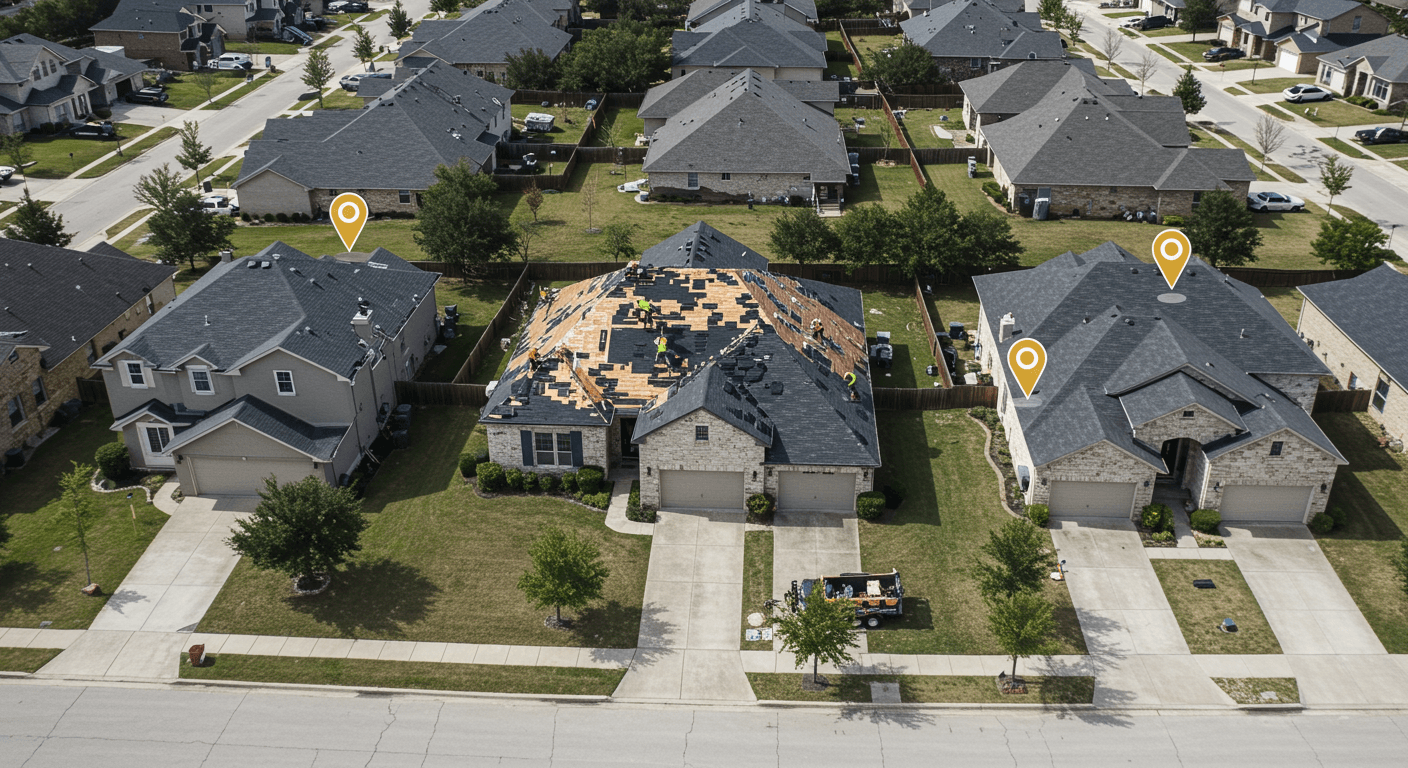
Both companies started the 2023 season with six crews and a $2.2 million baseline. Gavin, running a legacy shop out of Haltom City, relied on his 14-year reputation and local referrals. Meanwhile, his neighbor three miles down the road pivoted to a saturation strategy based on specific building permit density in the Alliance Corridor. By Q4, Gavin was fighting for a 4.1% margin while the competitor had locked down 18.7% of the new reroof permits in 76177. The difference wasn't the quality of the shingles or the speed of the installers; it was a fundamental shift from waiting for the phone to ring to dominating the map.
I was in Gavin's office last November looking at his profit and loss statements. He had done the work, but his customer acquisition cost had ballooned to $1,432 per contract. He was bidding against six other guys for every "organic" lead that came through his website. In contrast, the firms winning the Fort Worth market aren't just taking what the market gives them. They are using surgical precision to identify where the highest concentration of 15-year-old roofs sit and then owning those neighborhoods before a single hailstone falls.
The Tarrant County Market Reality
The roofing industry in the United States is currently seeing a massive shift toward consolidation and data-centric operations. According to recent market research from IBISWorld, the competition is no longer just the guy with a truck and a ladder. It is the enterprise-level firm using predictive analytics to forecast demand. In a metroplex like Dallas-Fort Worth, and specifically the Fort Worth side of the line, the geographic sprawl creates a unique challenge.
If your crews are bouncing from a repair in Benbrook to a full replacement in Keller, you are losing 22% of your billable hours to I-35W traffic. Domination isn't about being everywhere in North Texas. It is about being everything to three specific zip codes. When I work with shops in this region, we look at the density of "qualified rooftops." A qualified rooftop isn't just one that needs a shingles. It is one where the homeowner has the equity and the insurance profile to move forward without a six-month financing battle.
Shifting from Storm Chasing to Market Modeling
The old "wait for the storm" model is a race to the bottom. I've watched contractors in Fort Worth go broke waiting for a hail event that stayed north in Denton or south in Cleburne. To dominate market share, you have to treat roofing like a manufacturing process rather than an emergency service.
This requires a reliable pipeline. If you are constantly hunting for the next job, you cannot train your team to the standards required by the National Center for Construction Education. When Gavin's volume became unpredictable, his best installers left for a company that could guarantee five days of work every week. By using a platform that allows for territory locking, you create a moat around your business that prevents your competitors from siphoning off your most profitable neighborhoods.
I recently analyzed a firm in the 76107 area. They stopped bidding on every job across Tarrant County and focused exclusively on high-end residential within 12 minutes of their warehouse. Their revenue actually dropped by 8% in the first quarter, but their net profit climbed by 19.4%. Why? Because their fuel costs plummeted and their project managers could oversee four jobs a day instead of two.
- Market domination requires geographic density to reduce overhead and travel time.
- Data-driven lead selection reduces the customer acquisition cost by 31% on average.
- Reliable, verified lead sources allow for consistent crew scheduling and better retention.
- Focusing on specific zip codes builds local brand authority faster than a city-wide approach.
The High Cost of "Cheap" Leads
Many owners I talk to are obsessed with the price per lead. They'll tell me they can get "leads" for $30 on social media. But when we look at the math, those leads are costing them a fortune. If your sales rep spends 4 hours driving and 2 hours pitching to a lead that isn't the actual homeowner or has a $500 deductible they can't afford, you've just spent $400 in labor to find out the lead was junk.
The pros in the Fort Worth market are moving toward verified job opportunities where the preliminary data is already locked in. They want to see the roof size, the material type, and the age of the structure before they ever send a truck. This allows for a "lead scoring" system. In Gavin's case, we implemented a rule: if the lead was for a roof under 18 squares or more than 25 miles away, it was automatically routed to a junior salesperson or ignored entirely. This freed up his heavy hitters to close the $28,740 replacements in Westover Hills.
Operational Efficiency as a Sales Tool
When you own a market, your operations become your best marketing asset. Imagine a homeowner in the Fossil Creek area seeing your trucks on their street three times in a month. That visibility creates a psychological "default" in their mind. You aren't just a roofer; you are *the* roofer for their neighborhood.
To reach this level, you need a system that lets you preview opportunities without the risk of buying a lead that five other guys are already calling. Market domination is as much about blocking your competitors as it is about winning the client. If you can lock down a territory, you effectively starve the competition of the high-margin work they need to survive.
Managing the Growth Spurt
Domination often leads to a rapid influx of projects that can break a weak back office. I've seen it happen to a shop near the Stockyards. They hit a marketing vein that worked too well, and suddenly they had 42 roofs on the board with only enough cash flow to material-start 15.
To avoid this, you need a "staged" growth plan. Don't buy 100 leads if you can only produce 10 roofs a week. The goal is to maintain a rolling backlog of 3 to 4 weeks. This gives you enough time to stage materials (which saves about 4.7% on supply costs through bulk ordering) without making the customer wait so long that they get "buyer's remorse" and cancel the contract.
Once you land a job in a target Fort Worth neighborhood, offer a $250 "neighborhood discount" to the houses immediately to the left, right, and across the street if they sign within 72 hours of your crew arriving. This "Golden Circle" approach turns one lead into four, virtually eliminating your marketing costs for the additional three jobs.
Navigating the DFW Regulatory Environment
Fort Worth isn't just one big city; it's a patchwork of municipal requirements and HOA hurdles. If you are working in Tarrant County, you know that a permit in North Richland Hills is handled differently than one in Southlake. Market domination means knowing these inspectors by name and understanding the specific local codes (like the 2021 IBC/IRC updates) before you even step on a ladder.
Contractors who try to cover the entire DFW metroplex often get caught up in permit delays because they don't know the specific quirks of each satellite city's building department. By focusing your market share efforts on a specific cluster (like the suburbs along Highway 170), your office staff becomes experts in those specific filing systems. This can shave 4 to 6 days off your project timeline, which directly impacts your cash flow cycle.
[FAQ: How much of a market do I need to 'dominate' it?]
[ANSWER: You don't need 100% of the city. True domination in the roofing world is usually defined as holding 15% to 20% of the market share in a specific, high-density zip code. At this level, your brand recognition and referral loop become self-sustaining.]
[FAQ: Won't focusing on one area limit my growth?]
[ANSWER: Actually, it's the opposite. By lowering your travel time and increasing your closing rate through neighborhood authority, you increase your net profit. It's better to have 20% of one zip code than 0.5% of the entire DFW metroplex.]
[FAQ: How do I compete with the 'big box' roofing companies in Fort Worth?]
[ANSWER: The big national firms have high overhead and slow response times. You compete by being the 'local expert' who knows the specific weather patterns and HOA requirements of a neighborhood better than someone in a call center in another state.]
[FAQ: What is a healthy marketing spend for a growing shop?]
[ANSWER: For a shop looking to dominate a market, we typically see a marketing spend of 6% to 9% of total revenue. However, as your market share in a specific area increases, your referral rate should drive that number down toward the 4% range.]
- /blog/maximizing-roofing-roi-tarrant-county
- /blog/the-contractors-guide-to-lead-verification
- /blog/scaling-roofing-operations-without-the-chaos