I was standing on a salt-stained driveway in Upper Arlington last October, watching a sales rep named Julian hand over a $13,400 quote for a standard shingle replacement. The homeowner was ready to sign, but Julian didn't mention the rusted flashing or the fact that the ventilation was nowhere near up to code for an Ohio winter. By the time Julian walked back to his truck, he had left at least $3,215 in high-margin work on the table. He thought he was being "customer-friendly" by keeping the price low, but he was actually failing the business and the client.
There is a persistent myth in the roofing industry that upselling is a predatory tactic used by "shady" contractors to squeeze homeowners. Many owners I consult with in cities like Columbus and Dayton tell me they don't want to "scare off" leads with higher prices. They believe that the way to grow is to simply buy more leads and keep the crews moving.
This line of thinking is costing you a fortune.
In reality, providing a "basic" roof without addressing long-term durability is doing the homeowner a disservice, especially with Ohio's brutal freeze-thaw cycles. True professional growth comes from maximizing the revenue of every lead you already have. When you stop looking at a roof as just a pile of shingles and start seeing it as a complete weather-protection system, your profit margins shift overnight.
At a Glance
Shift from a 'volume first' mindset to a 'margin per ticket' strategy to offset rising material costs in the Midwest.
Leverage Ohio's specific weather patterns, like lake effect snow and high winds, as the catalyst for premium underlayment and ventilation upsells.
Implement a mandatory three-tier bidding system to give homeowners a choice while increasing average contract value by 18.4%.
Train field estimators to identify cross-sell opportunities like gutter guards and soffit repairs during the initial inspection phase.
The Cost of the "Basic Bid" Mentality
When you lead with your lowest price just to win the job, you are racing to the bottom. I worked with a mid-sized shop in Akron that was doing $2.4 million in annual revenue but struggling with cash flow. We looked at their last 47 jobs and found that 82% were "standard" installs with zero upgrades. According to the National Roofing Contractors Association (NRCA), material and labor costs have remained volatile, meaning those thin-margin jobs can quickly turn into losses if a single thing goes wrong on-site.
By failing to offer premium shingles, enhanced warranties, or integrated gutter systems, this Akron firm was missing out on an average of $4,102 per job. Across 115 jobs a year, that is nearly half a million dollars in "ghost revenue" that required no extra marketing spend to capture.
Contractors who present three pricing tiers see significantly higher average ticket sizes compared to single-quote approaches.
Leveraging the Ohio Climate for Premium Upgrades
In Ohio, we aren't just fighting rain. We are fighting lake effect snow in Cleveland, 60-mph wind gusts in the open plains near Lima, and humidity that turns shingles into petri dishes for algae in Cincinnati. These environmental factors are your best sales tools.
Instead of asking, "Do you want the better shingles?" your reps should be explaining why a standard 3-tab or basic architectural shingle is a liability. I've seen contractors successfully move 34% of their clients to impact-rated shingles simply by showing them the local hail maps from the previous three seasons.
The Ventilation Pivot
"In Ohio, ice damming is a major pain point. Always frame ridge vent upgrades and soffit inspections as 'ice dam prevention' rather than just 'attic airflow.' It connects the solution to a specific regional problem."
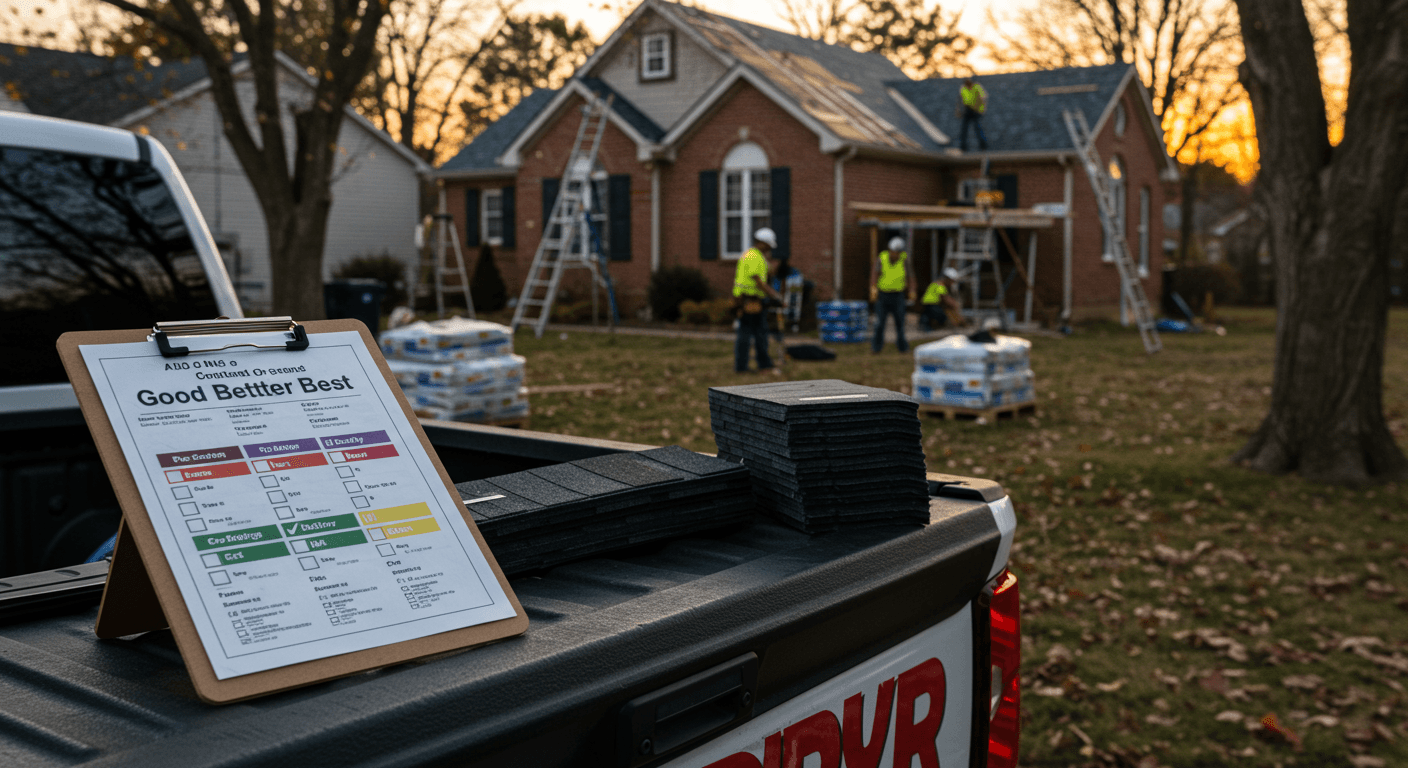
The Three-Tier Framework: Good, Better, Best
If you give a homeowner one price, their only choice is "Yes" or "No." If you give them three prices, their choice becomes "Which one is right for me?"
I helped a contractor in Toledo implement a "Protection Package" system. We didn't just change the shingles; we changed the entire presentation.
- The Essential Package: Code-minimum, basic shingles, 10-year workmanship warranty.
- The Ohio Shield: High-performance underlayment, algae-resistant shingles, 25-year workmanship warranty.
- The Lifetime Fortress: Impact-rated shingles, upgraded ventilation, lifetime workmanship warranty, and a 5-year gutter maintenance plan.
Basic Quote vs. Ohio Shield Bundle
| Feature | The Basic Quote ($12,840) | The 'Ohio Shield' Bundle ($16,255) |
|---|---|---|
| Shingles | Basic Architectural Shingles | SBS-Modified Shingles |
| Underlayment | Standard Felt | Synthetic Underlayment |
| Workmanship Warranty | 5-Year Workmanship | 20-Year Workmanship |
| Gutter Review | No Gutter Review | Gutter Guard Integration |
Shingles
Underlayment
Workmanship Warranty
Gutter Review
The results were immediate. Within four months, the "Better" package became their most popular option, accounting for 63% of all sales. The customer felt they were making an informed decision, and the contractor saw a 19.2% jump in net profit per project.
Cross-Selling: Beyond the Roof Deck
Your crew is already on the roof. The ladders are up. The permit is pulled. This is the most cost-effective moment to perform secondary repairs. Cross-selling isn't just about selling more; it's about efficiency.
I've found that the most successful Ohio shops don't just "do roofs." They manage the "building envelope." During the initial inspection, your estimators should be looking for:
- Gutter Integrity: 28% of roofing jobs have gutters that should be replaced or at least fitted with guards.
- Siding and Trim: Small repairs to fascia boards or siding that was damaged by the same storm that hit the roof.
- Sky-lighting: If the roof is 20 years old, the skylights are too. Replacing them during the re-roofing process is significantly cheaper for the homeowner and adds $1,200 to $2,500 to your ticket.
Action Plan
The 4-Step Upsell Integration
A systematic approach to maximizing revenue per job without overwhelming homeowners.
Evidence-Based Inspection: Use photos of damaged flashing and clogged gutters to show the 'why' before the 'how'.
The Comparison Pitch: Present the Three-Tier Quote on a tablet so the homeowner can visually compare the value of each level.
The 'While We Are Here' Discount: Offer a 11.5% discount on gutter guards if they are installed at the same time as the roof.
The Maintenance Hook: Close the job by offering a recurring $189 annual inspection plan to protect their new investment.
Want to skip the manual work and get exclusive, verified leads instead?
Get $150 in Free CreditsTraining Your Team to Spot the Gap
Your sales team needs to understand that they are consultants, not order-takers. This requires a shift in how you incentivize them. If you only pay commission on the total contract value, they might be tempted to cut the price to close the deal. Consider adding "performance bonuses" for specific upgrades, like selling a high-wind shingle package or a certain number of gutter guard feet.
I remember a conversation with an owner in Youngstown who was frustrated that his team was "too lazy" to upsell. When we looked at his sales process, he didn't even have a formal price list for upgrades. The reps had to "guess" the price of a skylight on the fly. Once we standardized the pricing in their CRM, the "laziness" disappeared because the friction was gone.
The key to scaling is ensuring that every lead you generate is squeezed for every drop of value. If your current lead source is providing low-quality opportunities that only want the cheapest price, it's hard to implement these strategies. The contractors who see the highest ROI are those who start with verified, exclusive opportunities that allow for a professional, value-based sales process.
Avoid the 'Dump' Mentality
Don't overwhelm the homeowner with 20 different options. Stick to three distinct tiers. Too much choice leads to 'analysis paralysis,' which can delay the signing of the contract by an average of 14 days.
Building Long-Term Value Through Maintenance
Finally, cross-selling shouldn't end when the shingles are nailed down. The most profitable roofing companies I know in the Midwest have a "Service Department" mindset. By selling a simple annual maintenance plan (cleaning gutters, checking flashings, removing debris), you stay top-of-mind. When that homeowner's neighbor needs a roof, or when a massive hailstorm rolls through the Scioto Valley, you are the first person they call.
According to data from Occupational Safety and Health Administration (OSHA), regular maintenance doesn't just protect the home; it identifies safety hazards before they become catastrophic failures. Positioning your maintenance plans as a "Safety and Longevity Audit" gives it a professional weight that a "gutter cleaning" just doesn't have.
If you can increase your average job size from $14,000 to $17,000 through these strategies, you could theoretically do 17% fewer jobs and still make more profit. That means less wear and tear on your trucks, fewer headaches with subcontractors, and a much healthier bottom line.
Ready to transform how your team approaches every opportunity? The foundation starts with quality leads that allow you to focus on value rather than competing on price. Start with $150 in free lead credits and see how verified opportunities change your sales approach.