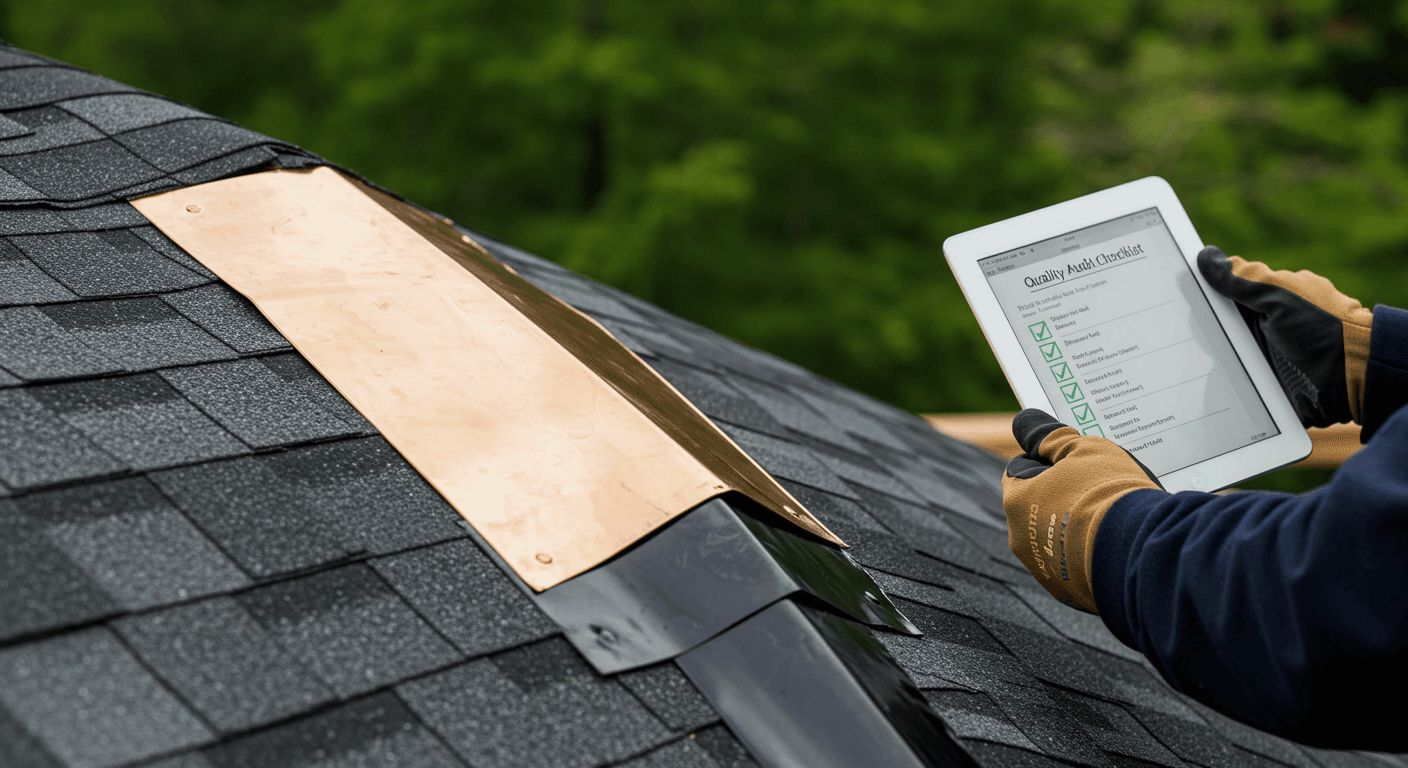
Stop treating flashing as a secondary detail if you want to protect your North Carolina company's net margins from the 31.7% callback rate plaguing the Southeast. I was walking a job site in Greensboro last month with a contractor named Zane, and we watched his best lead technician struggle with a complex chimney cricket. Zane's crew was fast, but they were following "standard" practices that simply don't hold up to the humidity and wind-driven rain we see from Asheville to Wilmington. Every time a crew rushes a valley or relies on a single bead of sealant instead of a mechanical bond, they aren't just risking a leak. They are burning approximately $1,240 in pure profit on the inevitable warranty claim that follows 14.4 months later.
Most roofing business owners view flashing as a line item in their material waste calculation, but I see it as the single biggest leak in your operational bucket. We often assume that following the North Carolina Residential Building Code is enough to guarantee a lifetime roof. It isn't. The code is a minimum standard, a "D minus" grade that keeps the building inspector off your back but does very little to protect your reputation in a competitive market like Charlotte or Raleigh. When you transition from "selling a roof" to "selling a waterproofed system," your entire business model shifts from price-commodity to high-value expertise.
At a Glance
Flashing failures account for nearly 68% of all residential roofing warranty claims in the Southeast.
Transitioning to a "mechanical-first" waterproofing system reduces labor waste by 12.4% over a 3.5-year period.
High-performance flashing systems can justify a 15% to 18% increase in total project ticket size.
Standardizing flashing details across all crews eliminates the "expert technician" bottleneck in your production schedule.
The Myth of the "Lifetime" Shingle Without Lifetime Flashing
We've all heard the sales pitches from shingle manufacturers about 50-year warranties and triple-laminate durability. However, in my 16.5 years of observing operations, I have never seen a shingle fail before the flashing does on a poorly executed job. In North Carolina, our weather cycles are brutal on metal-to-shingle transitions. We have the coastal salt air that eats away at cheap galvanized steel in places like Morehead City, and we have the rapid freeze-thaw cycles in the High Country that pop sealant joints like champagne corks.
Zane's problem in Greensboro wasn't that his guys were lazy. The problem was a lack of a systematic approach to waterproofing. They were treating every roof as a collection of shingles rather than a complex hydraulic system. When you realize that the average callback costs a North Carolina contractor $843 in fuel, labor, and lost opportunity costs, the business case for over-engineering your flashing becomes undeniable. You can't scale a business when your best guys are constantly spending 17.5% of their week fixing mistakes from last year's projects.
Why "Code Compliant" is a Business Risk
The North Carolina building code (specifically Chapter 9) dictates how we should handle roof assemblies, but it doesn't account for the "human variable" in a fast-paced production environment. I often tell shop owners that "code" is what you do so you don't get sued; "systems" are what you do so you can grow. For example, standard step flashing is often installed with the bare minimum three-inch overlap. That might pass an inspection in a suburban Cary neighborhood, but during a late-summer tropical depression with 55-mph gusts, that three-inch overlap is a highway for water intrusion.
I've seen shops transform their bottom line by mandating a five-inch minimum overlap and a hemmed edge on all valley metal. Yes, it adds $214 in material costs to a standard 25-square roof. But when you look at the Harvard Business Review insights on small business scaling, the focus is always on reducing "rework." In roofing, flashing rework is the most expensive type because it usually involves removing perfectly good shingles to fix a $15 piece of bent metal.
Most owners don't realize that previewing job specifics allows you to spot these complex chimney or valley details before you even bid. This prevents the "surprise" flashing issues that blow your labor budget on day two of a project.
The "Hemmed Edge" Advantage
"Always require your crews to hem the edges of their valley and apron flashing. This small mechanical detail prevents water from "creeping" sideways via capillary action, a common cause of mysterious leaks in the humid North Carolina climate."
Rethinking Valley Waterproofing: Metal vs. Shingle-Over
One of the biggest debates I have with operations managers is the "closed-cut" valley versus the "open-metal" valley. In the North Carolina market, where pine needles and oak leaves are a constant presence, the closed-cut valley is a maintenance nightmare. It traps debris, which holds moisture against the shingle granules, leading to premature rot.
I recently helped a firm in Fayetteville transition all their crews to open-metal valleys using 24-gauge pre-finished steel. The result? Their valley-related callbacks dropped by 44% in the first 2.5 years. More importantly, it changed their sales narrative. They stopped talking about shingles and started talking about "debris-shedding water management."
This is where The End of Solution Sales comes into play. Customers aren't just looking for a "solution" to a leaky roof; they are looking for insights into why their last roof failed. When you show a homeowner in Charlotte a piece of corroded 28-gauge "builder grade" flashing and compare it to your 24-gauge hemmed system, the sale is over. You've moved from a price war to an authority position.
The Financial Impact of the "Sloppy 10 Percent"
In any roofing operation, the first 90% of the job is easy. It's the shingles, the underlayment, the ridge vent. It's the final 10%—the flashing, the counter-flashing, the pipe boots—that determines your actual profit. I call this the "Sloppy 10 Percent."
Let's look at the math for a mid-sized NC shop doing 125 roofs a year:
- Average Roof Price: $14,600
- Gross Margin (Target): 35% ($5,110)
- Callback Rate: 12% (15 jobs)
- Cost Per Callback: $912
- Total Annual Profit Drain: $13,680
That $13,680 is enough to buy a new dump trailer or fund a massive marketing push. By investing just an extra 90 minutes of labor into "over-engineered" waterproofing, you can slash that callback rate to under 3%. If your current lead flow isn't keeping your crews busy enough to justify this extra time, exclusive roofing leads with locked previews can ensure you're picking the high-margin jobs where this level of detail is expected and paid for.
Action Plan
How to Implement a Zero-Leak Waterproofing Standard
A systematic approach to waterproofing that eliminates callbacks and protects your profit margins through mechanical-first installation techniques.
The "Double-Barrier" Rule: Every roof-to-wall transition must have a layer of ice and water shield behind the step flashing, extending 6 inches up the wall and 12 inches onto the deck.
Mechanical Counter-Flashing: Ban the use of "caulk-only" counter-flashing on brick chimneys. All counter-flashing must be reglet-set or have a secondary metal cap.
The Kick-Out Requirement: Mandate kick-out flashing on every roof-to-wall termination. No exceptions. This prevents the $5,000+ siding and framing rot claims that can bankrupt a small shop.
Photo Verification: Crews must upload high-resolution photos of the flashing *before* shingles cover it. This creates a permanent digital record for warranty defense.
Want to skip the manual work and get exclusive, verified leads instead?
Get $150 in Free CreditsSelling the System: Turning Waterproofing into Revenue
Most sales reps spend 20 minutes talking about shingle colors and 2 minutes talking about flashing. This is a massive mistake. Your flashing system is your strongest competitive advantage because it's the part of the job that requires the most skill.
I worked with a woman named Yara who runs a roofing company in Durham. She was struggling to compete with "truck and a ladder" guys who were undercutting her by $2,500. We revamped her sales presentation to focus entirely on "The Durham Drip"—her term for the common rot found behind siding where kick-out flashing was missing. She started carrying a 12-inch sample of her custom-bent copper chimney flashing to every appointment.
By educating the homeowner on the *mechanics* of water flow, she wasn't just another roofer giving a quote. She was a consultant identifying a structural risk. Her closing rate jumped from 22% to 38% in less than 7 months, despite being the most expensive option in the zip code. If you're ready to put these strategies into practice with homeowners who actually value quality, starting with free lead credits lets you test this approach on real-world projects without the initial overhead.
Addressing the Crew Psychology
You can have the best flashing strategy in the world, but if your lead installer thinks it's "overkill," it won't happen. Changing crew behavior is the hardest part of operations management. When Zane and I were looking at that chimney in Greensboro, he realized he had been rewarding his guys for speed, not for detail.
We changed his incentive structure. Instead of a flat "per square" bonus, we implemented a "Quality Audit" bonus. Every job was inspected by a production manager who used a 12-point waterproofing checklist. If the job passed with zero flashing deficiencies, the crew got a $150 bonus. If even one step flashing piece was missing a nail or a bead of sealant was messy, the bonus was zero.
It took about three weeks for the whining to stop. But once the crews realized that doing it right the first time meant they never had to go back on a Saturday to fix a leak, the culture shifted. Their efficiency actually increased because they weren't constantly switching mental gears between new installs and repair work.
The Silicone Trap
Never allow your crews to use standard silicone caulk as a primary waterproofing method. In the North Carolina sun, silicone can pull away from masonry in as little as 18 months. Always use high-grade polyurethane or tripolymer sealants that are specifically rated for high thermal expansion.
Regional Specifics: The NC Coastal Challenge
If you are operating in New Hanover, Brunswick, or Dare counties, your flashing requirements are a different beast entirely. The 130-mph wind zones require more than just "standard" nailing patterns. I've seen 26-gauge aluminum flashing literally vibrate until the nail holes widened and the metal flew off during a minor tropical storm.
In these coastal zones, I recommend a "Heavy Metal" policy. Move to 24-gauge steel or 16-ounce copper. Use stainless steel fasteners to prevent the galvanic corrosion that occurs when salt spray hits standard galvanized nails. These aren't just "good ideas"—they are survival tactics for your business. One bad storm can result in 50 leaks overnight if your flashing isn't secured for high-velocity winds.
Data-Driven Waterproofing
The future of roofing isn't just better shingles; it's better data. I encourage every shop owner I work with to track their "Leak by Type" data. Is it the valleys? The chimneys? The pipe boots?
For most, the "Pipe Boot" is the silent killer. The standard rubber collar boots we buy at the supply house have a lifespan of about 7.2 years in the North Carolina sun. If you are installing a "30-year" roof with a 7-year pipe boot, you are scheduling a callback. Moving to a lead boot or a high-grade silicone collar adds $38 to your cost but saves you that $912 callback fee. When you look at the ROI, it's a 2,300% return on your investment.
Conclusion: Building a Scalable Asset
The goal of every roofing business owner should be to build a company that can run without them. You can't do that if you are the only person who knows how to properly flash a skylight. By systematizing your waterproofing—from the material choice to the crew bonuses to the sales pitch—you are creating a "predictable profit machine."
Zane's shop in Greensboro is now doing $4.2 million a year with a callback rate of less than 2.1%. He's no longer the "fireman" rushing out to fix leaks. He's a strategist focusing on growth. This shift started with a single realization: flashing isn't a detail; it's the foundation of your company's financial health.