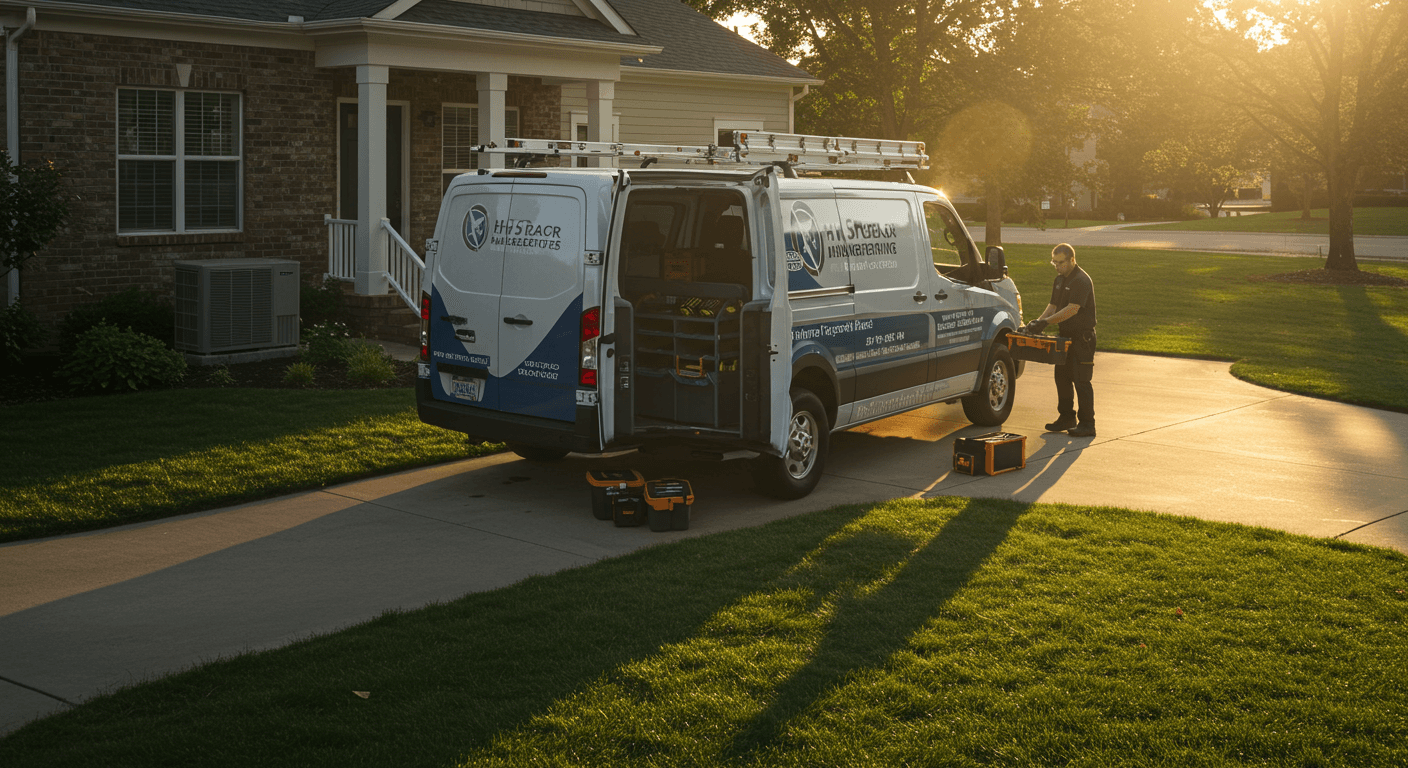
Traditional marketing metrics suggested Devin was winning because his average cost per lead sat at a comfortable $24.80, yet his bank balance told a story of fourteen-hour days with zero retained earnings. Contrast that with a smaller shop I audited last month in Tennessee, where the owner intentionally paid $87.15 per lead but saw a 41.3% higher net margin because every technician arrival turned into a system replacement or a high-margin IAQ upgrade. Devin's dispatch board was a frantic mosaic of $79 diagnostic calls that went nowhere, while the Tennessee crew focused on high-intent, exclusive inquiries that respected their time.
Efficiency is not found in the volume of the noise, but in the quality of the signal hitting your service manager's desk. When you stop measuring the cost of the phone ringing and start measuring the cost of a technician standing in a driveway, your entire operational perspective shifts. Focusing on the wrong number leads to a hollowed-out business where your best installers quit because they are tired of fighting for commissions on bottom-barrel leads.
Profit-Focused Lead Optimization
Prioritize Customer Acquisition Cost (CAC) over simple Cost Per Lead (CPL) to protect your net margins.
Account for technician windshield time and opportunity costs when evaluating lead quality.
Use high-intent lead verification to reduce wasted dispatch and installer burnout.
Leverage exclusive leads to maintain a closing rate above 38% for system replacements.
The False Economy of the $25 Lead
A green dashboard can hide a brutal cost per booked appointment once intake quality is honest.
Many HVAC owners fall into the trap of looking at their marketing dashboard and seeing a sea of green. If a lead costs $25 and the phone is ringing fifty times a week, it feels like growth. But as an operations strategist, I look at what happens after the phone rings. If those fifty leads only result in four actual booked appointments because the rest were price-shoppers, wrong numbers, or "just looking" inquiries, your real cost per appointment is $312.50.
I have seen shops scale their cheap lead spend only to realize they are subsidizing a call center that does not produce. When you pay for non-exclusive or unverified leads, you are not just paying the lead fee. You are paying for the labor of the CSR who has to call that lead eight times to get a no, the software to track it, and the mental fatigue of a sales team that feels like they are working a digital telemarketing floor instead of solving comfort problems for homeowners.
The reality of the current HVAC labor market is that skilled technicians are expensive and in high demand. According to the Bureau of Labor Statistics, there are over 415,000 mechanics in this field, and the competition for the top 10% is fierce. If you send a top-tier installer on a lead that has a 5% chance of closing, you are not just losing the $25 lead fee. You are losing the $3,800 in gross profit they could have generated on a high-intent system replacement elsewhere.
The appointment math trap
Fifty leads at $25 each is not $1,250 in growth if only four book. Your real cost per appointment is $312.50 before a tech ever leaves the shop. Run that number monthly and compare it across sources.
The Buried Cost of Technician Windshield Time
Every low-fit dispatch pulls margin out of the day before the homeowner opens the door.
In my time auditing service workflows, I have found that windshield time is the silent killer of HVAC profitability. A truck roll in a metropolitan area rarely costs less than $185 when you factor in fuel, vehicle depreciation, insurance, and the hourly rate of a lead tech and an apprentice.
If your lead generation strategy focuses on volume, your dispatchers are likely sending trucks to homes where the homeowner is just looking for a free estimate to use as leverage against a competitor. I recently worked with a shop in Ohio that reduced their lead volume by 32% but increased their net profit by 19.4% simply by raising their lead standards. By switching to verified, high-intent leads, they ensured that when a truck left the bay, it was headed toward a homeowner who had already passed a basic qualification filter.
Ohio shop cut lead volume 32% while tightening verification and dispatch fit.
Every time a technician sits in traffic for forty-five minutes to find out the homeowner is not actually the decision-maker or has not even started thinking about a budget, your operation takes a hit. We call this the Utility Gap. To fix it, you need lead sources that let you confirm job type and location against your profit centers before you commit a crew to the road.
Calculating True ROI Beyond the Click
Divide total spend by gross profit generated, not by how many names landed in your CRM.
To truly optimize your lead costs, you have to move beyond the top-of-funnel metrics. I recommend a back-to-front audit of your last 100 leads. Take the total spend for those leads and divide it by the total gross profit generated, not just the revenue.
Below is a simplified look at two lead sources I observed in a recent case study. Source A looks cheaper on paper. Source B wins on net marketing ROI because close rate and average ticket are not hostage to a shared bidding war.
High-volume shared leads vs exclusive verified intake
| Factor | Source A (high volume) | Source B (exclusive/verified) |
|---|---|---|
| Leads purchased (same $3k spend) | 100 leads at $30 each | 30 leads at $100 each |
| Jobs sold / close rate | 5 jobs (5% close rate) | 9 jobs (30% close rate) |
| Average job size | $4,200 | $9,400 |
| Net marketing ROI (after truck rolls) | $14,000 | $78,000 |
Leads purchased (same $3k spend)
Jobs sold / close rate
Average job size
Net marketing ROI (after truck rolls)
Both scenarios include roughly $200 per truck roll. Your shop should model labor, equipment cost, and financing on top of these figures.
In this scenario, Source B had a much higher cost per lead, but the net ROI was over five times higher. That is because the leads from Source B were likely exclusive and verified, meaning the contractor was not racing four other companies to the door. When you use real-time territory locking and lead scoring, you eliminate much of the waste associated with Source A.
Action Plan
Lead-to-profit audit for your HVAC shop
How to perform a lead-to-profit audit for your HVAC shop.
Gather 90 days of data: pull your total marketing spend and your CRM data for the last quarter.
Calculate all-in lead cost: include the lead fee plus the internal cost of your CSRs and intake team.
Calculate appointment cost: divide total spend by actual appointments ran, not just leads received.
Determine job gross profit: subtract equipment costs and direct labor from the total sale.
Assign ROI to source: compare the gross profit generated per source against the total cost of acquisition.
Maximizing Ticket Averages with IAQ and Retrofits
Better intent upstream makes downstream upsell conversations feel like education, not pressure.
Lead optimization is not just about spending less. It is about making each lead worth more. One of the biggest missed opportunities I see in the field is failing to leverage Indoor Air Quality (IAQ) as a profit multiplier. According to the EPA Indoor Air Quality guidelines, modern homes are often more polluted than the air outside due to tighter construction.
When you acquire a high-quality lead, your technician has the opportunity to educate the homeowner on filtration, UV lights, and humidity control. If your lead source is providing a homeowner who is actually concerned about comfort rather than just price, your ticket average can jump from a $450 repair to a $2,350 system enhancement.
This is why lead intent matters. A lead generated from a cheap furnace repair keyword usually attracts someone in a financial crisis looking for the lowest possible bid. A lead generated from whole home comfort solutions attracts a homeowner looking for a long-term partner. If your intake process is not filtering for these distinctions, you are leaving thousands of dollars on the table every week.
The 15-Minute Intake Rule
"Never send a truck based on a digital form alone. Have a trained CSR spend 15 minutes on the phone verifying the homeowner's needs, the age of the system, and their timeline. If the lead does not pass this human filter, it is often cheaper to decline the lead than to waste a technician's afternoon."
Why Exclusivity Beats Volume Every Time
Being first to the door helps. Being the only contractor in the conversation changes the math.
In the HVAC world, being the first one to the door is often cited as the key to winning. While speed to lead is important, being the only one at the door is even better. Shared lead platforms create a race to the bottom on price. If a homeowner receives five calls within thirty seconds of hitting submit, they immediately shift into a defensive, price-sensitive mindset.
Exclusive leads allow your team to build rapport. You can take the time to perform a proper load calculation or a ductwork inspection without the homeowner looking at their watch because the next contractor is pulling into the driveway. This operational breathing room is where the most successful shops find their margins.
At LeadZik, we focus on a mission to build a better lead marketplace where contractors are not forced to compete in a noisy, shared environment. By locking down territories and providing exclusive access, the focus shifts from who is the cheapest to who is the most professional.
Scaling Your Operations with Verified Intent
Predictable intake lets you staff, buy equipment, and plan shoulder season without guessing.
As you look to scale from $2M to $10M and beyond, your biggest bottleneck will not be leads. It will be qualified labor. You cannot scale a business on the backs of technicians who are burnt out from running leads that never had a real budget behind them.
Optimization means creating a predictable pipeline where your service manager knows that for every ten leads that hit the board, eight will be qualified appointments, and three will result in major installs or high-value service contracts. This predictability allows you to staff correctly, purchase equipment in bulk to save on margins, and maintain a steady cash flow even during the shoulder seasons of spring and fall.
Common Questions
The Operational Pivot: From Lead Chaser to Profit Leader
Walk away from volume that does not match crew capacity and margin targets.
Optimization is a mindset. It requires the discipline to walk away from high-volume, low-margin opportunities in favor of high-intent, exclusive partnerships. If you continue to treat leads as a commodity, you will always be at the mercy of the lowest bidder.
Start by auditing your current lead flow. Look for the gaps where money is leaking out of your trucks and into the pockets of lead aggregators who do not care about your bottom line. When you align your marketing spend with your operational capacity, you stop being a lead chaser and start being a profit leader.