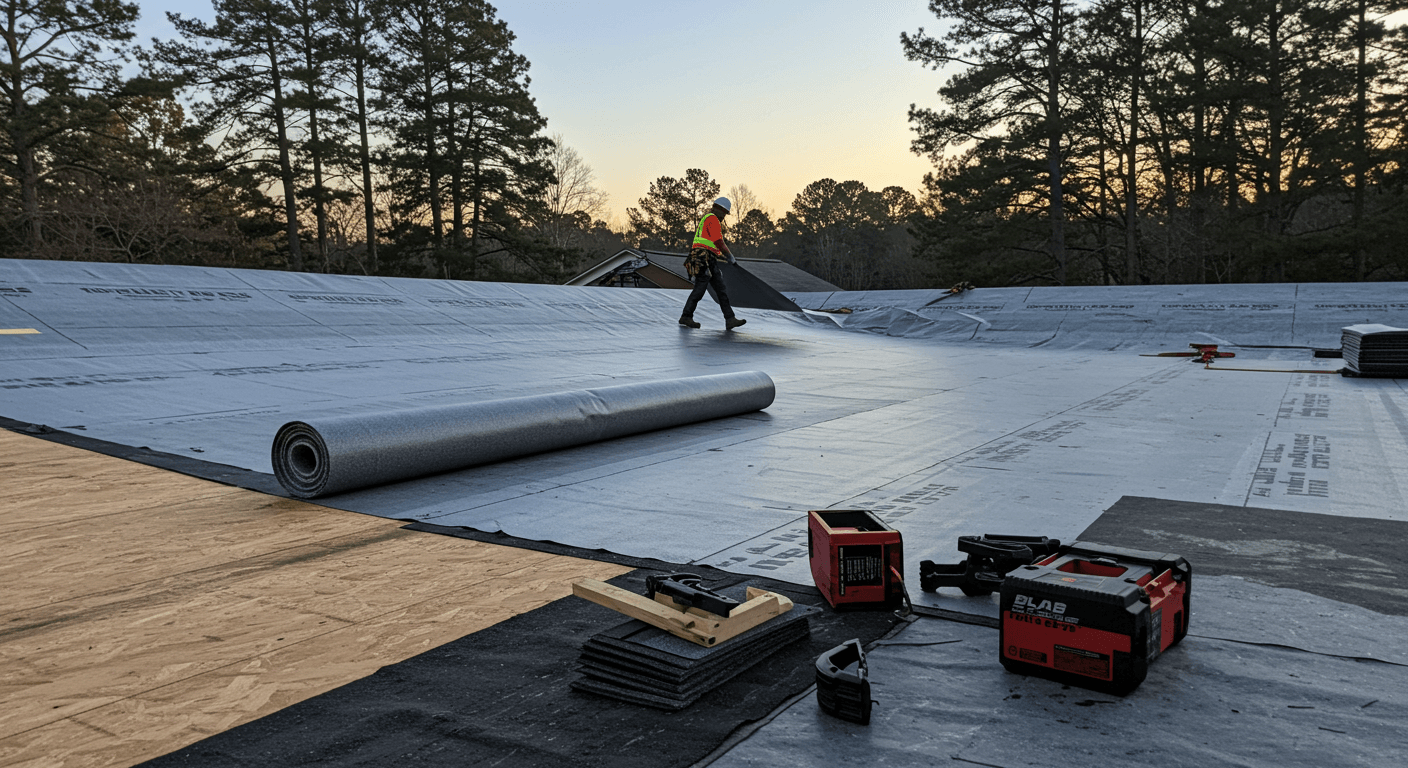
Main Points
Margin Protection: High-quality underlayment reduces "silent" callbacks that eat 12% to 15% of net profit on average Raleigh projects.
Sales Differentiation: Using advanced synthetic systems allows you to justify a 9% to 12% price premium over "trunk-and-ladder" competitors.
Crew Efficiency: Modern self-adhered membranes reduce installation time in tricky areas like valleys and dormers by roughly 22%.
Most roofing contractors in the Triangle area treat underlayment as a commodity, a line item to be squeezed for every penny of savings. I was sitting in a small office near North Hills last October with a contractor named Xavier. He was frustrated because his crew was finishing jobs faster than ever, yet his net profit was shrinking. When we dug into his books, we found a staggering $14,642 hole labeled as warranty work and "leak investigations." It turns out his team was rushing the valley flashing and using the cheapest felt they could find to offset rising labor costs. They thought speed was the metric that mattered.
The reality is that in a climate like Raleigh, where the humidity clings to everything and summer storms hit with sudden intensity, underlayment is actually your most important insurance policy. You aren't just installing a roof; you are building a moisture management system. Xavier’s "savings" on cheap materials were actually a high-interest loan he was taking out against his future reputation. Once we shifted his strategy to focus on high-performance synthetic integration, his callback rate dropped by 64% over the following nine months.
- Margin Protection: High-quality underlayment reduces "silent" callbacks that eat 12% to 15% of net profit on average Raleigh projects.
- Sales Differentiation: Using advanced synthetic systems allows you to justify a 9% to 12% price premium over "trunk-and-ladder" competitors.
- Crew Efficiency: Modern self-adhered membranes reduce installation time in tricky areas like valleys and dormers by roughly 22%.
- Risk Mitigation: Proper underlayment installation is a cornerstone of site safety and long-term structural integrity.
The High Cost of the "Good Enough" Mentality
I often see owners focus 90% of their sales pitch on the shingle brand and 0% on what happens underneath. In Raleigh, where we deal with significant thermal expansion and contraction, that's a recipe for failure. Traditional #15 or #30 felt is increasingly becoming a liability rather than an asset. It wrinkles, it absorbs moisture, and it degrades significantly if left exposed for even a few days during a typical North Carolina summer rain delay.
When I look at the data from the shops I consult, the ones with the highest referral rates are the ones who have moved away from asphalt-saturated felt entirely. They’ve realized that the extra $400 to $600 in material costs for a premium synthetic underlayment is a pittance compared to the cost of sending a two-man crew back out to a house in Wake Forest to chase a mystery leak.
Emerging Trends in the Raleigh Market
We are seeing a massive shift toward "total system" warranties. Homeowners in affluent pockets like Cary and Apex are becoming more educated. They aren't just looking for the lowest bid; they are looking for the contractor who can explain why their roof won't leak in ten years.
One trend that is picking up steam is the use of high-temperature self-adhered membranes across the entire deck, not just at the eaves. While the initial material cost is higher, the labor savings are real. You can see these types of premium jobs coming through verified lead previews where homeowners specifically ask for "upgraded" or "lifetime" systems. These are the leads that high-growth shops are targeting because the margins are protected.
| Feature | Traditional Asphalt Felt | Modern Synthetic Underlayment |
|---|---|---|
| Durability | Prone to tearing and UV degradation | High tear strength and 6-month UV rating |
| Moisture Resistance | Absorbs water and can wrinkle | Hydrophobic and remains flat |
| Safety Factor | Slippery when wet or dusty | Non-slip walking surfaces for crews |
| Installation Speed | Slower, requires more fasteners | Faster, larger rolls, fewer laps |
| Weight | Heavy and bulky for crews | Lightweight and easier to stage |
The "Seal" Strategy: Beyond the Eaves
A common mistake I see in Raleigh is the "bare minimum" approach to ice and water shields. Most contractors only run two courses along the eaves because that’s what the code requires. But if you want to scale a business that runs on autopilot, you have to go beyond code.
I recently worked with a firm that started using self-adhered membranes in all valleys, around all penetrations, and along all rake edges as a standard operating procedure. They even started using it on low-slope sections that technically didn't require it. The result? Their "leak-free" guarantee became a powerful marketing tool. This wasn't just a technical change; it was a sales transformation. They stopped competing on price and started competing on peace of mind.
To keep your crews updated on these changing standards, it is vital to follow the OSHA Roofing Safety guidelines, which emphasize that a stable, properly installed underlayment is the first step toward a safe working environment.
Operationalizing the Install
Training is where most Raleigh roofing businesses fall apart. You can buy the best materials in the world, but if your crew is stapling synthetic underlayment like it's 1995, you're wasting money. Synthetics require cap nails or specific fastener patterns to maintain their warranty and their water-shedding capabilities.
I recommend implementing a "photo-check" system. Before the shingles go down, the lead installer must upload four photos of the underlayment to your project management app. One of the valleys, one of the pipe boots, one of the ridge vents, and a wide shot of the field. When I helped a contractor in Garner implement this, his rework rate dropped to nearly zero. He could catch errors from his phone while he was at lunch.
Speaking of managing things from your phone, if you aren't using a mobile lead management app to track your pipeline while your crews are on-site, you are likely losing leads to faster competitors. Speed matters in sales just as much as precision matters on the roof.
- 1Deck Preparation: Ensure the deck is dry and all protruding nails are driven flush. Synthetic underlayment is thin; a single nail head can cause a tear under foot traffic.
- 2Overlap Verification: Enforce a minimum 4-inch side lap and 6-inch end lap. In wind-driven rain zones like NC, these overlaps are the only thing preventing water backup.
- 3Fastener Audit: Switch from staples to plastic cap nails. Staples often "fishmouth" the underlayment, creating small channels where water can migrate.
The Sales Impact of Technical Excellence
I've seen contractors turn their underlayment choice into their biggest closing tool. Instead of showing a shingle sample, they show a sample of the synthetic underlayment and try to rip it in front of the homeowner. Then they show a piece of torn felt. It's a visceral, easy-to-understand demonstration of value.
When you can prove that your installation techniques are superior, you can stop chasing the "bottom feeders" in the market. You can focus on high-quality jobs that you can claim with confidence knowing your profit won't be eaten by a service call in six months.
Leveraging Data for Long-Term Growth
Success in the Raleigh market isn't about who can do the most roofs; it's about who can do the most *profitable* roofs. By focusing on advanced underlayment techniques, you are building a barrier against the most common threats to your business: weather, labor inconsistency, and price-driven competition.
I’ve watched shops in the Triangle grow from two crews to twelve simply by obsessing over these technical details. They realized that high-quality installation is the foundation of a high-growth brand. They use OSHA's Plan, Provide, Train framework to ensure their teams aren't just fast, but safe and precise.
- Is the price jump from felt to synthetic really worth it? Yes. While the material cost is 2.4x higher, the reduction in labor for installation and the elimination of callbacks typically result in a 3.1x return on that specific investment.
- Does Raleigh code require ice and water shield on all roofs? Currently, NC building code requires it in areas prone to ice damming, but savvy Raleigh contractors install it in all valleys and transitions due to the high volume of wind-driven rain.
- Can I use synthetic underlayment on low-slope roofs? Most synthetics are rated for slopes down to 2:12, but for anything under 4:12, I recommend a double-lap or a dedicated self-adhered membrane to ensure a watertight seal.
- /blog/roofing-lead-conversion-strategies-for-contractors
- /blog/how-to-scale-your-roofing-business-in-a-competitive-market
- /blog/maximizing-roi-on-roofing-lead-purchases