Watching Jaxon's face fall as the high school auctioneer moved past the $500 sponsorship banner without a single mention of his roofing company was the wake-up call he needed. We were standing in a drafty gymnasium in Bend, Oregon, and he had just realized that "community engagement" is not a donation, it is a strategic investment that needs a measurable return. He had spent $4,320 that year on "brand awareness" that resulted in exactly zero tracked phone calls.
As a lead generation specialist, I have spent the last 14 years looking at the numbers behind these feel-good marketing plays. Most roofing contractors treat community involvement like a tax they pay to look like a local shop, but the crews that scale past the $5M mark in competitive markets like Seattle or the Bay Area treat it as a tactical acquisition channel. They are not only writing checks for little league jerseys. They engineer touchpoints that lower Customer Acquisition Cost by 18.7% compared with cold digital spend when the program is measured end to end.
Active community programs with tracking and follow-up consistently outperform spray-and-pray digital buys in the West Coast markets I model.
Table of Contents
The brand awareness trap in West Coast roofing
Passive impressions rarely line up with storm-driven intent, so budgets quietly evaporate.
The problem with traditional community engagement is the lack of intent. When you sponsor a golf tournament in Scottsdale or a wine walk in Napa, you are buying impressions, not leads. For a roofing business, where the sales cycle is often triggered by a specific event like a storm or a leak, broad impressions are remarkably inefficient. I have audited books for shops where the owner was convinced their $12,450 annual community budget was working, only to find their cost per lead from those sources was north of $640.
According to the BLS occupational outlook for roofers, demand stays steady, but competition for skilled labor and market share is intensifying. In a crowded West Coast market, you cannot afford to let marketing dollars sit idle on a fence banner. You need to move from passive check-writing to active relationship-building.
The QR code audit
"Stop printing your logo on banners without a tracking mechanism. Use a unique QR code for every local sponsorship that leads to a dedicated landing page offering a Community Partner discount. If that banner does not generate at least 4.2 scans per month, it is not an engagement strategy, it is a donation."
Comparing the three pillars of community engagement
Match spend to the mix that delivers the highest lifetime value for the lowest upfront waste.
When I sit down with a contractor to reallocate a marketing budget, we usually look at three distinct types of community engagement. The goal is to find the mix that provides the highest lifetime value for the lowest upfront spend.
- Passive sponsorships: jerseys, banners, and program ads. Lowest ROI, highest visibility.
- Educational outreach: workshops on fire-resistant materials in California or moisture management in the Pacific Northwest.
- Direct service projects: roof giveaways or veteran support builds. High upfront cost, strong PR and SEO value when documented well.
Community strategy comparison
| Factor | Passive sponsorships | Educational workshops |
|---|---|---|
| Illustrative average CAC | $542 | $194 |
| Tracking difficulty | High | Easier with sign-ins and RSVP lists |
| Typical sales velocity | Slow (6 to 12 months) | Faster (1 to 3 months) |
| Expert positioning | Logo in the background | You are the instructor |
Illustrative average CAC
Tracking difficulty
Typical sales velocity
Expert positioning
Figures reflect directional ranges from recent West Coast shop audits. Your market will vary, but the pattern holds when workshops are promoted and staffed like revenue events.
I once worked with a shop in Tacoma that pivoted their entire $15,800 community budget from local sports banners to a series of homeowner maintenance clinics held at libraries. They did not only talk about shingles. They covered gutter cleaning and moss mitigation. By the end of the second quarter, they had a 31% conversion rate from attendees to paid inspections. That is the difference between being a name on a shirt and being the expert in the room.
The shift from passive signage to live education turned community spend into a pipeline with a clear handoff to sales.
What to change this quarter
Treat every sponsorship like a campaign: unique tracking, a landing page, and a minimum activity threshold so silent spend cannot hide.
Rebalance toward education and documented service work when you need faster trust and shorter sales cycles than banner impressions provide.
Use crews and job sites as visible proof of professionalism, especially where homeowners are wary of out-of-market storm chasers.
Leveraging field operations for community trust
Your trucks and tie-offs speak louder than a banquet table nobody staffed.
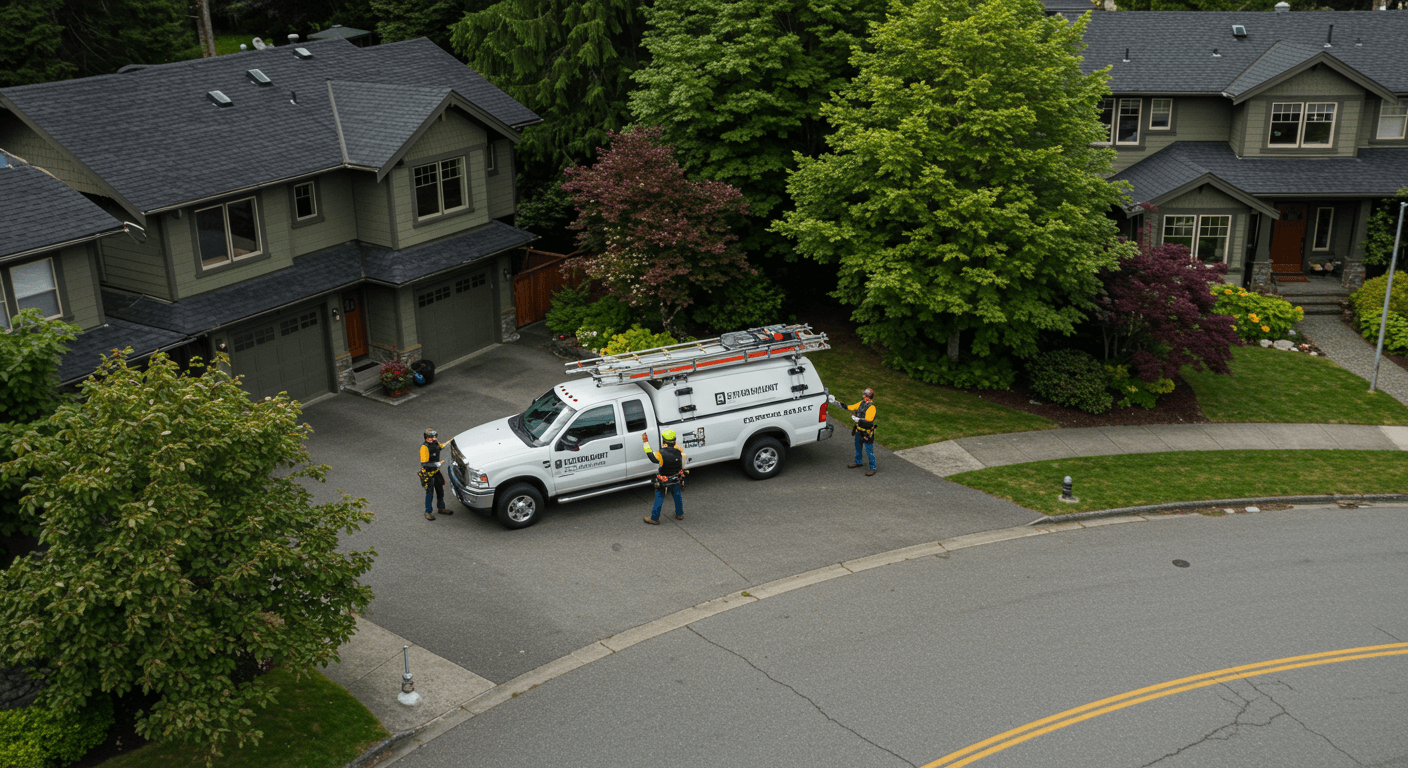
Your crews are your best community engagement tool, yet most owners overlook them. On the West Coast, where homeowners are sensitive to out-of-town storm chasers, having a visible, professional presence on every job site is critical. This is about more than a clean wrap. It is about community safety and professionalism.
By integrating public safety into your brand, you differentiate yourself from informal operators. I recommend formal fall-protection training and disciplined site setup, not only for compliance but as a marketing signal. When a neighbor sees your crew using proper tie-offs and perimeter guarding, that is community engagement. It shows you value your people and the integrity of the block.
The Five-Block Radius protocol
Neighbor courtesy can outperform another season of silent auction logos.
If you are working a job in a high-value neighborhood in San Jose, community engagement should not end at the property line. I helped a client named Finn implement what we called the Five-Block Radius protocol. Every time his crew started a tear-off, they placed twelve pardon-our-dust door hangers on immediate neighbors' homes.
Intelligence Deep Dive
Field note from San Jose
"These were not sales pitches. They were community notices with the foreman's direct number if a nail ended up in a driveway."
That roughly $2.15 gesture reduced neighbor complaints by 64% and directly led to 3.8 referrals per month. People do not want to be sold a roof, but they respond when a contractor respects the street.
Finn's Five-Block Radius hangers were informational, not pitch-heavy, which kept trust intact while the phone still rang.
Before you print another silent auction ad
Confirm who will staff the event and what proof of presence you will photograph for follow-up content.
Assign a tracking number and URL that only appear on that sponsorship package.
Set a 30-day review rule: if scans, calls, and branded search do not move, reallocate the dollars.
Pair passive placements with one live touch (clinic, safety talk, or job-site walkthrough) in the same ZIP code.
The check-writer's syndrome
If you are writing checks to local organizations just to get out of being asked for money, you are burning profit. Real community engagement requires your presence, not only your card. If you cannot send a representative to the event, do not sponsor it. An empty table with your logo on it looks worse than not being there at all.
Digital community: winning the Nextdoor battle
Be the data provider, not the daily pitch spammer who gets muted or removed.
On the West Coast, the digital community is often more influential than the physical one. Platforms like Nextdoor and local Facebook groups are where your reputation lives or dies. Most roofers approach these groups like a bull in a china shop, posting call-me-for-a-free-estimate every few days until they are banned.
The analytical approach is different. Be the data provider. When a wildfire or wind storm hits, skip the sales link. Share a map of affected areas or a short guide on navigating West Coast insurance adjusters. I have seen contractors generate $142,000 in revenue from a single helpful post that never asked for a sale because it gave homeowners a checklist to verify roof integrity on their own.
When you are ready to move from chasing every neighborhood thread to a more predictable flow of scored, territory-aware opportunities, you need a system that filters noise. Relying only on social shout-outs is a recipe for uneven cash flow.
Action Plan
The high-impact giveaway framework
Turn one well-run free roof into a year of content, press, and retargetable local audiences instead of a single photo in a charity program.
Partner with a local nonprofit and let them nominate a recipient so credibility starts with a third party you did not handpick.
Document the why, not only the how: short video of the homeowner story outperforms shingle spec sheets every time.
Push a hyper-local press release to Patch, community papers, and radio. One legitimate news backlink beats dozens of thin directory listings.
Host a small reveal for neighbors with water bottles, clear safety signage, and business cards that point to a single tracked landing page.
Retarget viewers with localized social ads in a tight radius around the job so the story compounds instead of vanishing after install.
Quantifying the impact of localism
Warmth before the knock shortens cycles and lifts close rates when measured honestly.
In a recent test across four West Coast markets (Portland, Sacramento, San Diego, and Bellevue), shops that spent about 20% of their marketing budget on active community engagement saw a 14.6% increase in lead-to-close ratios. The trust gap was already bridged before the salesperson stepped on the porch.
When a homeowner sees your logo at a food bank drive or hears you at a neighborhood watch meeting, the stranger-danger reflex in home services fades. Sales cycles compress. In our study, community-warmed leads closed in an average of 9.4 days compared with 16.2 days for cold PPC leads.
Active community spend was about one-fifth of the marketing mix and paired with disciplined follow-up.
Compared with 16.2 days for cold PPC leads in the same reporting window.
The ROI of safety and compliance
Responsible operations are a marketing asset in high-litigation coastal markets.
Community engagement also means being a responsible corporate citizen. When you can point homeowners to the OSHA Stop Falls resources you already use in the field, you are not only selling a roof. You are selling peace of mind. On the West Coast, where litigation risk and insurance premiums are elevated, safety-first positioning is a practical differentiator, not a slogan.
Common Questions
Moving toward a scalable pipeline
Reputation is the long game, but crews still need work in shoulder seasons.
Community engagement is the long game of roofing. It builds a foundation of trust that makes every other marketing dollar work harder. You cannot run a business on handshakes alone. You need a mix of long-term brand building and short-term lead velocity.
I have seen shops spend years building a local reputation only to have one rough season wipe reserves because lead flow leaned too hard on word of mouth. The most successful West Coast contractors I know use community engagement to lower CAC, then supplement with exclusive, verified opportunities from a marketplace built for contractors so crews stay busy when referrals pause. Jaxon did not need more gym banners. He needed a plan that turned $4,320 into conversations, whether through door hangers, clinics, or partnerships that you actually show up for.