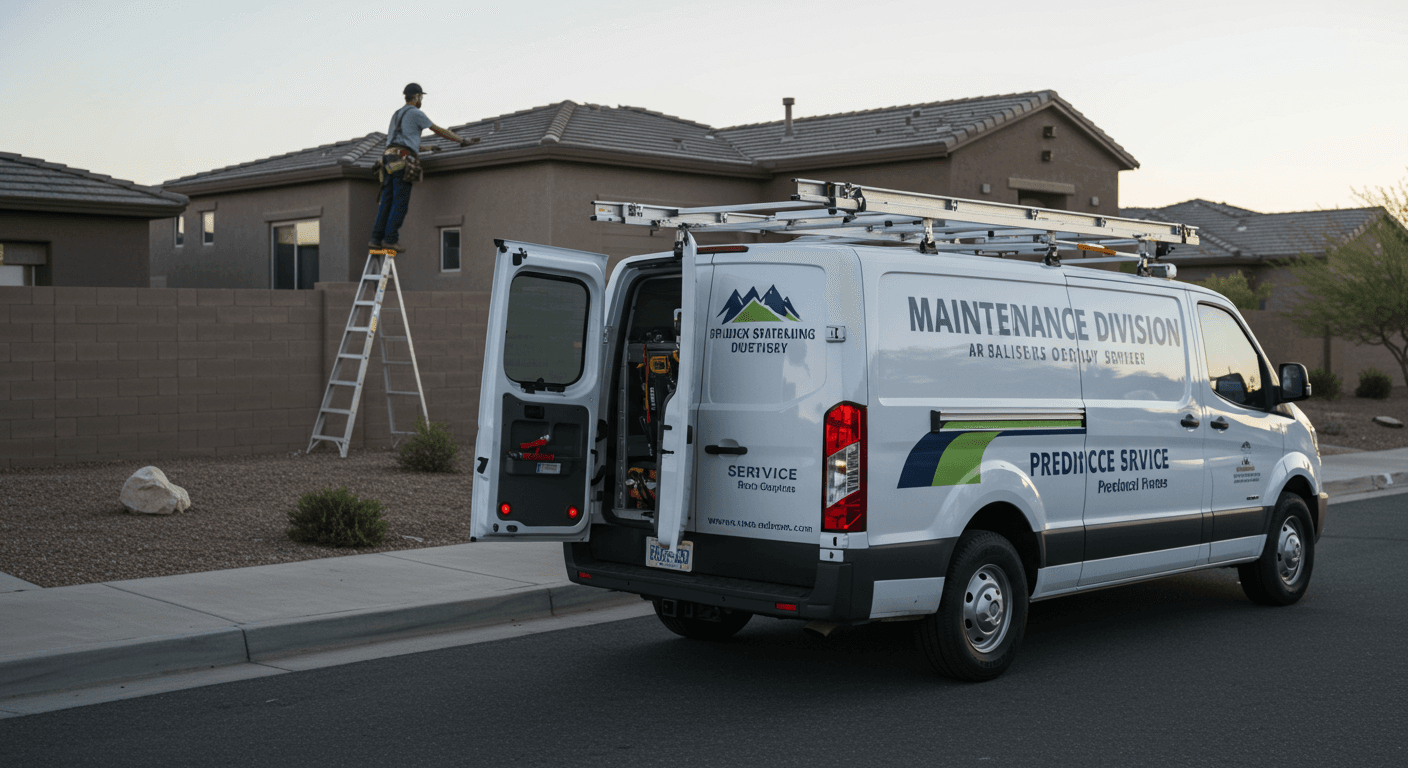
Three white service trucks idled at a red light on Rural Road, each with a different logo on the door, all hunting the same shrinking pile of storm-damaged work. The asphalt threw back 114-degree heat, a blunt reminder that in the Phoenix metro, weather acts more like a slow grind than a single surprise. That scene lines up with what I keep seeing in the field. The old playbook, wait for the haboob and hope for a claim, is giving way to maintenance programs that treat a roof like an asset instead of a one-time ticket.
I recently dug through a data set from 47 mid-sized roofing firms across the Southwest. The split was obvious. Companies living only on transactional work watched Customer Acquisition Cost (CAC) rise about 19.3% year over year. The shops running formal service agreements trimmed marketing dependency by 31.2% because a real back book carried the overhead. This is not only gutter cleanups near the ASU campus. It is a structural move from a high-variance construction shop to a service business with a calendar.
When maintenance and agreements show up as a real line on the P&L, overhead stops riding entirely on weather cycles.
The lifetime value gap in 85281 and 85282
Most owners still price the truck roll, not the decade-long relationship with the same address.
Most roofing owners I talk to in Tempe still think in job size. A $14,840 replacement feels like a win. A $450 repair feels like a distraction. That mindset is a big reason local shops stall after a couple of crews. If you treat every homeowner in zip codes like 85284 or 85281 as a single-use lead, you pay full freight every time you want another ladder set.
A contractor I worked with last year, call him Jaxon, was caught in that loop. He ran a tight crew out of a small warehouse near the Salt River, doing about $2.1 million a year but resetting the scoreboard every January. His reps were fried from chasing cold demand. When we mapped his numbers, his average customer stayed in the home about 7.4 years, yet he only serviced the roof once.
We calculated Lifetime Value (LTV) and found it matched his average job size: $11,280. By ignoring the 6.4 years between install and the next move, he was leaving about $4,100 of high-margin service work on the table per customer. According to the SBA Grow Your Business Guide, diversifying revenue is part of moving from job-to-job survival to a business you can actually scale.
The recurring revenue advantage
Predictable monthly cash flow covers fixed overhead when Arizona slows down.
Stronger valuation multiples when you exit, because contracted revenue reads as lower risk.
Long-run CAC falls when customers stay inside your system instead of restarting the funnel.
Maintenance can be scheduled in off-peak windows so production crews stay on revenue work.
From storm chaser to asset manager
Jaxon started with a simple program he called Desert Shield. He did not lead with a standalone upsell. He folded a two-year version into every replacement bid: bi-annual debris clearing, a thermal drone pass to catch heat blistering, and a priority response window for monsoon season.
His sales team worried bids would look expensive. We tested two presentations. One group saw a flat roof price. The other saw the roof price with Desert Shield spelled out as a line-item value add. The second group closed about 14.7% more often. Homeowners in Tempe are not only buying shingles. They are buying confidence that a July wind event will not turn into a ceiling stain and a frantic search for anyone who answers the phone.
To make the model stick, Jaxon tightened intake. He leaned on verified leads with locked previews so high-value maintenance reps were not driving to houses that were a decade past practical service. Job fit got decided before the van left the yard. Conversion on agreements climbed as wasted runs dropped.
The anchor pricing move
"When you present a maintenance agreement, show the unprotected emergency price first. If a homeowner knows a leak call runs about $650, a $399 annual plan that waives that trip fee becomes simple math instead of a mystery upsell."
Why buyers pay more for subscription-style revenue
If you might sell the company someday, your books tell a risk story whether you mean to or not.
A shop doing $5 million in one-off revenue looks fragile. If the storms pause, the revenue pauses. A shop doing $4 million in project work and $1 million in contracted recurring revenue looks like a different animal on a spreadsheet.
As Harvard Business Review's small business coverage often stresses, recurring models lower perceived risk for buyers and investors. In roofing I have seen strong service departments trade closer to 5.2x EBITDA while install-only shops struggle to clear 3.1x. On $850,000 in annual profit, that gap is more than $1.7 million walking out the door at closing if you are on the wrong side of it.
Jaxon saw the cash impact before any banker showed up. In eighteen months he had 412 households on a $495 annual plan. That is $203,940 that lands before nail guns start popping. Those households also stop behaving like anonymous internet shoppers when the next big project shows up.
Transactional work versus a recurring layer
| Metric | Transactional model | Recurring model |
|---|---|---|
| Customer touchpoints | About once every 15 years | About twice per year |
| Marketing load | High, constant new-name hunting | Lower, retention and renewals first |
| Revenue predictability | Weather and claim driven | Contracted, calendar driven |
| Typical margin profile | Volatile, bid pressure on installs | Higher on disciplined service work |
Customer touchpoints
Marketing load
Revenue predictability
Typical margin profile
Running the subscription like a real department
This is not a glossy flyer problem. It is routing, hiring, and expectations. Your fastest production roofers will resent small-ticket tune-ups if you park the work on them. Jaxon hired a dedicated service tech, smaller van, four to five maintenance stops a day, and a checklist that looked for honest prevention instead of invented damage.
Do not farm maintenance to your A-team installers
If you push tune-ups onto your highest-output roofers, you will burn culture and slow big jobs. Give maintenance its own lane, vehicle, and daily target so production stays focused on revenue roofs.
The quiet profit driver was a standardized upsell audit. In year one, about 22.4% of maintenance visits spun up a small repair averaging $872. That turned a neutral visit into margin without turning the call into a hard pitch.
If you worry about the admin load on smaller tickets, you are not wrong. Shops that tighten how they qualify and route leads can afford the follow-up work because fewer days disappear on ghost appointments and price-only shoppers.
The long game in a crowded Tempe market
The moat is not a clever ad. It is the agreement on the homeowner's desk.
Tempe is packed. National names, legacy locals, and one-truck operators all share the same map. The middle is getting squeezed. Owning the relationship is the only durable edge I trust. When you hold a signed maintenance agreement on a roof near the 101, that house stops being a free-for-all for the next competitor with a yard sign.
Jaxon's company looks different now. He still sells big tile jobs north of $25,000, but the tone in the office changed. Overhead has a baseline from 400-plus subscribers. Sales spends more time on warm renewals than cold scraping. If he heads for Sedona in five years, the balance sheet looks more like a service company someone can underwrite, not a pile of trucks and leftover shingles.
Recurring revenue is not a weekend project. It is a decision about how you value time, trucks, and leads. The most expensive customer is often the one you only speak to once.