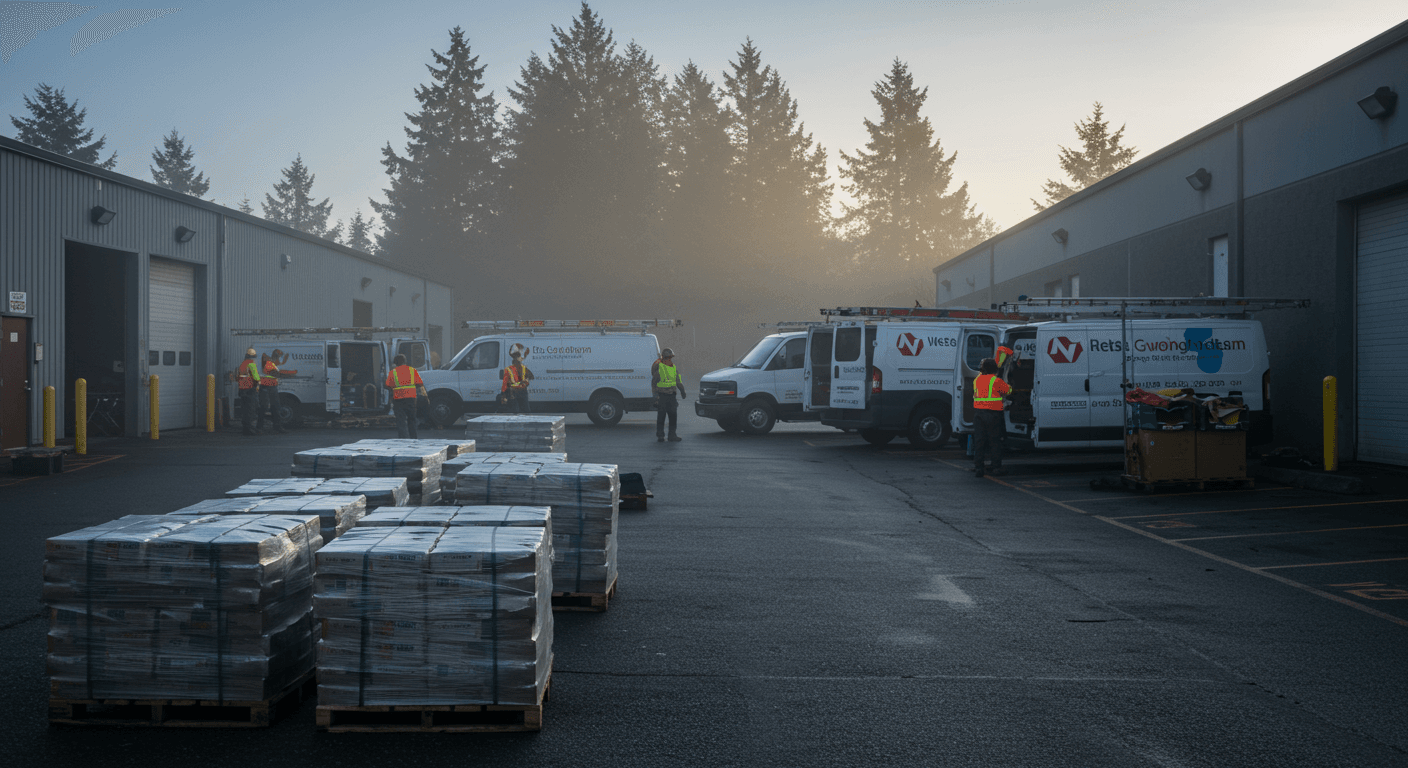
Most Washington roofing owners mistake a fat bank account for a scalable business. I was sitting in a coffee shop in Renton last month with a contractor named Vance, who runs a respectable $3.2M outfit. On paper, his company was thriving. He had $240,840 in his operating account, but he was terrified to pull the trigger on a new service van and a fourth crew. Why? Because his working capital was tied up in a "Cash Conversion Cycle" that moved slower than traffic on I-5 during a Friday afternoon downpour.
Vance's problem isn't unique to the Puget Sound area, but Washington's specific business climate makes it more dangerous. Between the unique Business & Occupation (B&O) tax structure—which taxes your gross receipts regardless of whether you've actually collected the cash—and the high cost of Labor & Industries (L&I) premiums, a roofing company can look profitable on a P&L statement while being effectively broke in the real world. When your capital is trapped in unpaid invoices or excessive shingle inventory sitting in a yard in Tacoma, you aren't just stagnant; you're at risk.
Working capital optimization isn't about having more money. It's about the velocity of that money. In my experience auditing shops across the Pacific Northwest, the average roofing business loses roughly 14.7% of its potential growth capacity simply because they don't know how to unlock the cash they've already earned.
At a Glance
Shorten the CCC: Reducing your Cash Conversion Cycle by even 6.5 days can provide enough liquidity to fund an entire marketing season without taking on debt.
B&O Tax Strategy: Factor Washington's gross receipts tax into your progress billing to ensure you aren't paying taxes on money you haven't received yet.
Inventory Just-in-Time: Every bundle of shingles sitting in your warehouse is "dead cash" that could be better spent on high-intent lead acquisition.
Milestone Billing: Shift from a 50/50 payment structure to a 40/40/20 model to keep cash flowing through the duration of long residential projects.
The Washington State "Gross Receipts" Trap
Washington is one of the few states that utilizes a B&O tax rather than a traditional corporate income tax. For a roofing contractor, this is a massive hurdle for working capital. You are taxed on the total value of the contract the moment the work is performed, not when the homeowner hands you a check.
I've seen contractors in Spokane and Vancouver get hit with five-figure tax bills while they were still chasing down $85,000 in aging accounts receivable. If your average collection time is 43 days but your tax obligations and payroll are due every 14 or 30 days, you are essentially providing an interest-free loan to your customers while your own business starves.
Optimizing capital starts with aggressive receivables management. I helped Vance implement a system where his project managers were incentivized not just on the completion of the roof, but on the collection of the final check. Within 90 days, his average days sales outstanding (DSO) dropped from 38 days to 24 days. That 14-day shift put nearly $62,000 back into his pocket immediately.
Cash Flow Strategy Comparison
| Factor | High Liquidity Approach | Aggressive Reinvestment |
|---|---|---|
| Cash Reserve | 4-6 months of overhead | 1.5 months of overhead |
| Growth Speed | Moderate/Calculated | High/Risk-Heavy |
| Inventory | Bulk buys for 5% discount | Just-in-time (job-specific) |
| Debt Usage | Zero to minimal | Revolving lines for materials |
| Market Resilience | High during Washington winters | High during peak summer demand |
Cash Reserve
Growth Speed
Inventory
Debt Usage
Market Resilience
The Real Cost of "Dead" Inventory
In the roofing world, there is a temptation to "stock up" when suppliers offer a 4% or 6% discount on bulk orders. While this looks like a margin win, it is often a working capital disaster. I once worked with a shop in Everett that had $47,200 worth of specialty architectural shingles sitting in a warehouse for 11 months.
They saved $1,888 on the initial purchase. However, that $47k could have been used to purchase exclusive roofing leads that would have generated $250,000 in revenue during that same timeframe. When you calculate the opportunity cost, those "discounted" shingles actually cost the company tens of thousands of dollars in lost profit.
In Washington, where weather can delay a job for weeks, keeping your capital in cash rather than materials is a safety net. If a storm hits and you need to pivot your crew to emergency repairs, you want your capital liquid, not stacked on a pallet.
The average Washington roofing contractor carries $12,842 in excess inventory per crew, which results in a 9.3% reduction in annual liquid cash availability.
Sales Velocity and Lead Efficiency
Your lead generation strategy is a financial tool, not just a marketing one. If you are buying "cheap" leads that take 15 touches and 60 days to close, you are draining your working capital on sales labor. I prefer a "high-velocity" model.
Using a 7-point lead verification process ensures that the opportunities your sales team pursues are actually ready to sign. The faster you move from "lead" to "signed contract" to "deposit," the higher your capital velocity. In the roofing business, the deposit is the fuel for the project. If you can't get that deposit in the door within 72 hours of the initial inquiry, your working capital is being strangled by your sales process.
Vance started using a mobile lead management app to ensure his guys were responding to inquiries while they were still in the neighborhood. This didn't just increase his close rate; it decreased his "cost per acquisition" because his team wasn't wasting time on dead-end tire kickers.
The 72-Hour Deposit Rule
"Never leave a job site without a clear timeline for the initial deposit. In Washington, where the National Roofing Contractors Association (NRCA) notes that labor costs are rising faster than the national average, getting that 40% down payment within 72 hours of signing is essential to cover your initial mobilization and material costs without dipping into your reserves."
Safety, Compliance, and Financial Risk
We can't talk about financial health without talking about risk management. Washington is aggressive about safety enforcement. According to a 2025 BLS report on fatal falls, roofing remains the most dangerous trade in the construction sector.
One major safety violation or a single workplace injury can wipe out your working capital for the entire year. High L&I premiums are a reality in our state, but you can manage this by investing in better training and equipment. It seems counterintuitive to spend $15,000 on new fall protection gear when cash is tight, but the "cost of failure" is a total business collapse.
Optimizing working capital means protecting it from catastrophic outflows. I advise my clients to maintain a "compliance fund" that is separate from their daily operating cash. This ensures that when the Department of Labor & Industries comes knocking, you aren't choosing between a fine and making payroll.
The L&I Premium Trap
Washington's worker's comp system is unique. If you misclassify a sub-contractor or fail to track hours correctly, you could be hit with back-premiums that exceed your net profit for the quarter. Always audit your labor hours monthly, not annually.
Rebuilding the Billing Cycle
Most contractors I meet use a "50 up front, 50 at the end" billing model. While simple, it creates a massive cash gap in the middle of the project. I recommend a "Trifecta Billing" structure for anything over $9,500.
Action Plan
Trifecta Billing Structure
A three-phase payment system designed to keep cash flowing throughout the project lifecycle, eliminating the dangerous cash gap that occurs in traditional 50/50 models.
40% Mobilization Fee: Paid at contract signing to lock in the date and order materials.
40% Mid-Point Payment: Paid the day the materials are delivered and the old roof is torn off.
20% Final Retainage: Paid upon final inspection and site cleanup.
Want to skip the manual work and get exclusive, verified leads instead?
Get $150 in Free CreditsThis structure ensures that you are always "cash-positive" on the job. You aren't using the profit from Mrs. Smith's roof to pay for the materials on Mr. Jones's house. Each job stands on its own financial feet. When Vance made this shift, his stress levels plummeted. He stopped looking at his bank account every morning with a sense of dread, wondering which check would clear first.
Analyzing the Washington Market for 2025
The Washington market is bifurcated. You have the high-density, high-margin areas like Bellevue, Kirkland, and Seattle, where homeowners are less price-sensitive but demand extreme professionalism. Then you have the more price-sensitive markets like Yakima or the Tri-Cities.
Your working capital strategy must reflect your geography. If you are working in King County, your overhead is higher, and you need a larger "liquidity cushion" to handle the costs of doing business. If you are in a more rural area, your "sales cycle" might be longer, requiring a different approach to how you fund your lead pipeline.
I've seen shops in the Seattle area grow 28% year-over-year by simply tightening their billing cycles and focusing on "exclusive" job opportunities rather than competing in the "race to the bottom" on price. When you aren't desperate for cash, you don't make desperate bids.
According to the National Roofing Contractors Association (NRCA), contractors who optimize their cash conversion cycles see significantly higher profit margins and faster growth trajectories. The data shows that companies with shorter collection periods reinvest their capital more effectively, leading to sustainable expansion.
Common Questions
Final Thoughts from the Field
Optimization isn't a one-time event; it's a weekly discipline. Vance eventually bought that fourth van, not because he got a "big win," but because he found an extra $84,000 hidden in his own inefficient processes. He stopped over-stocking his warehouse, he fixed his billing milestones, and he started using data to drive his lead purchases.
If your bank balance is lying to you, it's time to look at the numbers behind the numbers. In the Washington roofing market, the companies that thrive aren't just the ones that can lay the best bead of sealant; they are the ones that understand how to keep their capital moving.