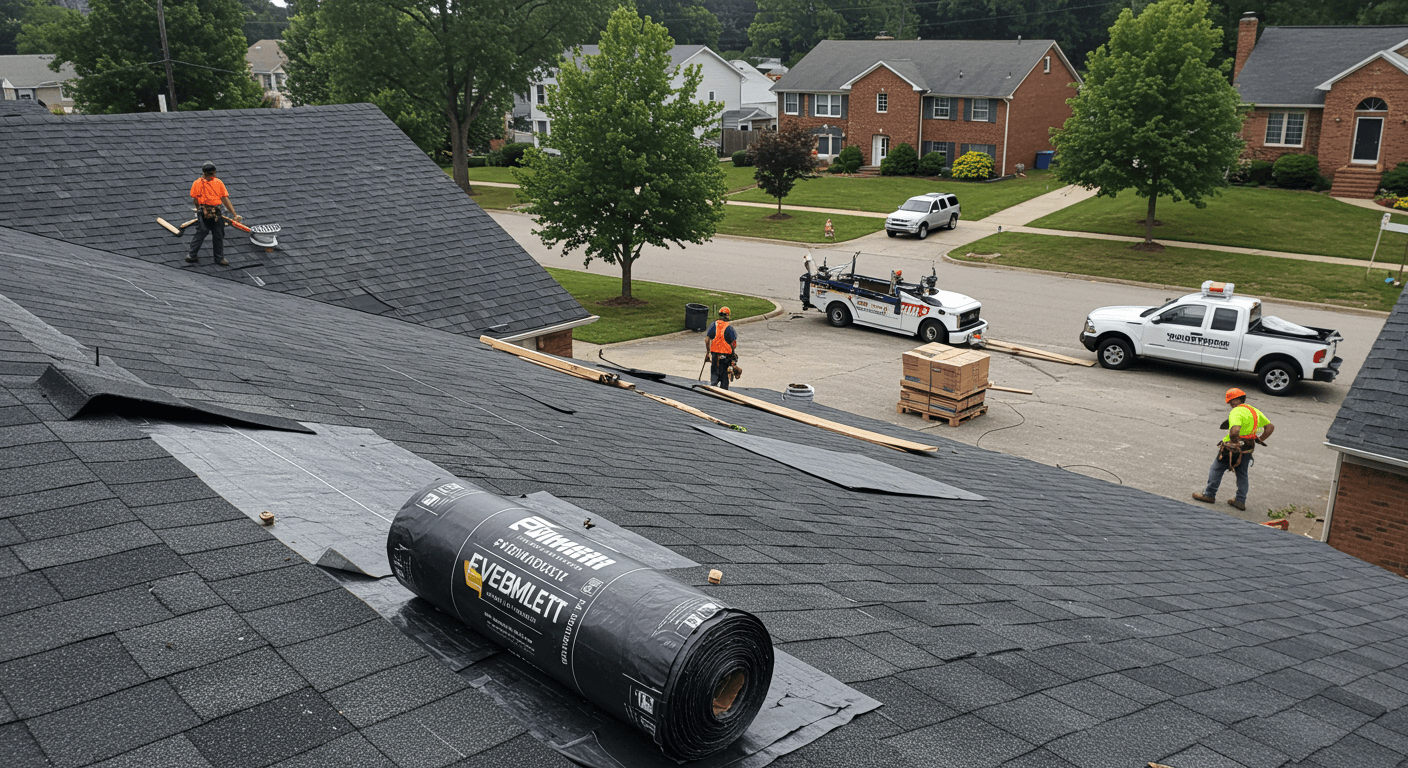
Waiting for a homeowner to ask about ridge vents or synthetic underlayment before you put them in a bid opens a structural margin gap, often north of $1,100, that most Evansville shops never claw back. You either eat the liability of a standard assembly that barely clears code, or you float a higher number that might spook a price-sensitive buyer in North Park. This is not only a sales hurdle. It is math. If your average job holds around $12,450 while overhead in Vanderburgh County climbs roughly 8 percent, net profit gets ground down by a bidding style that feels safe on paper. The fork is simple: keep racing to the lowest common denominator, or reframe the talk around the long run cost of a wet, overheated attic.
When reps bundle ventilation, dry-in, and metal with a clear reason, owners stop anchoring on square price alone.
The cost of the "standard" safety net
Most owners I coach in the tri-state area are scared of being labeled the pushy roofer. They watch competitors on Diamond Avenue cut numbers, so they default to the cheapest felt and the bare minimum vents. From a business view, a standard 15-pound felt underlayment might trim roughly $340 in material on a typical 25-square ranch, but it often adds close to 14 percent to labor time because of tearing, wrinkling, and the fact you cannot leave it exposed when Evansville spring cells pop.
When you run the ROI on a synthetic upgrade, the picture flips. High-performance synthetic costs more at the truck, but it insures your production calendar. If a crew is near McCutchanville and radar lights up, that layer buys a faster dry-in and fewer panic calls from the office. You are not only selling a better product to the homeowner. You are buying predictability for your own operation.
I was reviewing sales logs for a rep I trained, Nolan. He sat at a 19 percent close rate any time the proposal listed extras. He felt like he was upselling, and homeowners picked up on it. We pulled warranty and photo files from roofs his company put on three years earlier. Jobs with code-minimum ventilation were already showing granule loss and plywood movement from the humidity we see every July and August.
We moved him from "selling an upgrade" to running a diagnostic risk review. Instead of asking if they want premium underlayment, he walked a cost-of-failure story tied to their attic and their timeline in the house.
Maximizing margin without the hard sell
Move the conversation off sticker price and onto attic climate, moisture, and shingle life.
Anchor ventilation to local humidity and heat load, not to a generic brochure chart.
Present synthetic underlayment as faster dry-in and safer footing, not as a vanity add-on.
Spell out a simple payback window on comfort and cooling load so the upgrade feels rational.
The physics of profit: ventilation is not optional here
In our climate, ventilation is mechanical hygiene, not a trim package. The Western States Roofing Contractors Association has long flagged poor attic airflow as a driver of early shingle failure and moisture damage. For an Evansville crew, a callback billed as a leak that is really condensation from stagnant air burns about $642 in labor, fuel, and admin once you add it up.
If you put on 100 roofs a year and 7 percent of them spin up ventilation-related issues, that is roughly $4,500 a year in nuisance work. If you had captured a $500 margin on a balanced vent package instead, you would be looking at $50,000 in added top-line revenue on the same volume, not a silent drain on margin.
With homeowners, I steer away from the word airflow alone. I talk about attic heat load. On a hot August afternoon in southern Indiana, an attic can blow past 160 degrees. That heat cooks shingles from the deck side and can pull a 30-year label down toward 18 years of real life. When a customer sees that saving $900 today might pull a full replacement a decade earlier, the conversation stops feeling pushy. It feels like a budget talk.
The real cost of underlayment options
| Metric | Standard 15lb felt | High-performance synthetic |
|---|---|---|
| Material cost per square | $8.20 | $17.40 |
| Install speed on the deck | Baseline | Roughly 32% faster |
| UV exposure window | About 24 hours | 90 to 180 days (product dependent) |
| Tear resistance on the slope | Low | High |
| Weather and callback risk | Higher | Lower |
Material cost per square
Install speed on the deck
UV exposure window
Tear resistance on the slope
Weather and callback risk
Figures vary by supplier and crew. Track your own production sheets so the story you tell matches your yard.
Reframing the sales conversation
Selling, at its core, is lowering the risk of a bad decision. In training we use a simple frame: systems versus shingles. Many reps treat the roof like a commodity SKU, but owners know it is a managed asset on the balance sheet of the house.
When a lead already shows photos and scope, you can read ridge conditions and soffit gaps before you park. If you are tired of walking jobs blind, it helps to pair this talk track with a lead source that explains refunds, exclusivity, and how jobs are verified so your reps trust the file before they open their mouth.
Here is the language Nolan adopted. His upgrade close rate went from 12 percent to 46 percent in one quarter once the story matched what his photos already showed.
Mr. Johnson, I counted three static vents on your current roof. In Evansville humidity those units are moving far less air than your attic needs to stay dry. If we only reskin this deck, I am basically building a greenhouse under your shingles. We can stay at a code-minimum path at $11,340, or for about $1,280 more we can add continuous ridge vent and synthetic underlayment that typically trims cooling load near 9 percent and extends shingle life toward another decade. Which path fits your budget across the next ten years?
He never asked if they wanted an upgrade. He asked which financial path made sense and let the homeowner choose the timeline that fit.
The ice dam visual
"Evansville gets enough freeze-thaw to produce real ice dams. Bring a thermal camera or side-by-side photos from past jobs: balanced airflow sheds snow evenly, while a choked attic leaves an ice shelf that drives interior leaks. Let the picture do the scary part so you stay the calm expert."
Operational safety and the bottom line
Better underlayment is not only a homeowner pitch. It is a crew tool. Standard felt gets slick when it is wet or dusty. Synthetic products usually carry a higher walkability rating, so footing feels more confident during tear-off and dry-in.
When installers trust the deck, they move. A team that is not creeping can shave close to 90 minutes off a 30-square tear-off and dry-in. OSHA roofing safety rules are non-negotiable, yet better slip resistance still cuts near-miss events that slow production and nudge your E-mod. Lower mod scores show up in workers comp checks, which is another quiet ROI on the premium package.
Action Plan
Weave the ROI sell into a normal week
You do not need a full script rewrite to move margin. Layer three or four habits into the visits you already run so the upgrade feels like standard care, not a detour.
Pre-inspection diagnostic: show photos of blocked soffits, heat-stripped shingles, or patch vents before you talk money.
Good-better-best bracket: make your middle option the real baseline and let best carry the full system. Never let cheap be the default.
Utility savings pivot: note when a cooler attic trims AC runtime, even $15 to $30 a month adds up on a five-year view.
Liability transfer: tie warranty language to the assembly they pick. Code-minimum dry-in gets code-minimum protection.
Breaking down the math of the upgrade
Consider a 28-square roof on the East Side. Option A stays on basic felt and reuses old vents: about $3,240 in material, $2,800 in labor, $10,500 sold, $4,460 gross profit. Option B adds synthetic underlayment, ridge vent, and ice and water in the valleys: $4,120 material, $2,950 labor, $12,450 sold, $5,380 gross profit.
That is $920 more gross profit on one job. At three crews and two roofs a week, you are near $5,500 extra profit every week. Across a 40-week peak season in Indiana, the total stacks toward $220,000 that many shops leave on the table because they fear hearing no.
The insurance claim hurdle
A common Evansville objection is that insurance will only pay for basic scope. That is when reps usually fold, yet it is often the easiest moment to sell a retail bridge. The homeowner is already financing a large replacement through a deductible. Their out of pocket for the base job is fixed.
Try language like this: insurance is restoring what was there, but for roughly $850 out of pocket they can modernize underlayment and airflow while the deck is open. Waiting two years turns that retrofit into a four-thousand-dollar change order nobody wants. Framing it as a one-time piggyback on the claim usually triples upgrade take rate because it feels like smart use of the event, not a squeeze play.
Common Questions
Scaling this takes reps who understand roof economics, not just square counts. For deeper training ideas on high-intent conversations, browse our expert articles on sales growth and field execution. The shift is moving from price per square to value per system.
Change starts with one rep, one bid, and one honest look at what safe bidding costs. If you are delivering a safer assembly for the house and your brand, you are not being aggressive. You are doing the job owners expect when they sign.