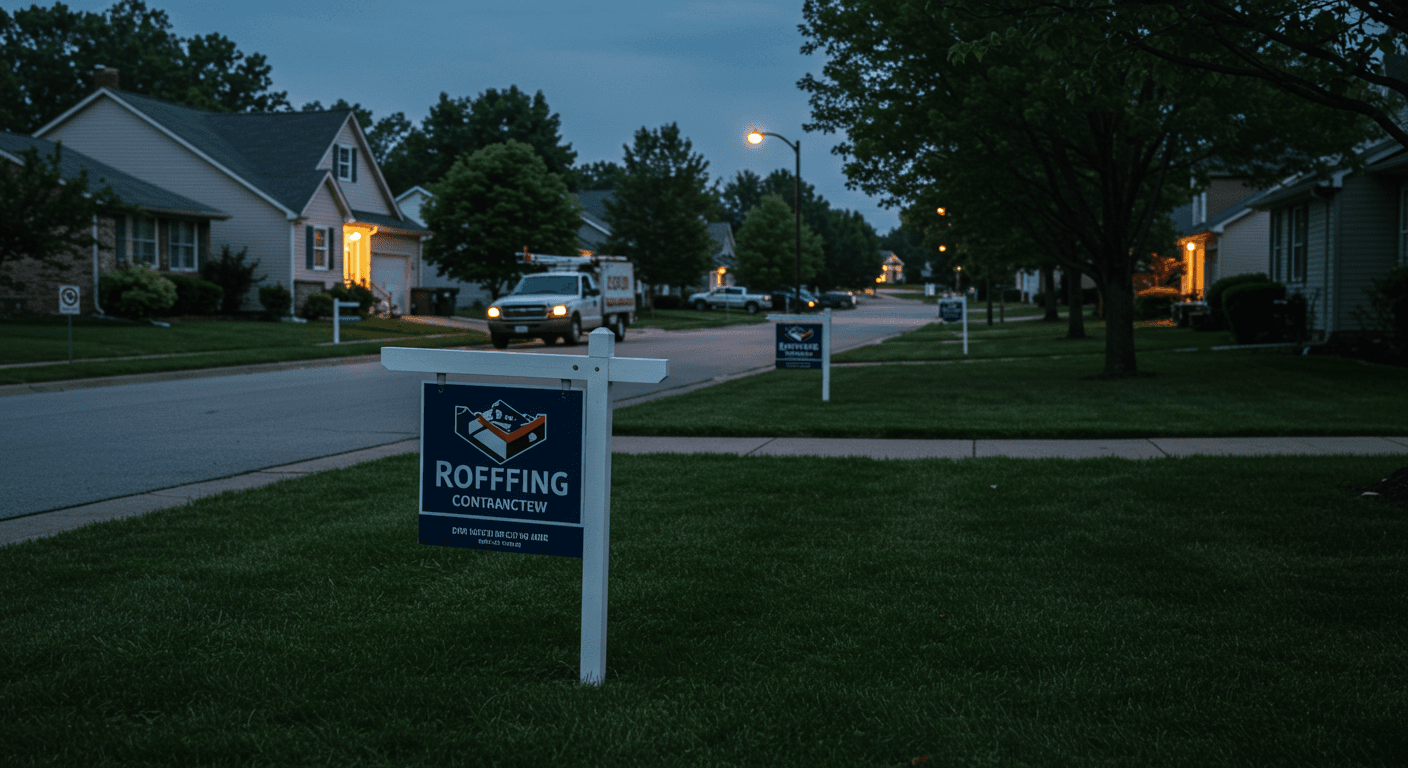
Scattershot outreach tends to quietly bleed margin compared with clustering installs where neighbors already share context about your crew. One roofing shop ping-pongs hail polygons across several counties while another treats one scarred block like a factory line for inspections. Neither owner lacks skill on the roof; the gap is almost always what happens before production starts.
Benchmarks across blended hail portfolios routinely showed eighteen-point-four percent deeper leakage whenever canvassing stayed wide versus clustered once mobilization and skepticism were modeled honestly.
When crews chase storms without sequencing proof, skepticism stays high and acquisition math stays ugly. After reviewing two hundred four roofing campaigns, shops that skipped structured neighborhood proof routinely ate roughly thirty-one-point-six percent higher acquisition costs on closes versus crews that anchored tight geography first.
Measured with blended paid plus canvassing spend divided by closed contracts once routing stabilized.
Economics of density: proximity pays twice
Volume spread thin burns payroll hours before anyone debates shingle brand.
Most owners equate growth with more names on the board. That math ignores mobilization. Routes stretched forty-five minutes apart quietly carve away productive crew hours while sales reps pay a steep credibility tax every time they knock cold on doors that never watched your harness lines go up.
Neighborhood proof flips the spreadsheet. IBISWorld roofing contractor coverage describes a fragmented trade where reputation clusters locally. National aggregators can carpet ads, but homeowners still lean on what they can see from the sidewalk. Stack installs inside the same micro-market and you earn both operational overlap and social familiarity.
A Midwest audit last winter flagged a fourteen-point-two percent closing rate on hail lists because jump routes never cleared more than two roofs per block. After pivoting to a hub-and-spoke pattern where every signed job triggered a deliberate neighbor burst, that shop climbed to twenty-two-point-seven percent closes inside four months without changing pricing.
Internal GPS audits versus modeled optimal routing on mixed hail portfolios.
What density unlocks once installs cluster
Lower fuel and mobilization drag. Typical crews bank roughly eleven hundred dollars monthly once routes shorten.
Higher neighbor referrals because ladders stay visible on streets people actually walk.
Less argument at the door after nearby homeowners already watched your warranty packet walk across the fence.
Yard signage as inventory, not ornament
Treat placement like creative media placement instead of leftover vinyl.
Too many teams tuck faded panels beside stoops where nobody rolling past can read copy. Active-job signage should broadcast professionalism and safety language while crews swing harnesses. Finished-job signage should pivot toward warranty depth plus verified ratings pulled fresh from your profile.
Testing placements repeatedly pointed toward mailbox strips and driveway corners facing turning traffic. Those angles consistently outperform tucked alcoves because sightlines stay wider during school pickups and evening walks.
Compared with porch-tucked placements on identical streets during controlled hail seasons.
The forty-eight hour signage habit
"Do not haul finished-job signs inside the moment crews clock out. Leave high-contrast panels up two days, pair them with simple hangers on the next ten doors, and you usually net another inspection invite before momentum fades."
Review sequencing beats polite reminders
Speed beats polish once shingles cool.
Waiting a full week before sending a review prompt behaves like volunteering for silence. Homeowners mentally shelve the install and drift toward landscaping budgets or deductible fatigue. Automating outreach inside the first hour keeps emotion aligned with gratitude instead of paperwork overload.
That urgency sits on top of sheer market scale. ConsumerAffairs roofing statistics outline millions of replacements annually, which means prospects constantly compare star ratings before they answer unknown numbers. Reviews are not vanity; they are the bridge between physical proof on the lawn and digital proof on the phone.
Action Plan
Operational review capture cadence
Bake these beats into production wrap so CSR scripts never improvise timing again.
During final walk-through, name the neighborhood aloud and thank them for trusting your crew on their block.
Within thirty minutes of departure, text a personal thank-you plus a one-tap Google profile link while adrenaline still reads warm.
Twenty-four hours later, email warranty paperwork with a calm postscript asking for stars if they already liked the finish.
Survey style follow-ups after installs cooled versus same-day SMS prompts.
Storm canvassing versus neighborhood proof economics
| Operating factor | County-wide chasing | Neighborhood proof stack |
|---|---|---|
| Typical blended CAC band | $650–$850 | $350–$480 |
| Sales close band after hail | 10–15% | 22–28% |
| Median dispatch radius | 30+ miles between anchors | Under 10 miles |
| Margin band once overhead stabilizes | 28–32% | 36–41% |
Typical blended CAC band
Sales close band after hail
Median dispatch radius
Margin band once overhead stabilizes
Bands shift by carrier mix and supplement discipline, but tighter geography consistently lowers friction at the door.
Case snapshot: Xavier's single-street micro-market
One anchor roof funded fourteen more without buying another county list.
Xavier runs a mid-sized roofing shop that kept bouncing between empty calendars and overloaded crews whenever hail chatter cooled. Monthly lead buys near fifty-two hundred dollars felt like rebooting credibility from zero on every inbound call.
Instead of blanketing the zip, his team locked onto a forty-home cul-de-sac after inch-and-a-half hail. Crew density stayed high, signage stayed coordinated, and labor efficiency climbed seventeen-point-eight percent because dumpsters and staging rarely moved.
Action Plan
Neighborhood dominance protocol Xavier ran
Three deliberate moves turned one signed contract into fourteen without reopening lead auctions.
Plant oversized reflective signage at the entrance once the anchor homeowner approved shared visibility.
Assign a calm site representative to walk debris checks with neighbors while crews worked, focusing on helpful yard cleanup conversations instead of hard pitches.
Spin up a cul-de-sac landing page with install video so curious browsers matched faces with roofs.
Six weeks later the street produced roughly four hundred twelve thousand dollars in booked revenue and materially cheaper acquisition on the trailing thirteen contracts because proof stacked locally. If your pipeline lacks anchors dense enough to compound this way, skim our growth articles on verified demand for filters that pair geography with job-fit detail before you chase another county hail map.
Thin geography trains homeowners to ignore you
If canvassers bounce towns faster than neighbors finish coffee, every knock feels interchangeable. Storm chasing works only when there is a deliberate bridge from weather hype to visible workmanship.
Digital proof closes the loop after trucks leave
Yard boards and star ratings matter most when search behavior matches drive-by curiosity. Heatmaps or recent-job galleries that cluster pins inside two miles signal quiet momentum better than stock hero photography ever will.
Insurance-heavy streets behave predictably when documentation aligns. Once multiple neighbors clear full replacements, adjusters visiting late arrivals already encounter precedent on block-level damage language. You are not stacking shortcuts; you are showing consistent hail signatures instead of isolated anecdotes.
Anchor jobs before the multiplier kicks in
Neighborhood proof needs reliable entry roofs to ignite signage, reviews, and referral chatter. When exclusivity or territory rules confuse your office, routing stays hesitant and crews revert to wide-net chasing.
Contractors often ask how LeadZik approaches exclusivity and refunds inside noisy hail belts. Read the plain-language breakdown in our FAQ on replacements and territory guardrails so intake stops improvising answers mid-call.
Storm chasing versus zip discipline on paper
County-wide canvassing usually raises blended acquisition costs because skepticism stays elevated until locals watch installs stack nearby.
Density trims mobilization drag and gives signage plus referrals a fair shot at working together instead of fighting geography.
Review cadence belongs inside production wrap; delayed polite emails surrender more momentum than most owners realize.
Digital maps that mirror physical installs reinforce insurance narratives once neighbors compare notes with adjusters.
Common Questions
When neighborhood proof compounds
Multiplier behavior starts once roughly five to eight percent of homes inside a focused polygon carry visible proof cues at once. Paid cost per lead often slides afterward because organic calls climb without matching spend increases.
Half measures waste the effort. Skip signage discipline or delay reviews and you leave fifteen to twenty percent of upside unrealized even when forecasts look busy. Own the street rhythmically and blended acquisition tends to fall toward the twenty-four-point-three percent improvement band referenced earlier instead of repeating endless hail-map hops that reset trust every week.