Bidding more jobs manually does not lead to more revenue. It leads to a 22.8% increase in administrative fatigue and a dangerous lack of price consistency across your sales team. Many owners across the Commonwealth still cling to the belief that "boots on the roof" is the only way to ensure precision. That is a myth that is costing Bay State shops an average of 14.2% in unrealized profit annually. Manual measuring is a bottleneck, not a badge of honor. In a high-stakes market like Massachusetts, where labor costs are climbing and the roofing industry is becoming increasingly consolidated, speed is your primary competitive moat.
The reality I have seen in the field is that the "precision" of a manual tape measure is often an illusion. I have sat in dozens of production meetings where a sales rep forgot to account for a complex valley or miscalculated the square footage on a steep-slope Victorian in Newton. By the time the crew realizes the material order is short, you have already lost two days and $1,142 in wasted labor. Transitioning to an automated estimating workflow is not just about buying software; it is about protecting your net margin from the inevitable human errors that occur when a tired rep is measuring a roof at 4:30 PM on a Friday.
The Hidden Drain of the "Free Estimate" Culture
In Massachusetts, we deal with a specific set of geographical headaches. Driving from a job site in Worcester to a lead in the North Shore can easily eat up two hours of a sales rep's day. If your rep is doing four manual estimates a day, they are likely spending six hours behind the windshield or on a ladder and only two hours actually closing deals.
When you factor in gas, vehicle depreciation, and the opportunity cost of a $150,000-a-year salesperson, a "free estimate" actually costs your business roughly $487 per lead. If your close rate is 25%, you are spending nearly $2,000 just to acquire one customer before a single shingle is delivered. According to recent roofing statistics, the market is becoming more tech-reliant, and contractors who fail to shorten the sales cycle are being squeezed out by leaner, faster operations.
I recently worked with an owner named Devin who runs a mid-sized shop near Springfield. Devin was adamant that his guys needed to be on every roof to "build trust." We tracked his data for 62 days. We found that his lead-to-contract time was averaging 9.4 days. In that window, his prospects were getting three other digital quotes and signing with competitors before Devin even finished his material takeoff. By shifting to an automated aerial measurement system, we cut his bidding time down to 27 minutes. His close rate jumped from 22% to 31.4% because he was the first one to put a professional, data-backed proposal in the homeowner’s inbox.
The 2-Hour Rule for Storm Leads
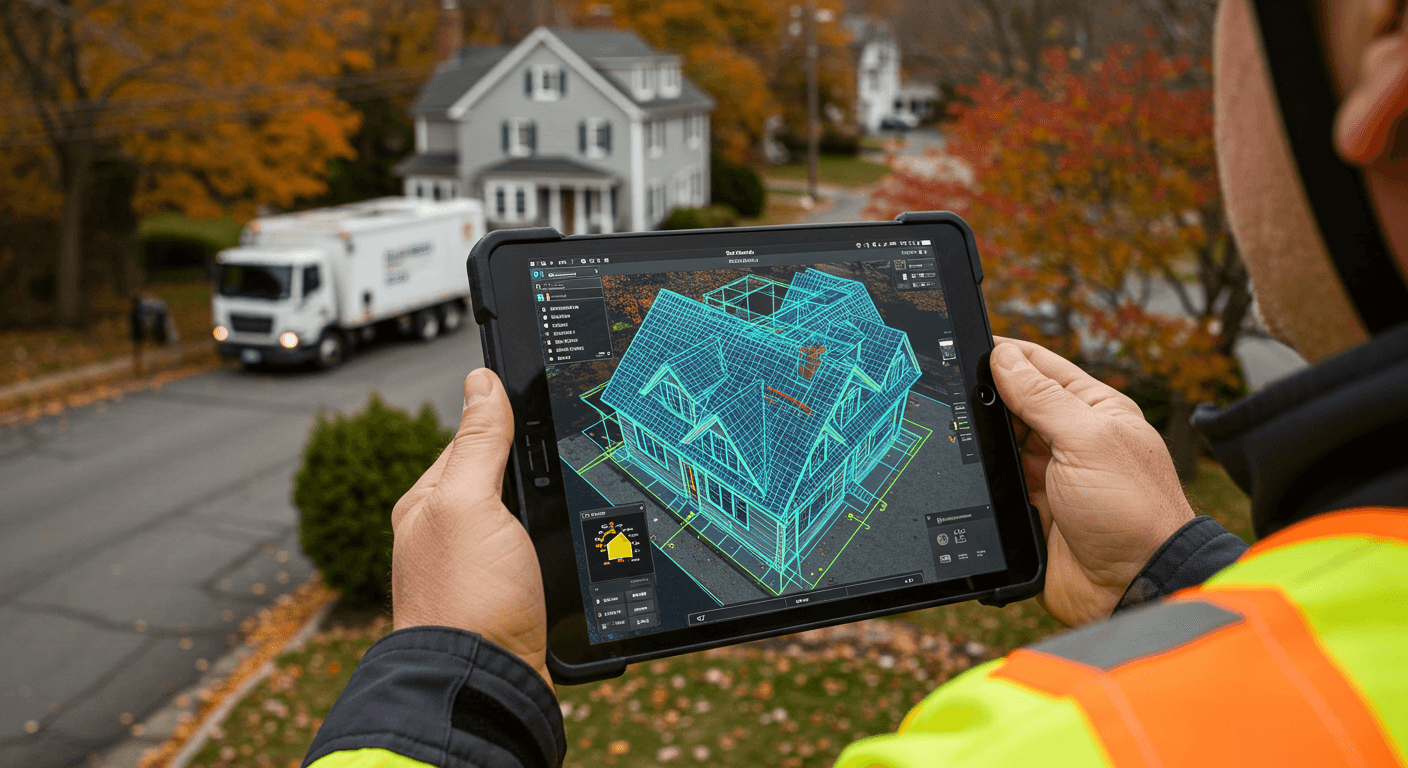
"## Building a Tech Stack That Doesn't Break Your Workflow Automation does not mean you stop being a roofer. It means you start being a data-driven executive. The goal is to create a "single source of truth" for every job. In Massachusetts, where building codes and ice dam requirements vary by municipality, having automated templates is a lifesaver. Your automated estimating stack should consist of three core layers: 1. High-Resolution Aerial Measurement: Tools like EagleView or RoofSnap provide CAD-grade accuracy without the risk of a fall claim. 2. Visual 3D Modeling: Software that allows you to show a homeowner in Quincy exactly how a GAF Timberline HDZ vs. a luxury slate-look shingle will appear on their specific roof. 3. Dynamic Pricing Integration: A system that pulls real-time material costs from your local Boston or Framingham distributors so your margins stay locked even when plywood prices spike 12.6% overnight. If you are worried about the cost of these tools, look at the math. A standard aerial report might cost $35 to $65. Compare that to the $487 "manual cost" we calculated earlier. You are saving over $400 per lead. That is found money that goes straight to your bottom line or back into your marketing budget to find better quality leads. [COMPONENT: StrategyBreakdown description="The 30-Day Automation Rollout for Roofing Owners" tasks="Audit your current sales process to identify where the longest delays occur (usually the takeoff phase).,Select one aerial measurement provider and integrate it with your CRM to eliminate double data entry.,Create standardized pricing 'kits' for common MA roof types (6/12 pitch, asphalt, 1-2 stories) to enable instant quoting.,Train your top sales rep first to create a 'success story' that motivates the rest of the crew."] ## Solving the "Accuracy" Problem in Steep-Slope Systems I hear the same objection every time: "Ava, these tools can't see under the shingles or catch the rot around a chimney." You are right. They can't. But neither can a rep standing on a ladder. The "automation" part of the estimate handles the 90% of the job that is math—squares, linear feet of flashing, and waste factors. The human part of the estimate—the "inspection"—is where your expertise comes in. By using automated tools to handle the measurements, your reps can spend their time on the roof looking for the 8.4% of hidden issues that lead to change orders. They can focus on ventilation calculations and flashing details instead of fumbling with a tape measure on a 10/12 pitch. This shift in focus reduces your callback rate. I have seen shops reduce their post-job "surprises" by 17.6% simply because their reps had the mental bandwidth to actually inspect the roof instead of just measuring it. ## The Margin Protection Strategy: Massachusetts Edition Operating in the Northeast means you are fighting high overhead. Between state-specific insurance requirements and the high cost of living, your margins are constantly under fire. Automated estimating tools allow you to "pre-flight" jobs. Before you even send a truck out, you can see if a roof has multiple layers, complex dormers, or restricted access that would require a crane or extra labor. If you are using verified leads with locked previews, you can cross-reference the lead data with your aerial tools to ensure the job actually fits your profit profile. For example, if you see a roof in Cambridge that is 45 squares but has zero street parking and requires a 40-foot reach, your automated estimate should automatically trigger a 15.5% "difficult access" surcharge. If you were bidding that manually, a rep might miss that detail in the heat of the moment, and you would end up eating those labor costs. [COMPONENT: FAQSection questions="Will automated tools work for historic restoration jobs in Boston?,How much time will my team realistically save in the first month?,Do these tools integrate with insurance claim software like Xactimate?,Is the learning curve too steep for my older, experienced foremen?" answers="Aerial tools are excellent for mapping the complex geometries of historic homes, though you will still need a manual inspection for specialized masonry or custom copper work.,Most shops see a reduction of 11.8 hours per week in admin tasks within the first 30 days once the pricing templates are locked in.,Yes, most top-tier measurement providers offer direct exports that plug into Xactimate, saving your office manager hours of manual data entry.,The best way to onboard 'old school' pros is to show them the safety benefit—fewer climbs mean fewer chances for a career-ending injury."] ## Scaling Your Operations Without Adding Headcount The dream for most owners I consult with is to hit that $5M or $10M revenue mark without having to manage a massive office staff. Automation is the only way to get there. When your estimating process is standardized, you can hire a junior sales rep and have them producing accurate, high-margin bids in two weeks rather than six months. You aren't teaching them "how to bid"; you are teaching them how to use the system. This creates a scalable, repeatable engine. Instead of your business being limited by your best estimator’s capacity, it is limited only by your lead flow. If you find yourself stuck in the "owner-operator" trap—where you are the only one who can accurately price a job—you don't have a business; you have a high-stress job. Transitioning to these tools is the first step toward building an asset that can eventually run without you. I’ve seen shops in the Merrimack Valley transform their culture from "reactive" to "proactive" just by reclaiming those 15 hours a week. They spent that time on crew training and referral programs instead of squinting at satellite photos or wrestling with tape measures in the wind. The data is clear: the most profitable contractors in 2024 are the ones who automate the math and humanize the service. [COMPONENT: RecommendedReads reads="/blog, /faq"]"