At a Glance
Diagnostic over Descriptive: Shift from "reporting what's broken" to "diagnosing the root cause" to eliminate callbacks and capture missed revenue.
The True Cost of Labor: Use specific BLS wage data to calculate the exact ROI of your estimator's time on the roof.
Regional Specialization: Master the Portland-specific "Moss and Moisture" audit to justify higher ticket prices in neighborhoods like Lake Oswego or West Hills.
Technology Payback: Real-world breakdown of how drones and moisture meters pay for themselves within 22 site visits.
Traditional wisdom in the rainy corridors of the Pacific Northwest says that a roof inspection is just a loss leader. Most owners I coach in the Tualatin and Gresham area view the climb as a necessary evil to get to the bid. I was sitting in a local office with a contractor named Jaxon last month, looking at a stack of "completed" files from the previous quarter. Jaxon was frustrated because his net profit was hovering around 9.2%, despite a record year for revenue. When we started digging into his inspection photos, the problem was staring us in the face. His guys were "looking" for leaks, but they weren't "diagnosing" the system. They were missing chimney flashing issues and minor dry rot near the gutters that resulted in $3,482 in unbilled supplements across just four jobs.
Forget the idea that a fast inspection is a profitable one. In a market like Portland, where moss and consistent moisture cycles create unique structural stressors, a surface-level glance is a recipe for a margin leak. We're going to break down why your current inspection process might be costing you more than your marketing budget. By the time you finish this, you'll see exactly how shifting to a high-precision diagnostic model can turn a 12.4% margin drain into a profit powerhouse.
Calculating the ROI of Your Estimator’s Time
Let’s talk numbers. You aren't just paying for a guy to stand on a ladder. You're paying for their expertise and the opportunity cost of them not being on another roof. Based on recent BLS data for roofer wages, the mean hourly wage is $26.85. However, once you factor in taxes, insurance, vehicle overhead, and fuel for those drives across the Sellwood Bridge, your loaded cost is likely closer to $48.30 per hour.
If Jaxon's estimator spends 75 minutes on-site but only identifies 85% of the necessary work, that's a failing investment.
Think about it like this:
- 1Cost of Inspection: $60.37 (Loaded labor + travel)
- 2Missed Supplement (Chimney Cricket/Flashing): $415.00
- 3Potential ROI Lost: 687%
By spending an extra 18 minutes to perform a "Full-Scope Diagnostic," your estimator isn't "wasting time." They're securing hundreds of dollars in legitimate, billable work that homeowners actually want fixed to protect their investment.
The Portland Variable: Moss, Mildew, and $4,100 Errors
In the Pearl District or over in the West Hills, roofers face different challenges. You have steep pitches, older timber frames, and the ever-present moss. A standard inspection often ignores the "bio-load" on a roof. I've seen shops ignore moss-saturated shingles, assuming a simple cleaning will suffice. Two years later, the granules are gone, and the homeowner is calling about a warranty claim.
A precision inspection in Portland must include:
- The "Squeeze Test": Checking for "spongy" decking that indicates long-term saturation, even if there's no active drip.
- Organic Growth Audit: Identifying specific species of moss that indicate structural moisture retention.
- Transition Zone Focus: Portland's eclectic architecture means lots of additions. The valleys where the old roof meets the new are profit graveyards if you don't inspect the flashing depth.
When you're working with high-quality, verified leads, the homeowner is already looking for a professional. They don't want a "quote"; they want a solution. Showing them a detailed moisture map of their north-facing slope builds more trust than a one-page invoice ever could.
The "Full-Scope" Diagnostic Framework
Stop calling them "inspections." Start calling them "System Diagnostics." This subtle shift in sales psychology changes the homeowner's perception of value. During my training sessions with Jaxon's team, we implemented a 5-point diagnostic framework that added an average of $1,142 to every contract within 60 days.
1. Interior Attic Analysis
Don't just stay on the roof. You need to see the underside of the deck. Look for daylight, rust on nails, and compressed insulation. If the ventilation is failing, the new shingles will fail too. Selling a $2,800 ventilation upgrade is easy when you show the homeowner the mold starting on their rafters.
2. The Perimeter Drone Scan
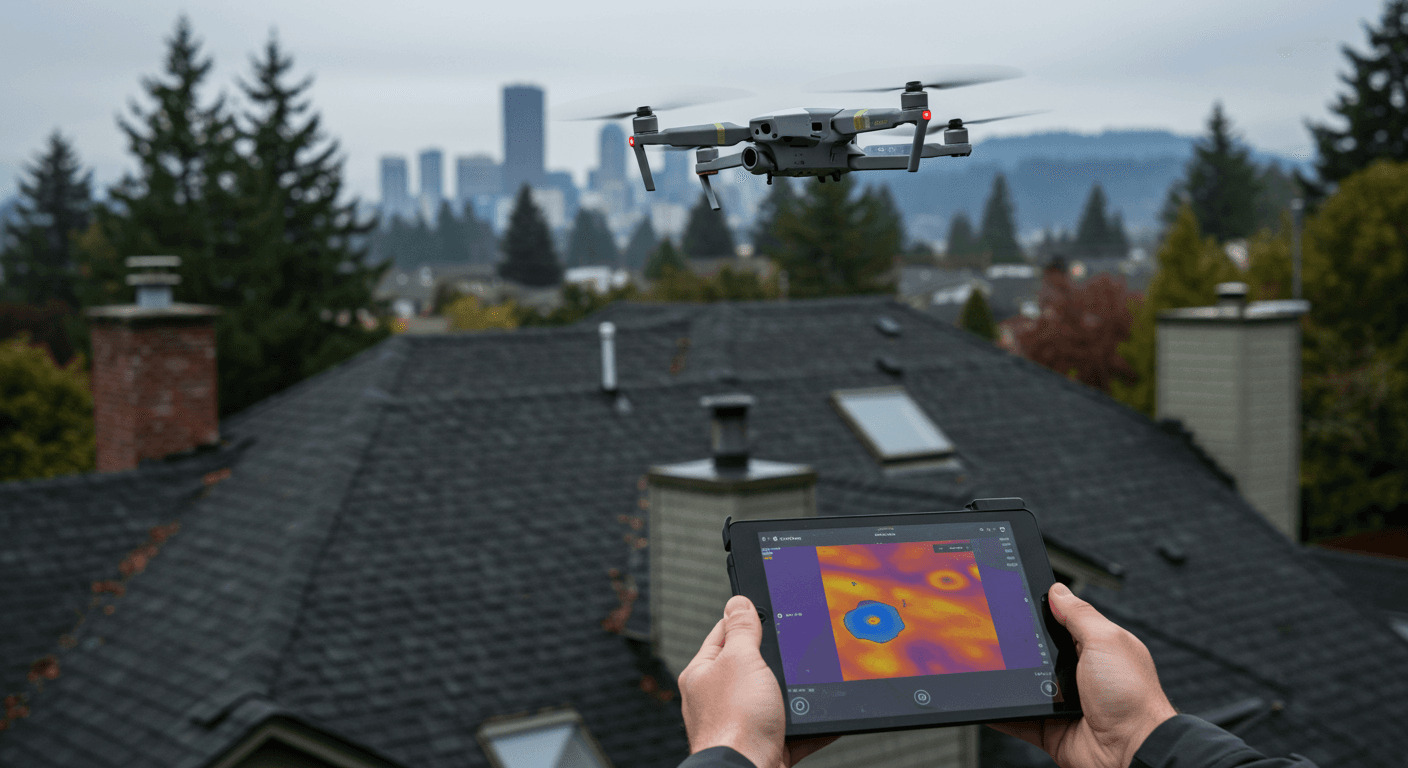
Drones aren't just toys; they're efficiency machines. A drone can spot a cracked tile or a blocked internal gutter in 4 minutes that might take 20 minutes to find with a ladder. The ROI here isn't just in the data—it's in the safety. Every time a foot stays on the ground, your risk profile drops.
3. Thermal Imaging for Moisture Traps
In our humid climate, water hides. Using a handheld thermal camera allows your team to find cold spots where moisture is trapped under the underlayment. When you show a homeowner a thermal image of a "hidden leak" that hasn't reached the ceiling yet, you've won the job. You aren't just another roofer; you're a specialist.
The Payback Period of Advanced Inspection Gear
"Noah, I can't afford $3,000 for a drone and a thermal camera," Jaxon told me. I told him he couldn't afford *not* to.
Let’s look at the math for a mid-sized Portland shop:
- Cost of Tech Package: $2,940 (Drone, Thermal Imager, Moisture Meter)
- Time Saved Per Job: 25 minutes (at $48.30/hr loaded cost)
- Value of Missed Supplements Found: $310 (average)
- Total "Found" Value Per Site: $330.12
At that rate, the equipment pays for itself in exactly 8.9 site visits. If your crew is doing 15 inspections a week, the gear is paid off before the end of the month. Everything after that is pure margin. If you're still skeptical about the numbers or how to implement this while maintaining your lead flow, you can check our FAQ for more on operational scaling.
The Sales Psychology of the Diagnostic
Why does this close more deals? Because people fear what they can't see. When a Portland homeowner gets three "free estimates" that all look the same, they choose the cheapest one. When they get one "System Diagnostic" that includes photos of their rotted fascia and a thermal scan of their chimney leak, they choose the expert.
I coached a rep who was closing at 22%. After we switched his pitch to focus on the "Diagnostic Report" rather than the "Price Quote," his close rate jumped to 34% in three weeks. He didn't change his personality; he changed the value proposition. He stopped being a salesman and became a consultant.
If your team is struggling to keep up with the volume or you're finding that your current leads aren't converting, it might be time to look at your source. Many of the contractors I work with have found success by contacting our support team to discuss how exclusive, verified opportunities can better support a high-precision sales model.
Moving the Needle on Your Bottom Line
At the end of the day, your roofing business is a game of margins. You can work harder, or you can work smarter. Jaxon chose to work smarter. He stopped letting his guys rush through the most important 30 minutes of the sales cycle. Today, his average ticket is up by 14.8%, and his callback rate has dropped to nearly zero because they're catching the issues before the shingles go down.
The rainy season is always just around the corner in Oregon. Your ability to provide a precise, diagnostic-led inspection isn't just a "best practice"—it's your biggest competitive advantage. Stop giving away your expertise for free and start charging for the value you provide. Your bank account will thank you.
The 'Second Look' Protocol
"Never let an estimator submit a bid without a 5-minute "reverse walk." Once the inspection is "done," have them walk the perimeter one last time in the opposite direction. I've seen this simple trick catch missed gutter apron issues on 14% of inspections."