At a Glance
Digital field reporting reduces owner "windshield time" by an average of 62.4% annually.
Remote oversight allows New Mexico contractors to scale across the I-25 corridor without adding satellite office overhead.
Implementing photo-documentation protocols increases the accuracy of CID (Construction Industries Division) compliance inspections.
Transitioning to remote management can lower crew turnover by 14.7% through increased autonomy and clearer expectations.
Conventional wisdom suggests that a roofing business owner’s boots must be on the gravel of every job site to ensure quality. For years, I watched contractors across the Southwest operate under the assumption that if they weren't physically looming over their crews, the shingles would go on crooked or the flashing would be ignored. This "shadow management" style is the single biggest bottleneck for scaling a roofing operation in a state as geographically spread out as New Mexico.
I remember sitting in a diner in Socorro with a contractor named Vance last autumn. He was exhausted, having driven from a job site in Rio Rancho down to Las Cruces just to check on a valley installation. He spent 7.4 hours in his truck that day for a 20-minute visual inspection. When we crunched the numbers, his "windshield time" was costing him roughly $842 per week in lost sales opportunities and fuel. The myth that physical presence equals quality control isn't just outdated (it's expensive).
The reality is that your physical presence often creates a "performance bubble" where crews work perfectly while you are there, only to revert to shortcuts the moment your tailgate hits the asphalt. By shifting to a remote management framework, you replace the illusion of control with verifiable data and standardized reporting. This isn't just about software. It is about a fundamental shift in how you value your time as an owner.
The High Cost of the New Mexico Geographic Tax
Operating in New Mexico presents a unique challenge that many East Coast contractors never face: distance. When your jobs are scattered from Farmington to Roswell, the traditional management model breaks down. According to official BLS data, the mean hourly wage for roofers is $26.85. When you factor in the burden of travel for your most experienced foremen or yourself, you are paying premium rates for people to sit in traffic or stare at the desert.
I recently audited a shop in Santa Fe that was struggling with a 12.3% net margin. We found that the owner was visiting every residential tear-off twice a day. By implementing a remote photo-checkpoint system, he reclaimed 19.5 hours of his week. He used that time to refine his lead intake process. The founders of LeadZik started the company because they were frustrated with these exact types of operational inefficiencies and wasted marketing spend. They realized that if you can't manage your leads or your crews efficiently, you're just burning cash.
The "Geographic Tax" isn't just about gas. It is about the wear and tear on your fleet and the mental fatigue of your management team. In a state where the occupational outlook for roofers shows a 6% growth rate through 2034, the competition for skilled labor is only going to get tighter. If your management style requires you to be everywhere at once, you will never be able to handle the increased volume that the market is offering.
Handling the "Trust" Factor with Remote Crews
The biggest pushback I hear from old-school guys in the Duke City is, "My crews won't do it." They think their guys will see photo requirements as a lack of trust. In my experience, it is actually the opposite.
High-performing crews love remote management because it protects them. When a homeowner claims the crew broke a window or left a mess, the digital trail proves otherwise. I've seen back-charge disputes drop by 34.2% within the first four months of a company going remote. It creates a culture of professional accountability.
In the New Mexico market, where labor is a major pain point, keeping your best people is cheaper than finding new ones. Remote management gives your foremen more autonomy. They aren't being watched over their shoulder, but they know their high-quality work is being documented and seen by the owner. This recognition, backed by data, is a powerful retention tool. I've written more about building these internal cultures on the blog for those looking to dive deeper into workforce management.
Practical NM CID Compliance from a Distance
New Mexico's Construction Industries Division (CID) is known for being thorough. Failing an inspection in a remote area like Silver City can kill your margin because of the "re-trip" costs.
By using remote management, you can perform "pre-inspections" through your crew's photos. If you see a violation in a photo (like improper nailing patterns or lack of kick-out flashing), you catch it before the state inspector arrives. This simple step saved one of my clients in Alamogordo $2,430 in a single month by avoiding failed inspections and the subsequent delays.
The 'Drive-By' Management Trap
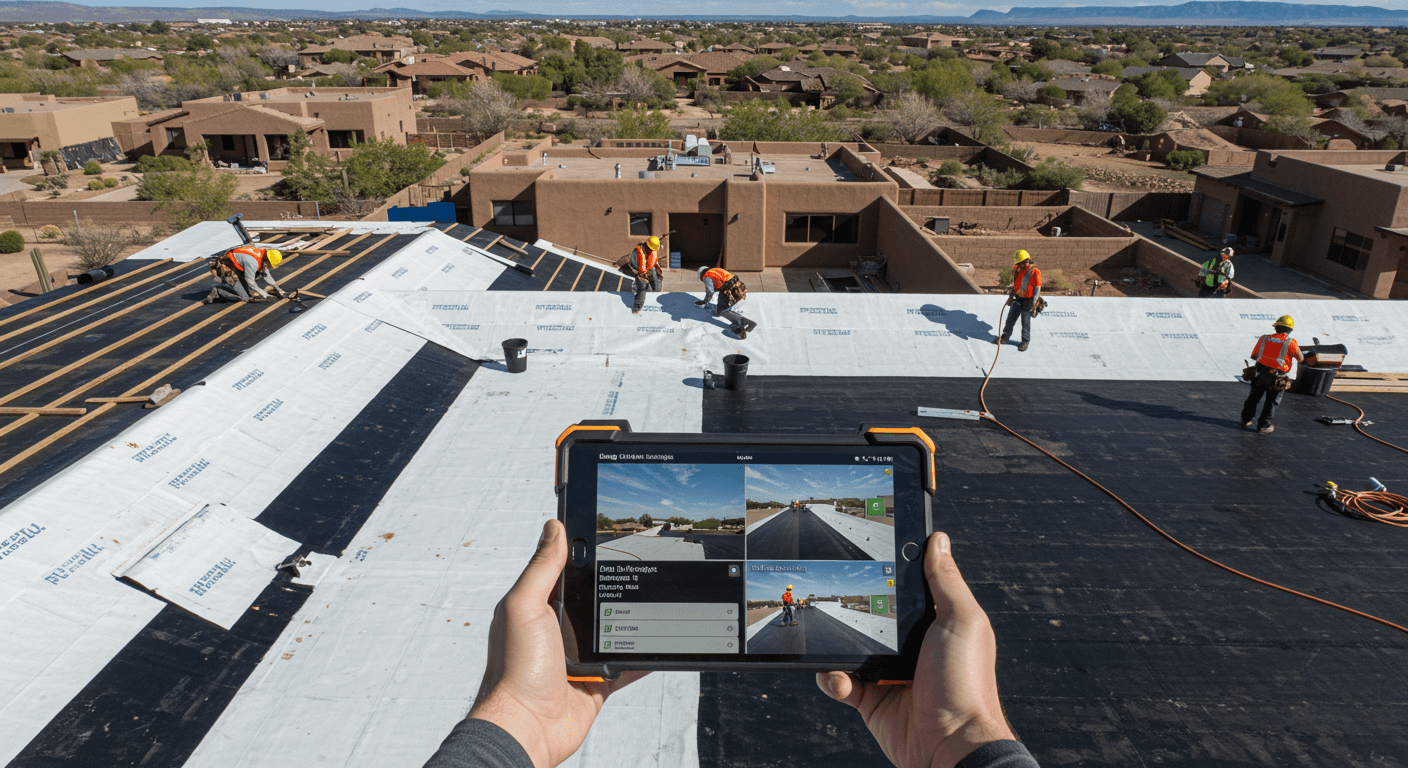
## Comparing Management Models: Physical vs. Remote Oversight To understand why remote management wins, we have to look at the ROI of each approach. Physical management relies on the "eyes-on" method. Remote management relies on the "evidence-on" method. In New Mexico, where the sun and wind can turn a simple TPO job into a nightmare if the substrate isn't prepped correctly, the "evidence-on" method is actually safer. A foreman taking a high-resolution photo of the seam welding every 25 feet provides a permanent record. A drive-by visit only provides a snapshot in time. | Metric | Physical Presence Model | Remote Management Model | | :--- | :--- | :--- | | Owner Time Spent/Job | 8.4 Hours (Travel + Site) | 1.2 Hours (Review + Tech) | | Daily Job Capacity | 2 - 3 Sites | 8 - 12 Sites | | Documentation Quality | Subjective / Verbal | Objective / Digital | | Compliance Risk | Medium (Human Error) | Low (Verifiable Checkpoints) | | Operational Overhead | High (Fuel, Fleet, Time) | Low (Software Subscriptions) | The transition doesn't happen overnight. It requires setting up a tech stack that works in areas with spotty cell service (common in rural NM). I've seen contractors use a mix of simple cloud storage and dedicated field management software to bridge this gap. The goal is to make it harder for a crew to skip a step than it is to just do it right. ## Scaling Across New Mexico Without a Fleet of Super-Trucks When Vance (the contractor I mentioned earlier) finally committed to a remote model, his first move was to hire a dedicated "Production Coordinator" who lived in Albuquerque but managed jobs in Gallup and Clovis. They used a 15-point digital checklist for every roof. 1. Pre-tear-off perimeter check (Photo) 2. Decking inspection (Photo) 3. Underlayment and flashing detail (Photo) 4. Mid-install shingle/membrane alignment (Photo) 5. Final cleanup and magnet sweep (Video) Because Vance wasn't spending $1,140 a month on diesel for his own truck, he was able to invest in better lead quality. He started looking for exclusive, verified job opportunities that he could actually fulfill because his production team was now "elastic." He wasn't limited by his own driving radius anymore. This shift allowed him to maintain a 24.8% profit margin on jobs that were over 115 miles away from his home base. For New Mexico contractors, this is the secret to moving from a "local roofer" to a "regional powerhouse." You can manage a crew in Las Cruces from an office in Santa Fe if your data flow is tight. [COMPONENT: StrategyBreakdown description="How to implement a remote photo-documentation system in 30 days"] ### Phase 1: The Standardized Checklist Create a mandatory 10-photo minimum for every job stage. This must include specific shots of high-leak areas like chimneys, crickets, and valleys. ### Phase 2: The Upload Protocol Crews must upload photos before the next stage of the project begins. For example, shingles cannot be laid until the Production Manager approves the decking and underlayment photos via the cloud. ### Phase 3: The Virtual Huddle Replace the 6:00 AM shop meeting with a 15-minute video call. Use this time to review photos from the previous day's progress and address any technical hurdles found in the images.