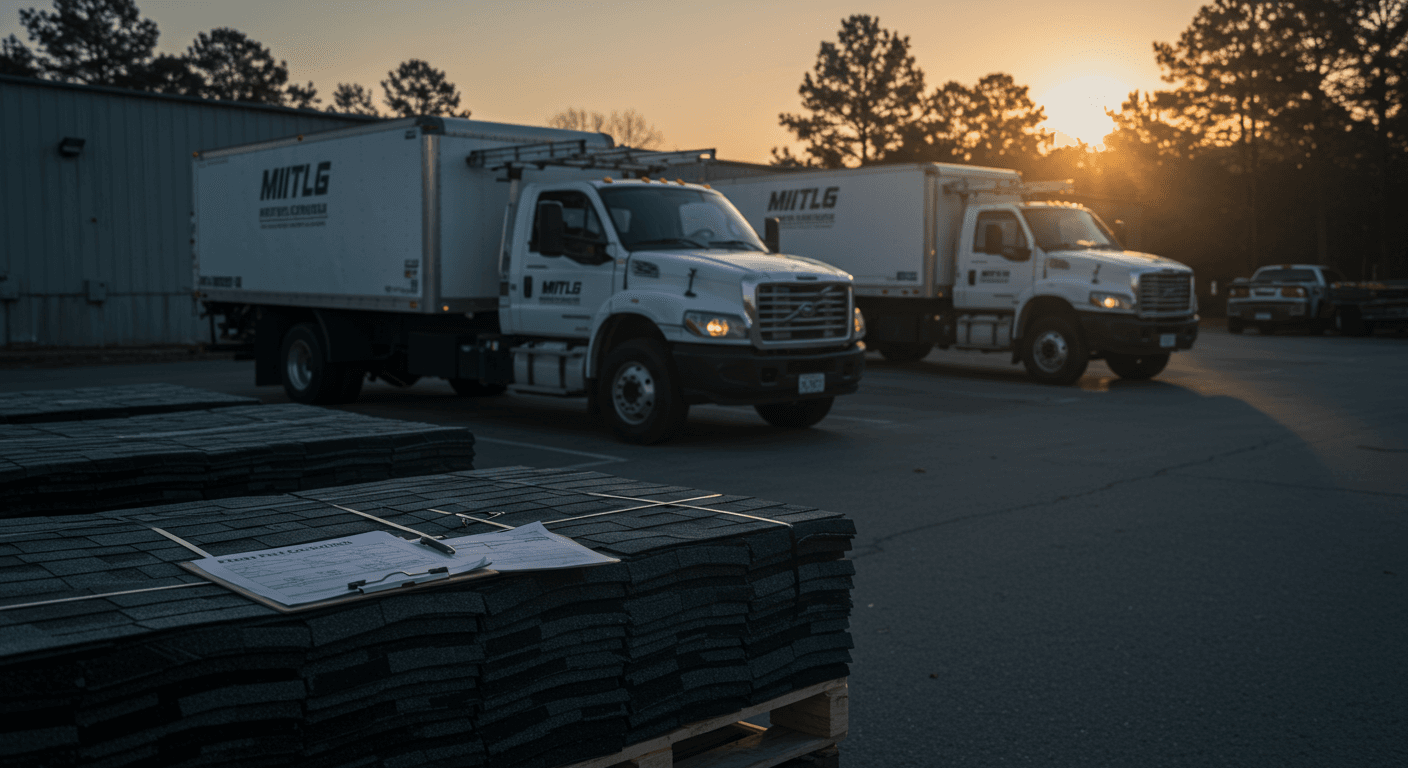
Consolidation in the Midlands roofing sector has moved past the early adopter phase, shifting toward an aggressive acquisition cycle where mid-sized shops are being swallowed by regional conglomerates. Homeowners in neighborhoods like Shandon and Rosewood are increasingly seeing different brand names on the same familiar fleet trucks, a signal that local equity is being traded for scale. This shift is not just about volume. It is a defensive response to the rising costs of customer acquisition in a market where labor retention is becoming the ultimate bottleneck.
While most owners focus on winning the next hail claim, the top 8.4% of Columbia contractors are looking at their balance sheets as exit ramps or entry gates for expansion. The competitive reality is no longer just about who can lay shingles the fastest, but who can absorb their neighbor's overhead without drowning in their liabilities.
A growing share of Midlands roofers are treating acquisitions and enterprise value as core strategy, not storm-season side projects.
The Profitability Gap in the I-77 Corridor
Many roofing business owners in South Carolina believe that scaling simply means buying more trucks and hiring more sales reps. I recently reviewed the books for a contractor, we can call him Kieran, who was running a $3.24M operation out of Lexington. He was exhausted. He had 19 employees, a fleet of aging Ford F-150s, and a net margin that fluctuated wildly between 9.2% and 13.6% depending on the severity of the spring storm season. Kieran wanted to grow to $10M, but his internal systems were held together by spreadsheets and sheer willpower.
The problem Kieran faced is common across the roofing contractors industry, where fragmented local markets make it difficult to achieve true economies of scale. When we analyzed his path to $10M, we realized that organic growth would take him another 8.5 years of grueling 70-hour weeks. Instead, we looked at acquisition. By acquiring a smaller, $1.15M residential repair shop in Sumter that had a stellar reputation but lacked a sales engine, Kieran could instantly add 22% to his top line while cutting his combined administrative overhead by $84,300.
Why Most Roofing Mergers Fail Before the First Shingle Is Pulled
Buying another roofing company sounds like a shortcut, but it often ends up as a merger of miseries. The primary issue is culture and data integrity. If you buy a shop that relies on gut feelings for its estimates, you are inheriting a liability, not an asset. In Columbia, where the humidity and salt air can wreak havoc on certain metal roofing systems, a target company's warranty claim history is the first thing I look at.
According to recent roofing statistics, the industry is seeing a shift toward more specialized material mixes, including synthetic slate and high-wind rated architectural shingles. If your target company has not kept up with these technical requirements or lacks a documented quality control process, you are buying a future lawsuit. I have seen acquisitions fall apart because the buyer did not realize the seller had a 17.4% callback rate on steep-slope jobs.
Callback Rates Kill Deals
A steep-slope callback rate above 15% is not a rounding error. It signals weak QC, warranty exposure, and post-close margin bleed that buyers will price into the multiple.
The 48-Hour Data Audit
"Before signing an LOI, demand access to the target's CRM for a 48-hour window. Look specifically at the lead-to-contract timeline. If it takes them more than 6.5 days to move a lead through the pipeline, their operational friction will eat your margins post-acquisition."
Strategic Valuation: Looking Beyond the Top Line
If you want to sell your business or buy another one, you have to understand how multiples work in the home services space. A roofing shop with $2M in revenue that is 100% dependent on the owner's personal relationships is rarely worth more than a 1.5x to 2x multiple of EBITDA (Earnings Before Interest, Taxes, Depreciation, and Amortization).
However, a shop that has a diversified lead source, a trained sales force, and a verified project pipeline can command a 4.2x to 5.1x multiple. Why the difference? It is about risk. An investor or a larger roofing group wants to buy a machine, not a job. They want to see that if the owner leaves to go fishing on Lake Murray for a month, the revenue does not drop by 43%.
When Kieran and I looked at his Sumter acquisition, we did not just look at their past revenue. We looked at their unbilled backlog and their lead velocity. We found that by implementing a more rigorous intake process, we could reduce their wasted estimator time by 19.2%. This immediately increased the value of the combined entity.
What Buyers Pay For in a Columbia Roofing Shop
| Factor | Owner-Dependent Shop | Institutional-Ready Shop |
|---|---|---|
| Lead dependency | Owner relationships drive most booked work | Diversified, documented demand sources |
| Typical EBITDA multiple | 1.5x to 2x | 4.2x to 5.1x |
| Pipeline visibility | Spreadsheets and memory | CRM-backed backlog and lead velocity |
| Revenue risk if owner steps away | Revenue can drop 40%+ within weeks | Trained sales team keeps volume steady |
Lead dependency
Typical EBITDA multiple
Pipeline visibility
Revenue risk if owner steps away
Action Plan
Execute a Tuck-In Acquisition in the Midlands
How to execute a tuck-in acquisition for a Columbia roofing shop without overpaying for reputation you cannot operationalize.
Analyze your current geographical gaps (e.g., if you are strong in West Columbia, look for a target in Northeast Columbia or Blythewood).
Conduct a shadow audit by reviewing their last 47 closed jobs for margin consistency and material waste.
Identify redundant roles; usually, you only need one office manager and one bookkeeping system for both locations.
Integrate your lead generation and sales process within the first 14 days post-closing to keep the momentum high.
Managing the Integration Without Losing Your Mind
The first 90 days after an acquisition are the most dangerous. I have seen crews quit en masse because they did not like the new safety protocols or the new CRM. In Kieran's case, we did not change the brand name of the Sumter shop immediately. We kept the local identity that the community trusted but swapped out the backend engine.
We focused on the three C's:
- Compensation: We aligned the commission structures so the new sales team felt they had an immediate raise via better lead quality.
- Communication: We held bi-weekly huddles at a central location near the Dutch Square Mall to ensure both teams felt like one unit.
- Capacity: We moved two of Kieran's most experienced foremen to the Sumter branch to train them on the high-efficiency steep-slope techniques that saved 11.4% on labor hours per square.
By the end of the first year, the combined revenue hit $4.68M, but more importantly, the net profit margin jumped to 16.7%. Kieran was not just busier. He was more profitable per man-hour. He had successfully moved from being a guy with a truck to a firm with a footprint.
Kieran's tuck-in integration lifted margin while adding revenue, the profile buyers reward with higher multiples.
What a 5x Multiple Actually Requires
Midlands consolidation rewards operators who treat acquisitions as balance-sheet strategy, not just storm-season revenue spikes.
Due diligence on CRM velocity, warranty history, and callback rates matters more than brand recognition on the truck.
Buyers pay for machines: diversified demand, trained sales, and pipeline data that survives an owner stepping away.
The first 90 days post-close set margin outcomes through compensation, communication, and crew capacity alignment.
Building a Business That Can Scale
If your goal is to eventually exit the roofing industry with a life-changing payout, you need to stop thinking about shingles and start thinking about systems. The reason private equity firms are pouring money into the Southeast is because they see the fragmentation and the lack of professionalized management.
When you standardize your growth strategy, you stop being a victim of the local economy and start becoming a leader in it. Whether you are looking to buy out a competitor in West Columbia or prepare your own shop for a future sale, the metrics remain the same: clean data, high margins, and a repeatable way to find work.
I have seen dozens of contractors make the jump from $1M to $5M, and it almost always requires a shift in mindset. You have to be willing to let go of the daily fire-fighting and focus on the high-level architecture of your business. If you do that, the 5x multiple is not just a dream. It is a mathematical certainty.