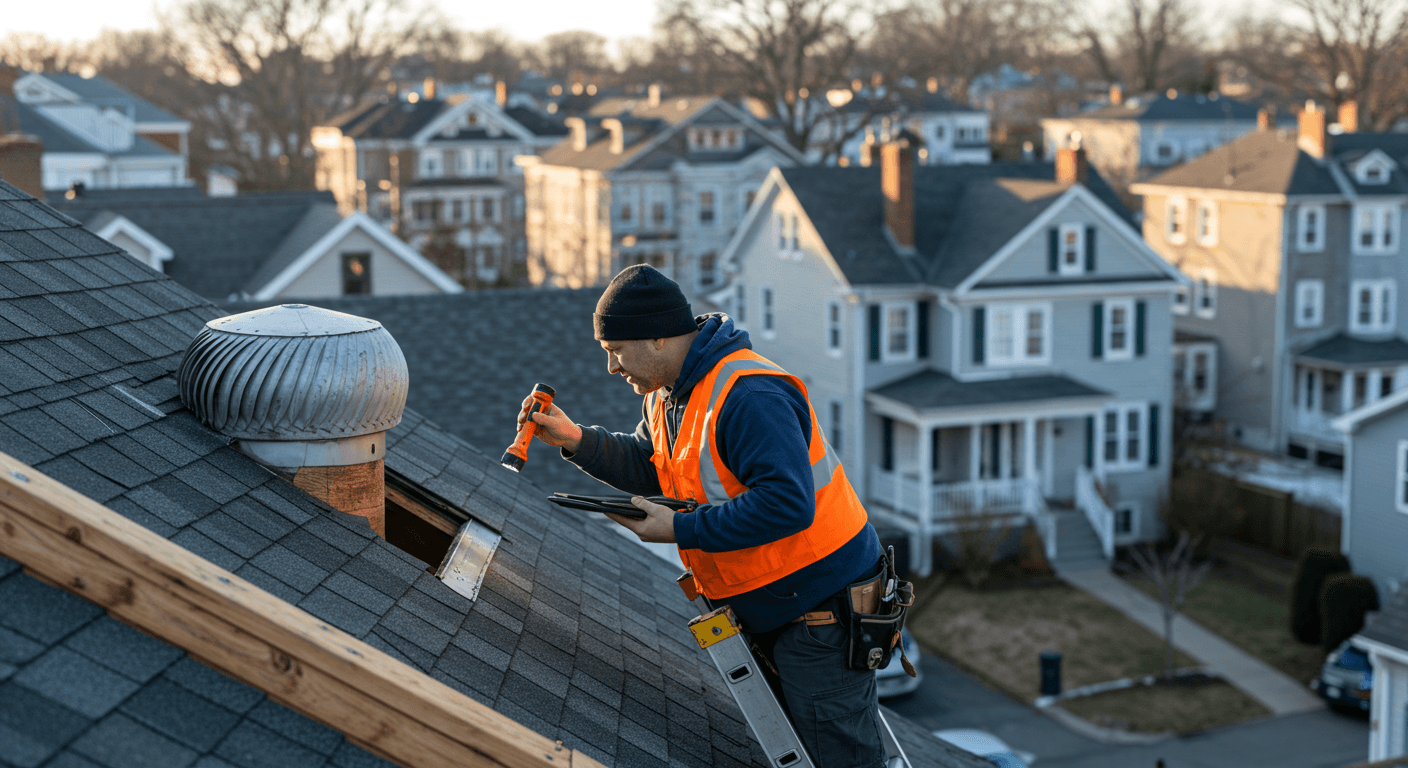
Forget the notion that a fast estimate is a productive estimate. Most contractors working the North Jersey corridor believe that "burning through" eight inspections a day is the pinnacle of efficiency. They think speed is the secret to winning the high-density neighborhoods of Elizabeth. But in my experience, this rush is actually a profit-draining trap.
I was walking a job site near Elmora Avenue last spring with a contractor I'll call Adrian. He was frustrated because his average ticket price was stagnant at $9,430 while his material and labor costs were climbing. I watched his lead estimator spend exactly 14 minutes on a ranch-style roof. He took six photos, checked the flashing, and hopped down. He missed the systemic plywood delamination caused by poor attic ventilation, a detail that would have added $3,100 to the contract and saved a massive headache during the tear-off.
The myth that a quick look-over is "good enough" is why so many shops in Union County struggle to scale. If you aren't using your inspection as a forensic deep-dive, you aren't just missing sales—you're inviting liability.
At a Glance
Revenue Capture: Shifting from "estimates" to "forensic inspections" typically increases average contract value by 16% to 22% through legitimate necessary repairs.
Liability Reduction: Documenting pre-existing conditions in Elizabeth's older housing stock prevents "you broke it" claims regarding gutters and siding.
Conversion Power: High-resolution photo reports build 43% more trust with commercial and residential property owners than verbal quotes.
Operational Flow: Accurate inspections reduce "change order friction" which currently stalls 31% of roofing projects mid-stream.
The Problem: The "Surface-Level" Assessment Trap
Most Elizabeth roofing companies operate on a volume-first mindset. They see a lead, they send a guy with a ladder, and they want a number in the homeowner's hand within 20 minutes. This creates a "race to the bottom" on price. When you only look at the shingles, you are a commodity. When you look at the entire building envelope, you are a consultant.
According to the Bureau of Labor Statistics (BLS) guide on becoming a roofer, successful professionals must possess specific physical stamina and balance, but the business side requires an analytical eye that goes beyond just standing on a slope. In Elizabeth, we deal with a unique mix of century-old Victorians and mid-century industrial buildings. A surface-level assessment on a 90-year-old house on Jersey Ave is a recipe for a $5,000 back-charge when the rafters turn out to be undersized or rotting.
Shops relying on 15-minute visual inspections lose significant revenue by missing critical structural issues that surface during production.
Analysis: Why Elizabeth's Geography Demands Precision
Geography matters in your inspection protocol. We are sitting right off the Newark Bay. The wind loads here are different than they are in Morristown or further inland. I've seen 75 mph gusts whip off the water and lift tabs that looked perfectly fine from a 12-foot ladder.
If your crew isn't performing a "tab lift test" on at least four facets of the roof, they aren't inspecting; they're guessing. I worked with another shop owner, Skylar, who was seeing a 14.3% callback rate after minor wind events. We realized her team wasn't checking for seal failure on older architectural shingles. Once we implemented a mandatory "uplift check" in her 22-point inspection, her callbacks dropped to under 2% within four months.
The "Attic-First" Rule
"Never step on a roof in Union County until you've spent 10 minutes in the attic. Looking for daylight, rusted nail heads, or matted insulation tells you more about the roof's lifespan than the shingles ever will. It also justifies the "full system" replacement rather than just a recovery."
The Solutions: Implementing a Forensic Inspection Protocol
To move away from the commodity game, you need to arm your team with a repeatable, data-driven system. I don't care if you have two crews or twenty; the process must be identical every time.
High-Resolution Documentation: Every inspection should generate a minimum of 35 photos. This isn't just for the estimate. It's for the insurance adjuster and the skeptical property owner. When you're working with exclusive roofing leads that have locked previews, this documentation becomes your competitive advantage—you can show the homeowner exactly what needs attention before they've even seen another contractor.
Thermal Imaging for Moisture Traps: In the humid North Jersey climate, moisture gets trapped in flat roof systems common in Elizabeth's commercial zones. A handheld FLIR camera can identify saturated ISO board that a visual check would miss. I saw this save a contractor $12,700 in potential litigation because he could prove the leak was coming from a masonry parapet wall, not his new membrane.
Safety as a Sales Tool: Professionalism sells. When your team arrives with proper fall protection gear, it signals quality. It's also a business necessity, as BLS data on fatal falls highlights that roofing remains the highest-risk trade in construction. Showing a homeowner you value safety tells them you value their property.
Action Plan
How to transition your sales team from "estimators" to "inspectors" to increase close rates and margins
A systematic approach to transforming your inspection process from a quick price check into a comprehensive diagnostic tool that increases contract value and reduces callbacks.
The Pre-Inspection Brief: Before the ladder touches the gutter, have your tech check the LeadZik mobile app for any specific notes or locked preview data. Knowing the age of the structure or previous repair history allows the tech to lead with authority.
The Envelope Walk: Start at the foundation. Check for siding drainage issues and gutter clogs. This often uncovers $800 to $2,500 in additional work that solves the client's actual problem (basement dampness) rather than just the roof.
The Forensic Roof Climb: Execute the 22-point check. This includes checking chimney flashing, vent pipe boots, and performing a manual seal test. If you are evaluating exclusive roofing leads with locked previews, this is where you confirm the job's profitability before committing your top crew.
The Digital Presentation: Do not leave a paper chicken-scratch estimate. Use a tablet to show the homeowner the photos of their failed flashing. Seeing the rust and rot in high-def makes the "no" much harder for them to say.
Want to skip the manual work and get exclusive, verified leads instead?
Get $150 in Free CreditsComparison: Drone-Only vs. Multi-Point Physical Inspections
I hear a lot of talk about drone-only inspections. While drones are great for safety and initial measurements, they are a supplement, not a replacement. In a dense urban environment like Elizabeth, a drone might miss the granular loss or the hairline cracks in a chimney crown that a physical inspection catches.
I've seen a 19.4% difference in average contract value between "drone-only" shops and "high-touch" inspection shops. The drone shop sees a roof; the high-touch shop sees a ventilation problem, a masonry repair, and a gutter replacement opportunity.
Inspection Method Comparison: Drone-Only vs. High-Touch Physical
| Factor | Drone-Only | High-Touch Physical |
|---|---|---|
| Average Contract Value | $9,200 (drone-only) | $10,985 (high-touch) |
| Hidden Issues Detected | Surface-level only | Full building envelope |
| Callback Rate | 8-12% | Under 2% |
| Upsell Opportunities | Missed | $2,000-$3,500 avg |
| Client Trust Level | Moderate | High (visual proof) |
Average Contract Value
Hidden Issues Detected
Callback Rate
Upsell Opportunities
Client Trust Level
Satellite Imagery Limitations
Don't rely solely on satellite imagery for Elizabeth properties. The heavy tree canopy in neighborhoods like Westminster can obscure 30% of the roof surface, leading to massive under-bidding on valley metal and debris removal.
Recommendation: Building a Culture of Accuracy
If you want to scale to a $5M or $10M operation, you have to stop being the "cheapest guy" and start being the "most thorough guy." This starts with how you handle your lead flow. When you get started with verified leads, you already have a head start with $150 in credits to test your new inspection protocol on high-quality opportunities.
I recently worked with a firm that mandated a "Second-Look" policy for any estimate over $18,500. A senior tech would review the inspection photos to ensure nothing was missed. In the first 60 days, they found an average of $1,142 in missed line items per project. That's pure profit that was previously being left on the table.
Your inspection is your first opportunity to show the client that you are different. In a market like Elizabeth, where competition is fierce and the housing stock is complex, the contractor with the best data always wins the contract. Using tools like the LeadZik mobile app to access detailed lead information before you even arrive on-site gives you the context needed to conduct a truly comprehensive inspection.